Dilated Residual TCN Model for Crop Yield Prediction Using Multi-Source Farmland Sensors
DOI:
https://doi.org/10.64972/jaat.2023v1.281p3e:34-47Keywords:
Crop Yield Prediction, Multi-Source Farmland Sensors, Dilated Residual TCN, Temporal Feature Fusion, Interpretable AgricultureAbstract
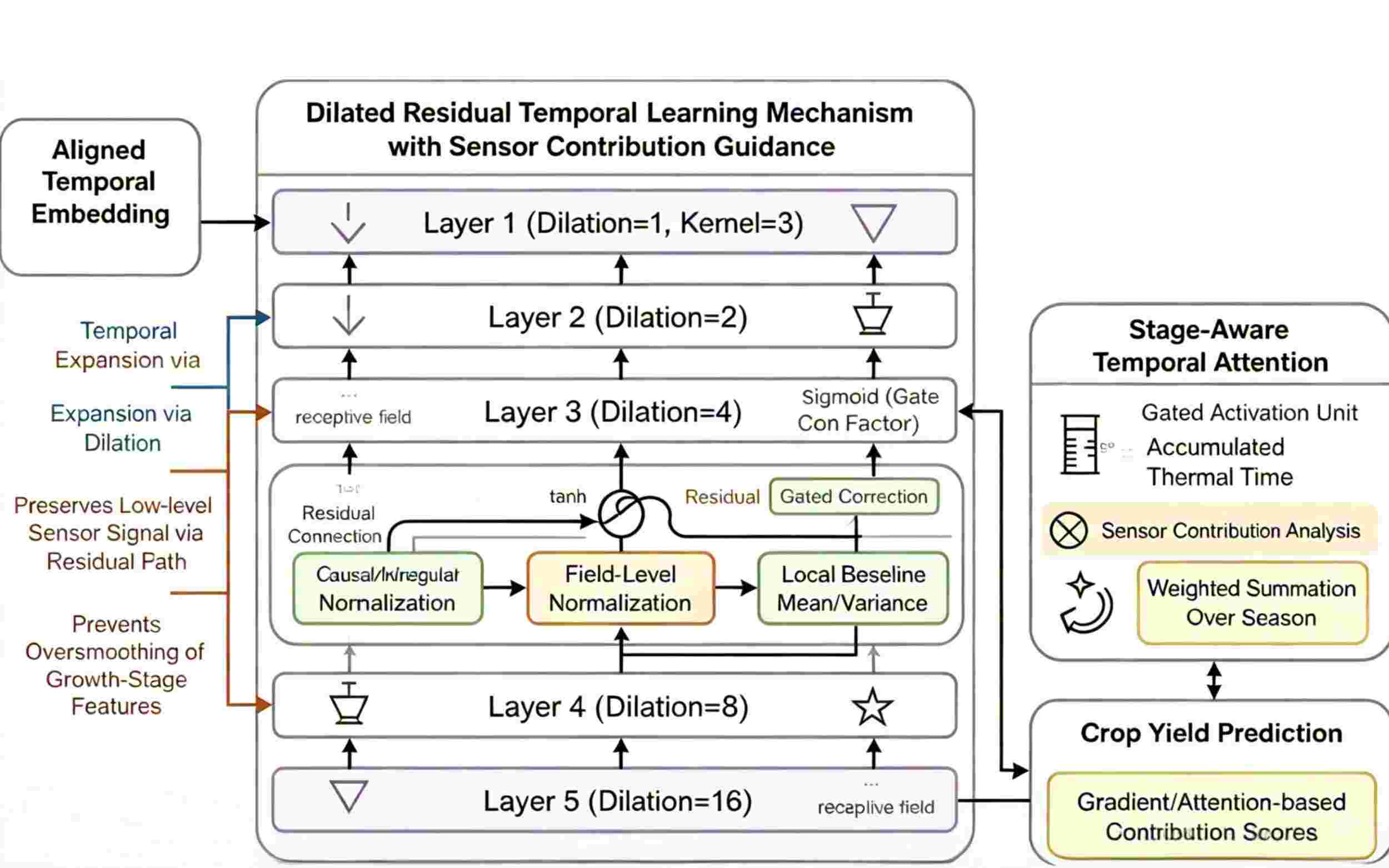
Create a high-precision agricultural system for field-level resource allocation, irrigation scheduling, and production risk management that predicts crop yield using multi-source farmland sensor data. Because soil, weather, irrigation, and other vegetation characteristics have distinct cycles and delayed effects on crop growth, the majority of current data-driven systems have failed to handle diverse sensing signals. An interpretable dilated residual temporal convolutional network for crop yield prediction is presented in this paper. Create aligned sensor representations, use dilated causal convolution to identify long-range growth relationships, use residual connections to stabilize deep temporal learning, and calculate sensor contributions for agronomic interpretation. Compare the outcomes of attention-based forecasting models, Random Forest, XGBoost, LSTM, GRU, and regular TCN. According to the simulated field-scale findings, the suggested model reduces the prediction error by 14.8% when compared to the standard TCN and by 22.6% when compared to LSTM, with an RMSE of 0.412 t/ha and a R² of 0.903. Additionally, robustness research demonstrates that it operates normally with cross-seasonal transfer and a 20% lack of sensor data. Assist agricultural sensing systems with high-precision, high-efficiency, and comprehensible crop yield forecast.
Downloads
Published
How to Cite
Issue
Section
License
Copyright (c) 2023 Gabriel Láska, Natálie Králová, Kateřina Svobodová

This work is licensed under a Creative Commons Attribution-NonCommercial-ShareAlike 4.0 International License.