Long-Sequence Informer Modeling for Crop Yield Prediction from Multi-Source Farmland Sensors
DOI:
https://doi.org/10.64972/jaat.2024v2.278p23e:320-334Keywords:
Multisource Sensor Fusion, Crop Yield Prediction, Long-Sequence Modeling, Probabilistic Sparse Attention, Temporal DecompositionAbstract
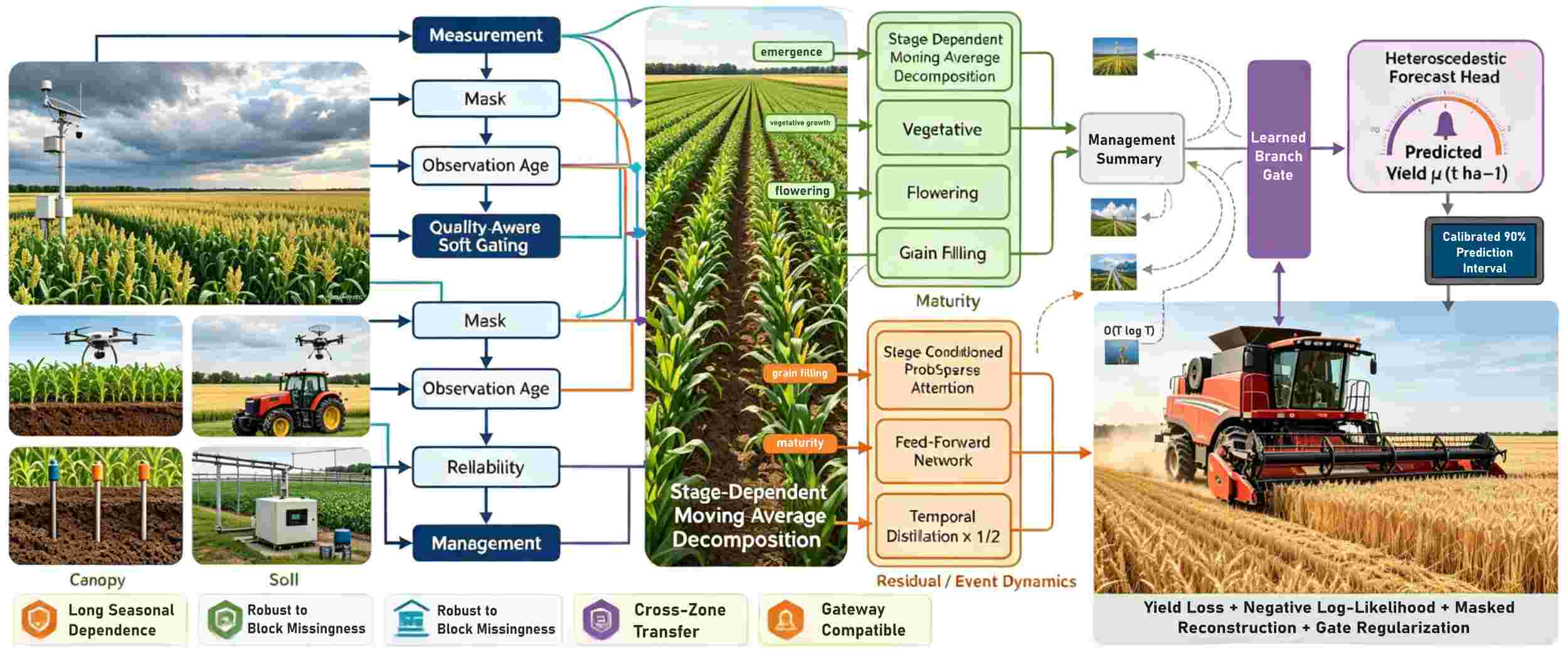
Obstacles to crop yield prediction from multiple sources of farmland sensors include asynchronous sampling, long-term seasonal variations, sensor failures and significant field-to-field differences. Develop a quality-aware decomposed Informer in this study that aligns the weather, soil, canopy and management streams on a daily basis and keeps observation age and reliability as learnable evidence. A seasonal-residual decomposition separates the slow-varying phenological context from the event-driven fluctuation, and a stage-conditioned probabilistic sparse attention module selects informative historical states without quadratic cost. A total of 18,720 field-season sequences were divided into 64 production areas for testing maize, wheat and soybean. Compared with the strongest recurrent and Transformer baselines, the proposed model reduced the root-mean-square error to 0.438 t and mean absolute percentage error to 6.1%, and shortened inference time by 41.8% compared to a full-attention Transformer. Under 30% missingness, the error increase was limited to 11.4%, and cross-zone testing maintained an R² of 0.827. Calibration reduced the interval undercoverage from 15.8% to 6.4% by 90%. According to the above experiments, explicit sensor-quality encoding and decomposed sparse attention jointly enhance the accuracy, robustness and computational efficiency of the model. The above framework provides an engineering path for all-season forecasting of heterogeneous precision agriculture networks.
Downloads
Published
How to Cite
Issue
Section
License
Copyright (c) 2024 Natálie Králová, Kateřina Svobodová

This work is licensed under a Creative Commons Attribution-NonCommercial-ShareAlike 4.0 International License.