Seasonality-Enhanced Autoformer Model for Crop Yield Prediction Using Multi-Source Farmland Sensors
DOI:
https://doi.org/10.64972/jaat.2024v2.279p24e:335-347Keywords:
Interpretable Yield Prediction, Seasonality-Enhanced Autoformer, Multi-Source Sensors, Agricultural Time SeriesAbstract
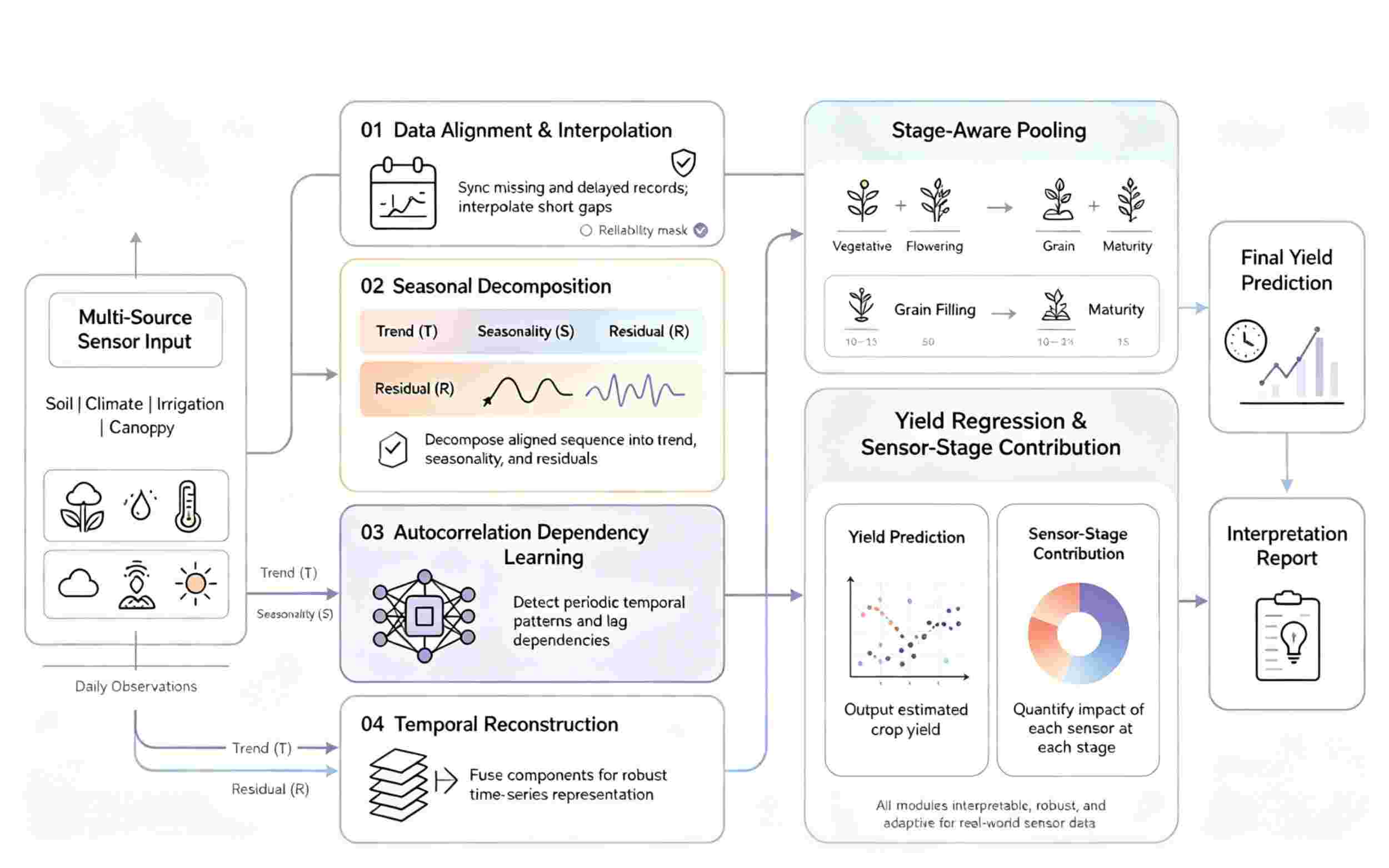
Crop output changes as a result of the growing season's processes, which include the buildup of soil moisture and heat, radiation, irrigation, and canopy development. Although the majority of current prediction algorithms have improved yield prediction's numerical accuracy, they are not interpretable for seasonal fluctuations in sensor data. In this work, a multi-source farmland sensor-based explainable seasonality-augmented Autoformer model for crop production prediction is presented. Determine long-range relationships using an autocorrelation technique, break down heterogeneous sensor sequences into trend, seasonal, and residual components, and calculate sensor-stage contributions for agronomic interpretation. To maintain all-weather mobility, separate long-term upward tendencies from transient changes in the structure. Prediction accuracy, the amount of the seasonal component, sensor influence, robustness to missing data, etc. are all assessed by experimental study. With an RMSE of 0.386 t/ha, an MAE of 0.304 t/ha, and an R2 of 0.917, the suggested model has a 13.4% lower RMSE than the standard Autoformer and a 20.2% lower RMSE than TCN. An Interpretable Long-Sequence Crop Yield Prediction Model for Smart Agriculture.
Downloads
Published
How to Cite
Issue
Section
License
Copyright (c) 2024 Jiří Vaněk, Kateřina Svobodová

This work is licensed under a Creative Commons Attribution-NonCommercial-ShareAlike 4.0 International License.