Self-Adaptive Feature Engineering Driven Deep Learning Model for Telecom Churn Prediction
DOI:
https://doi.org/10.64972/jaat.2024v2.250p6e:72-87Keywords:
Telecom customer churn prediction, Adaptive feature engineering, Feature selection, Machine learning, Customer behavior analysis, Classification modelAbstract
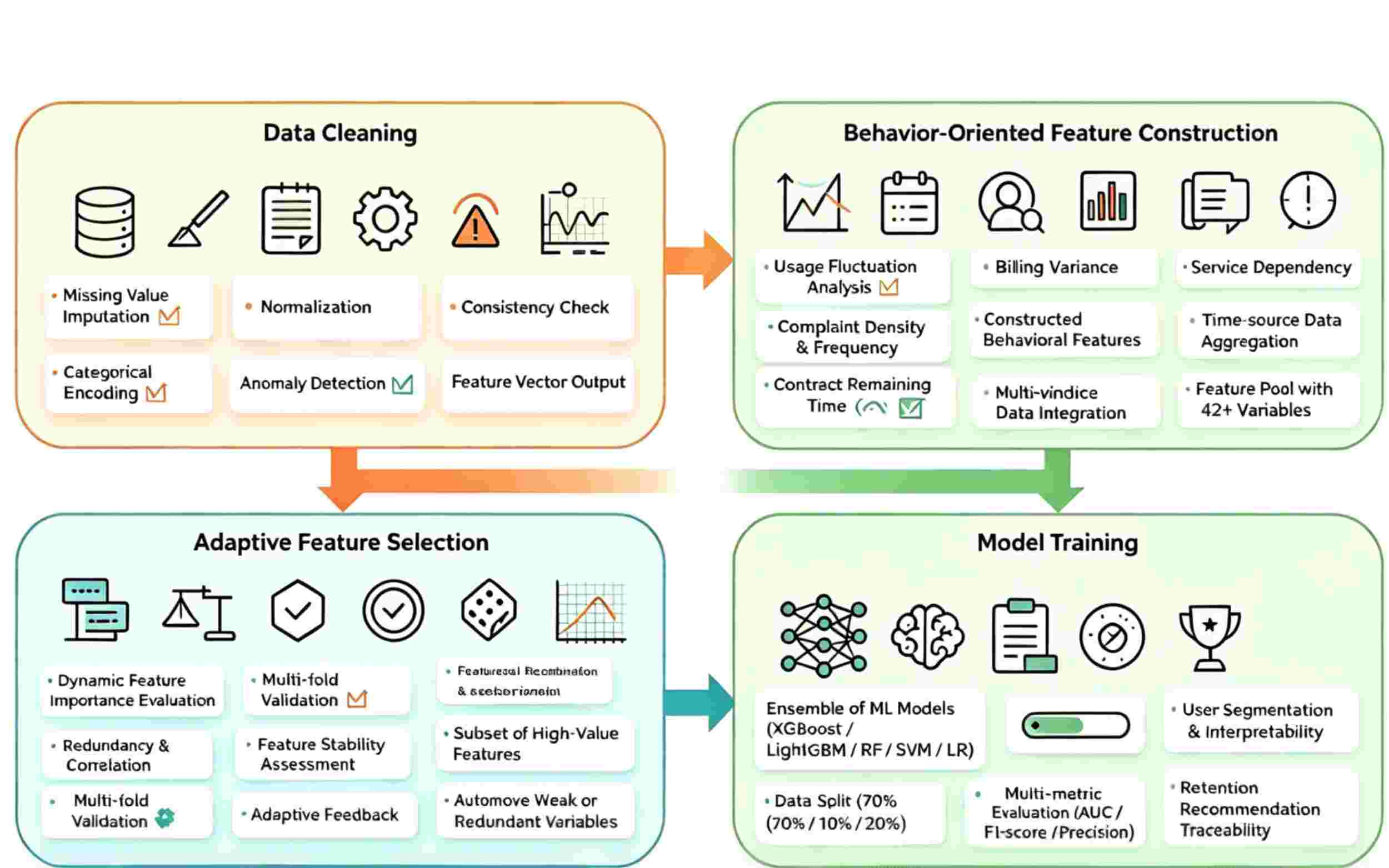
Telecom customer churn prediction must accurately identify clients who are likely to quit or cut back on their service in the future. In order to increase the accuracy of the telecom customer churn prediction model while maintaining the interpretability of business choices, this study proposes a novel adaptive feature engineering technique. The new approach consists of four parts: machine learning classification, adaptive feature selection, behavior-oriented feature generation, and data cleansing. Predictive features can be extracted from customer profile attributes, service subscription records, usage patterns, billing fluctuations, past complaints, and contract status. Adaptively choose a method to evaluate the features' significance, redundancy, and marginal contribution for the churn classifier. After preprocessing, a telecom customer dataset with 7043 user records and 42 engineered attributes was employed for the experiment. The feature dimension has been lowered from 42 to 24 while the accuracy is 89.42%, the F1-score is 86.17%, and the AUC is 91.36%. When compared to static feature engineering, the adaptive approach decreased feature redundancy by 31.6% and raised the AUC by 3.28 percentage points. Therefore, by using compact and behavior-sensitive customer features, adaptive feature engineering has improved churn forecast accuracy. The suggested framework for telecom customer retention analysis offers a workable method to enhance the feature selection.
Downloads
Published
How to Cite
Issue
Section
License
Copyright (c) 2024 Sławomir Bronisław Herdzik, Seweryn Grzelak, Michał Dąbrowski

This work is licensed under a Creative Commons Attribution-NonCommercial-ShareAlike 4.0 International License.