Real-Time Fault Diagnosis of Mechanical Systems Based on Convolutional Neural Networks
DOI:
https://doi.org/10.64972/jaat.2025v3.212p24e:322-334Keywords:
Convolutional Neural Network, Mechanical Fault Diagnosis, Multi-Scale Feature Extraction, Signal Processing, Real-Time Monitoring, Industrial Automation, RobustnessAbstract
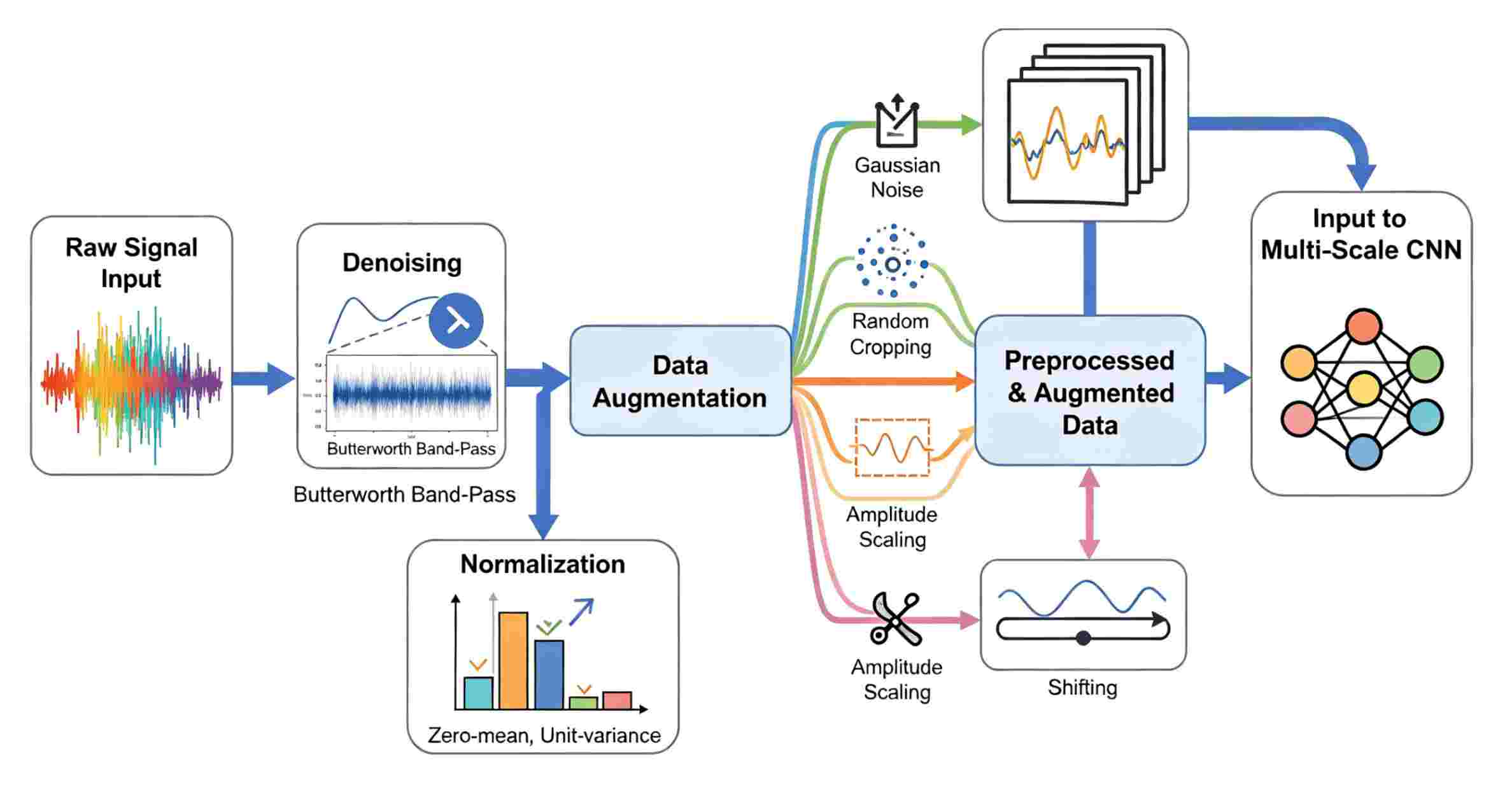
Convolutional Neural Networks (CNNs) are now frequently used as the foundation for intelligent fault diagnosis in modern industrial equipment because they can extract multi-level features from raw vibration data. This study adopts a multi-scale convolutional neural network (CNN) architecture to address issues such as noise, various operating conditions, and the lack of labeled fault data in real-time mechanical system diagnostics. In the new system, parallel convolution branches can capture both local and global features of the signal due to the different sizes of the convolution kernels. Data augmentation, normalization, and denoising preprocessing techniques improve the quality and generalization ability of the input data. In addition, a large number of open-source rotating machinery datasets were used, which were collected under various environments. Based on the above results, the proposed model has an average classification accuracy of 98.7% and an F1 score of 0.977; it outperforms single-scale CNNs, Transformers, and traditional machine learning models. Even in high-noise environments, it still maintains an AUC of over 0.95, indicating that it is less sensitive to artificial noise and changes in the operational area. The real-time performance was verified to be good; the average inference time was less than 3 milliseconds, and the memory consumption was less than 1 GB; therefore, it meets the requirements for industrial deployment. The aforementioned research indicates that multi-scale CNNs are beneficial for predictive maintenance and smart factories, as they can accurately and reliably identify faults in complex machinery in real-time.
Downloads
Published
How to Cite
Issue
Section
License
Copyright (c) 2025 Tadeusz Truskolaski

This work is licensed under a Creative Commons Attribution-NonCommercial-ShareAlike 4.0 International License.