Physics-Informed LongNet-CNN Prediction Model for Sparse Cross-Device Calibration Transfer in Industrial Sensors
DOI:
https://doi.org/10.64972/dea.2023.v2i3.3726d:65-80Keywords:
Calibration Transfer, Physics-Informed Learning, LongNet-CNN, Industrial Sensors, Drift CompensationAbstract
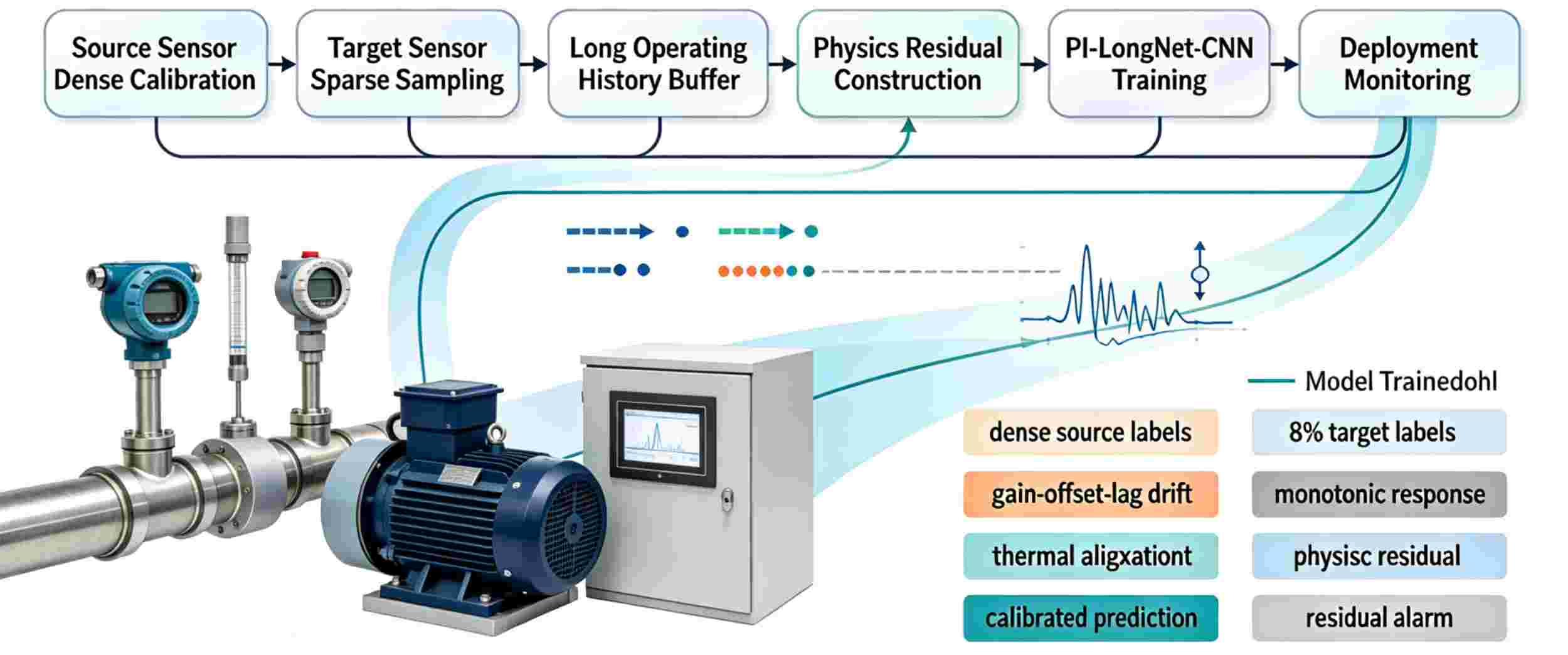
Industrial sensor calibration transfer remains challenging because the prediction model was trained on a reference device, but the actual sensor has different sensitivity, an aged state, thermal coupling, or installation history. This paper introduces a physics-informed LongNet-CNN model for cross-device calibration migration with limited target-domain labels. Dilated long-range attention is employed to model slow drift over extended operating windows; convolutional branches capture short transient responses; and a residual physics loss is used to constrain monotonic sensitivity, thermal relaxation and actuator-energy consistency. A controlled benchmark is established by generating several conditions of pressure, flow, vibration and temperature signals from six virtual production lines with realistic bias, lag, noise and hysteresis perturbations. With only 8% of the target calibration samples, the proposed model has an average RMSE of 0.118 engineering units, which is 31.4% lower than the source-only CNN and 18.6% lower than the transfer transformer. The mean absolute calibration slope error is reduced from 0.092 to 0.031, and the ninety-fifth percentile drift overshoot under thermal ramping is limited to 0.44 units. Ablation studies show that the physics residual increases the RMSE by 12.7% when omitted, and removing dilated attention reduces long-window stability by 16.9%. Based on the above results, combine a long-context sequence model with explicit physical constraints to improve the accuracy, robustness and interpretability of calibration transfer for industrial sensing systems. The main contribution is a unified sparse-transfer framework that couples long-context drift memory, local transient extraction, and physically constrained calibration correction. The benchmark is a controlled multi-condition industrial-sensor dataset designed to emulate gain shift, lag, hysteresis, thermal coupling, and vibration disturbance.
Downloads
Published
How to Cite
Issue
Section
License
Copyright (c) 2023 Nicola Mariani, Sergio Parisi, Tito Romano

This work is licensed under a Creative Commons Attribution-NonCommercial-ShareAlike 4.0 International License.