Edge-Ready Intelligent Monitoring of Batch Crystallization Processes Using Hierarchical Image Segmentation and Data-Driven Endpoint Analytics
DOI:
https://doi.org/10.64972/dea.2023.v2i3.3715d:52-64Keywords:
Online Particle Image Recognition, Hiera-UNet, Batch Crystallization Endpoint, Crystal Morphology Segmentation, Boundary-aware Decoder, Process Vision MonitoringAbstract
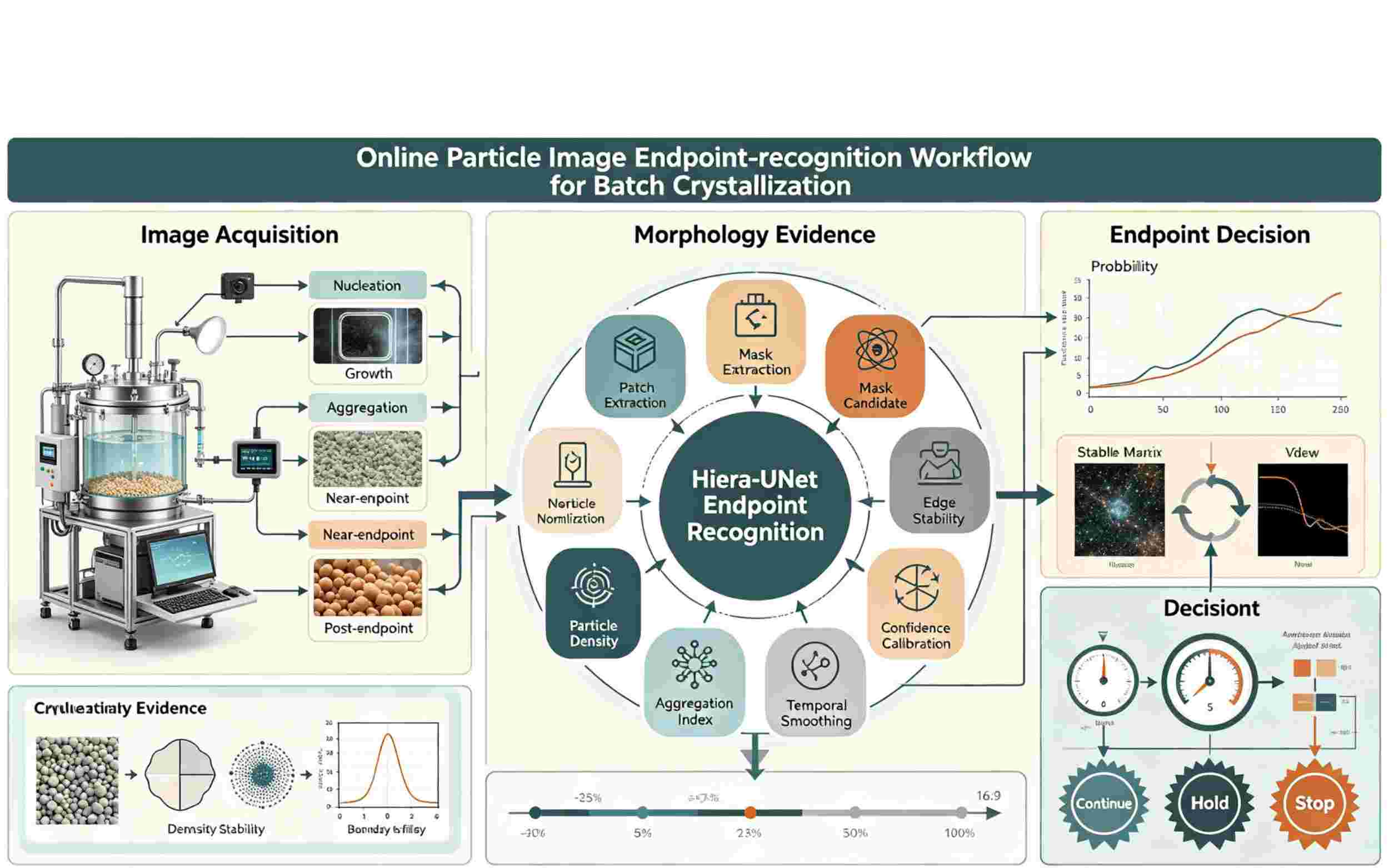
In this study, a Hiera-UNet model based on online particle pictures is proposed for endpoint recognition in batch crystallisation. Because of the constant changes in crystal size, boundary clarity, aggregation, blur, lighting, bubbles, and mother-liquid backdrop during the batch, endpoint detection is challenging. The suggested system reconstructs particle masks, generates overlapping crystal-region patches, extracts hierarchical morphological characteristics, normalises online particle frames, and transforms segmentation evidence into temporally smoothed endpoint probability. Particle masks, morphological labels, illumination disturbance markers, and endpoint windows are supplied, and a simulated picture stream including 12,600 frames of nucleation, growth, aggregation, near-endpoint, and post-endpoint phases is utilised for assessment. Hiera-UNet enhanced endpoint accuracy from 87.2% to 94.6%, decreased average endpoint-delay latency from 18.4 s to 7.9 s, and raised the mask Dice score from 0.841 to 0.906 when compared to U-Net, DeepLabv3+, SegFormer, and CNN-LSTM baselines. The live monitoring of crystallisation end-points can be supported by hierarchical segmentation, boundary-aware morphology extraction, and decision smoothing based on the results; however, recipe-specific calibration and validation using actual probe-image streams are still required.
Downloads
Published
How to Cite
Issue
Section
License
Copyright (c) 2023 Hrvoje Petković, Ante Španjol, Domagoj Mihalić

This work is licensed under a Creative Commons Attribution-NonCommercial-ShareAlike 4.0 International License.