Event-Driven Data Analytics Framework for Smart Home Occupancy Inference Using Point-Voxel and Transformer Representation Learning
DOI:
https://doi.org/10.64972/dea.2023.v2i3.3737d:81-95Keywords:
Event-Driven Occupancy Inference, Point-Voxel Convolution, Transformer Encoder, Environmental Sensor Stream, Smart Home AutomationAbstract
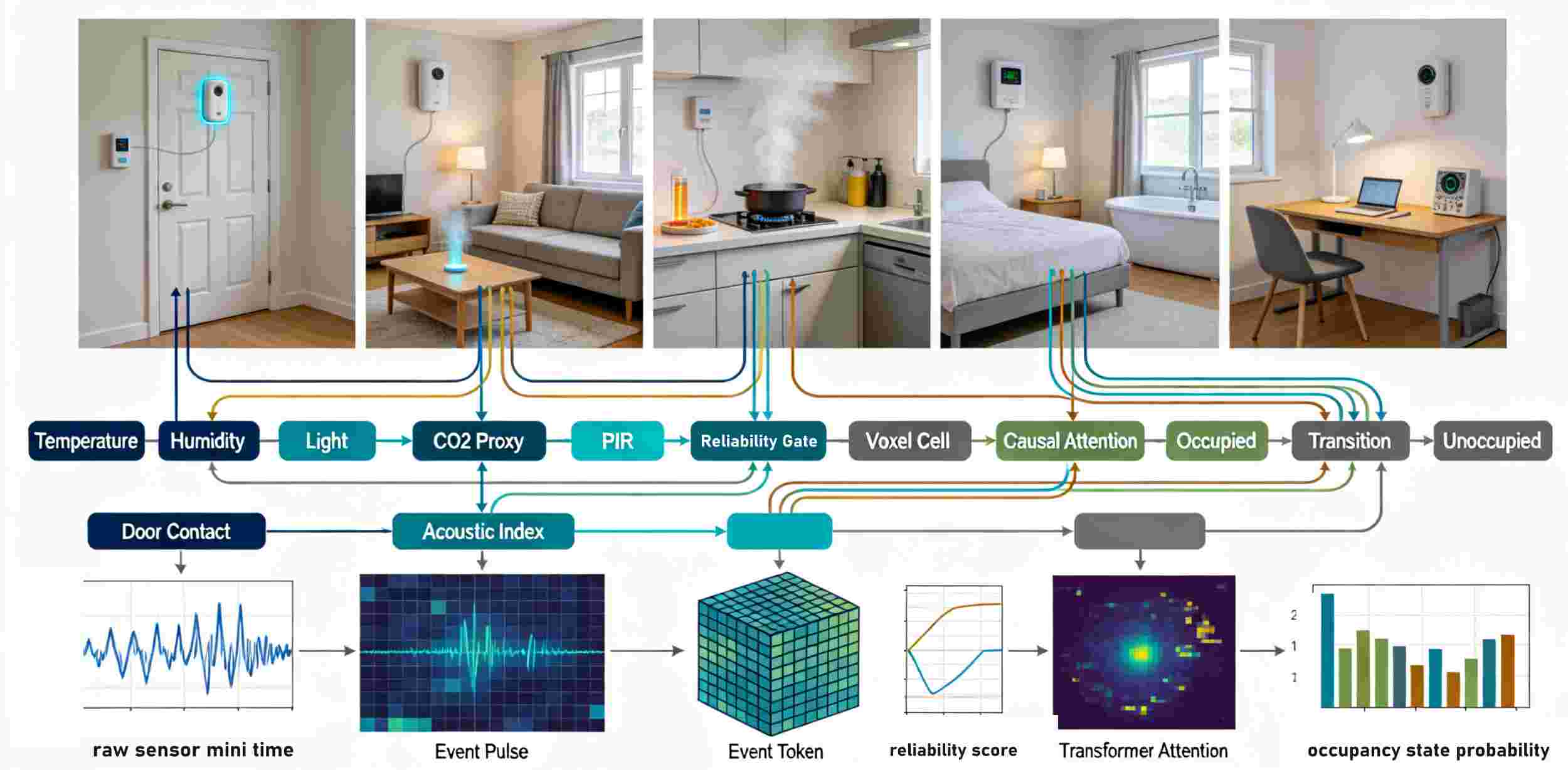
Occupancy inference in smart homes is still challenging due to sparse, event-driven sensing streams and delayed responses of the environment. This paper proposes a PVCNN-Transformer model for inferring occupied, transition and unoccupied states from environmental sensor event flows. The method converts asynchronous changes in temperature, humidity, illumination, CO2 proxy, passive infrared motion, door contact and sound-pressure statistics into room-indexed event points collected from a six-room, 42-day smart-home corpus. A point-voxel convolutional front-end extracts local cross-channel patterns and retains fine event timing, and a Transformer encoder models longer dwell-time dependencies reliably via position-aware encoding. The six-room smart home event corpus used for the experiment contains 42 days of annotated operations, 3.18 million raw sensor readings, and 146,220 event labels after threshold flow compression. Compared with LSTM, temporal convolution, vanilla Transformer and graph-temporal baselines, the proposed model achieved 95.8% accuracy, 0.941 macro-F1 and a 37.6% reduction in transition-state error. Ablation studies have shown that without voxel aggregation, the macro-F1 dropped by 3.4 percentage points, and removing the reliability gate increased night-time false alarms from 2.7% to 6.9%. The model also kept a 91.6% macro-F1 after randomly dropping 20% of the sensor events, showing stable deployment behavior under incomplete home sensing. Based on the above results, point-voxel local encoding and attention-based temporal reasoning can be employed to achieve accurate, privacy-preserving occupancy inference from general-purpose environmental sensors.
Downloads
Published
How to Cite
Issue
Section
License
Copyright (c) 2023 Hsiu-chen Yang, Hsiao-hung Yao

This work is licensed under a Creative Commons Attribution-NonCommercial-ShareAlike 4.0 International License.