TD3-Barrier Model for Cable Force Anomaly Diagnosis with Multi-Resolution Feature Fusion
DOI:
https://doi.org/10.64972/dea.2023.v2i1.3528d:102-114Keywords:
Cable Force Diagnosis, Multi-Resolution Feature Fusion, TD3-Barrier, Structural Health Monitoring, Safe Reinforcement LearningAbstract
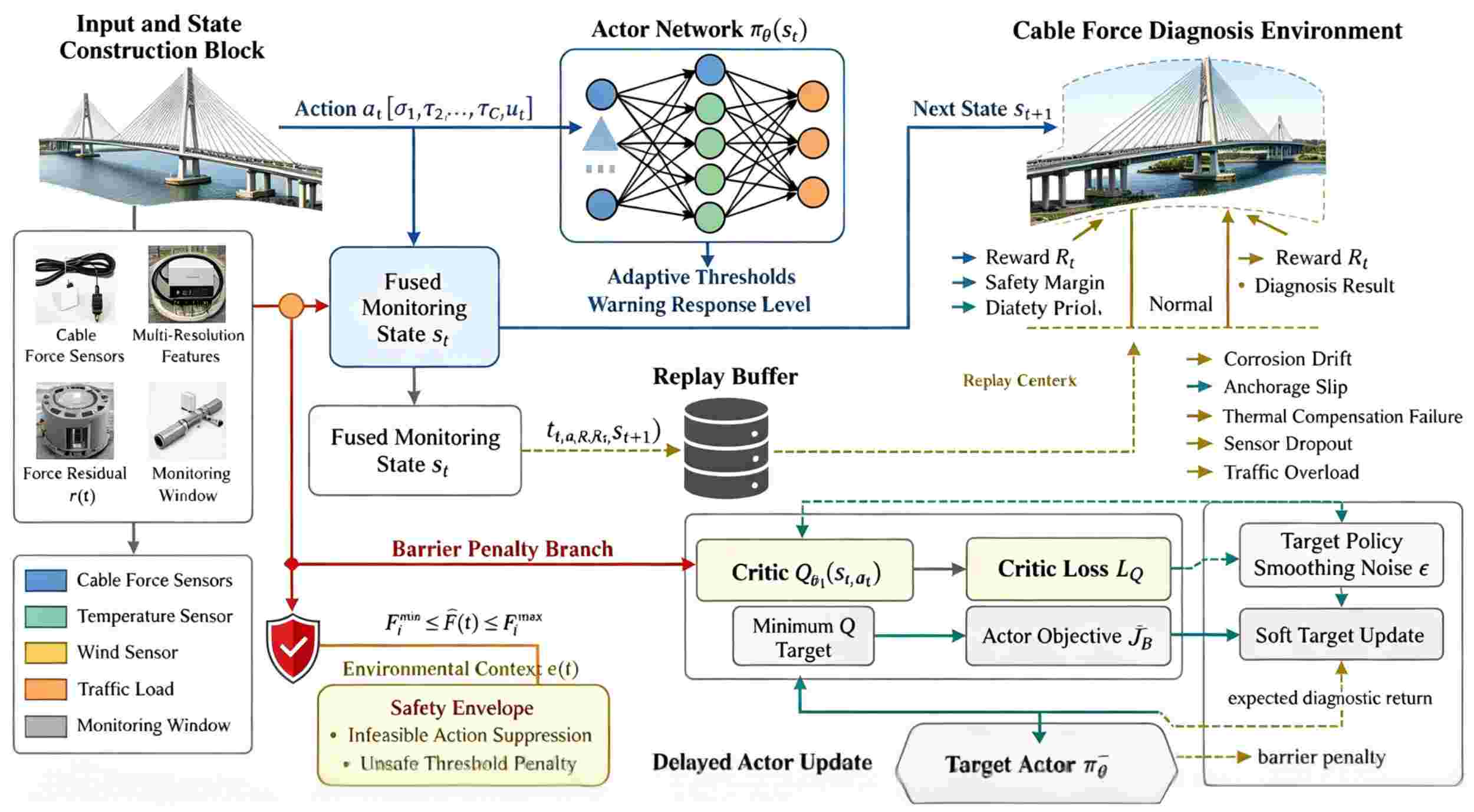
Cable-supported bridges have stable cable force states, but the practical monitoring records are significantly affected by temperature, traffic mix, wind, sensor drift and sparse abnormal samples. A TD3-Barrier model with multi-resolution feature fusion is proposed for cable force anomaly diagnosis in this paper. Decompose multi-channel cable force and environmental response into short-, medium- and long-horizon descriptors, fuse them via a gated temporal attention block, and train a twin delayed deep deterministic policy gradient agent under a barrier-based safety constraint. The actor learns the diagnostic threshold and intervention measures, and the barrier critic suppresses unsafe actions in near-physically-impossible tension states. A simulated field dataset was constructed for the model evaluation, consisting of 16 stay cables, 72 monitoring days, five anomaly mechanisms and 124,416 synchronous samples. The proposed model performed better than the LSTM-AE, TCN, Transformer and vanilla TD3 baselines, achieving 97.4% accuracy, 96.8% macro-F1 and a false-alarm rate of 1.9%. Vanilla TD3 has decreased the average diagnosis delay from 7.6 sampling intervals to 4.2 intervals. According to the ablation experiments, removing multi-resolution fusion reduced the macro-F1 score by 4.7 percentage points, and excluding the barrier term increased unsafe threshold violations by 63.5%. The results show that reinforcement learning is more reliable for cable force diagnosis when the policy search is constrained by structural safety priors and fed with scale-aware monitoring features.
Downloads
Published
How to Cite
Issue
Section
License
Copyright (c) 2023 Mohammed Al-Thani, Abdullah Al-Marri, Nasser Al-Kaabi, Faisal Al-Muhannadi

This work is licensed under a Creative Commons Attribution-NonCommercial-ShareAlike 4.0 International License.