Complex Scenario Wildlife Detection Based on Improved Faster R-CNN and Feature Pyramid Networks
DOI:
https://doi.org/10.64972/dea.2026.v5i1.1679d:114-129Keywords:
R-CNN, Object Detection, Feature Pyramid Network, Wildlife Monitoring, Scene RobustnessAbstract
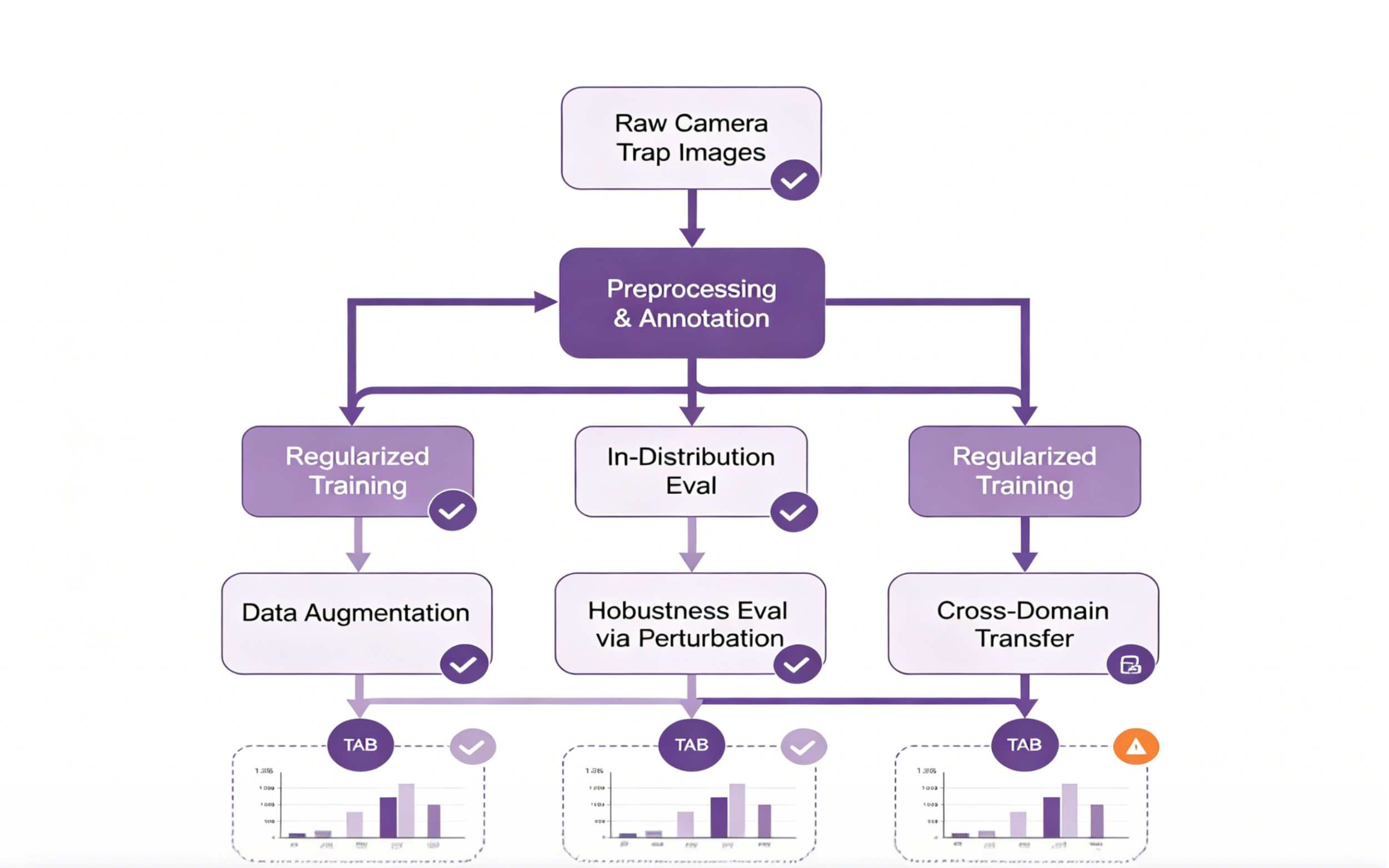
Even though deep learning has increased the automation of wild animal monitoring, issues including occlusion, scale variation, and crowded backdrops in natural settings remain unresolved. To solve the aforementioned issues, this paper proposes a detection architecture that combines an enhanced Feature Pyramid Network with context-adaptive Faster R-CNN. The stratified camera-trap dataset of 12,483 photos featuring 32 different species of wildlife was subjected to three different types of methods: multi-scale feature fusion, attention-based proposal mechanisms, and explicit context modeling. The experiment will evaluate the model's robustness and capacity for generalization using cross-validation and several domains. The aforementioned findings show that the primary test set's mean Average Precision (mAP) is 0.872, greater than that of the baseline detectors SSD (0.756 mAP) and YOLOv4 (0.783 mAP). The suggested framework exhibits a slight decrease of only 0.033 in mAP under challenging cross-domain transfer settings, and it has attained a comparatively high precision (more than 0.80) in dense forest, grassland, and nocturnal situations. Failure analysis reveals that the addition of a spatial attention module considerably reduced the number of false positives and occlusion-induced misses. According to the aforementioned findings, adaptive attention mechanisms and multi-level feature aggregation have greatly increased detection accuracy and resilience, supporting the implementation of large-scale intelligent monitoring systems in biodiversity assessment.
Downloads
Published
How to Cite
Issue
Section