LSTM-CNN Hybrid Model for High-Dimensional Load Forecasting in Smart Grids
DOI:
https://doi.org/10.64972/dea.2026.v5i1.1613d:30-45Keywords:
Deep Learning, Smart Grid, Load Forecasting, LSTM-CNN Hybrid, Time Series PredictionAbstract
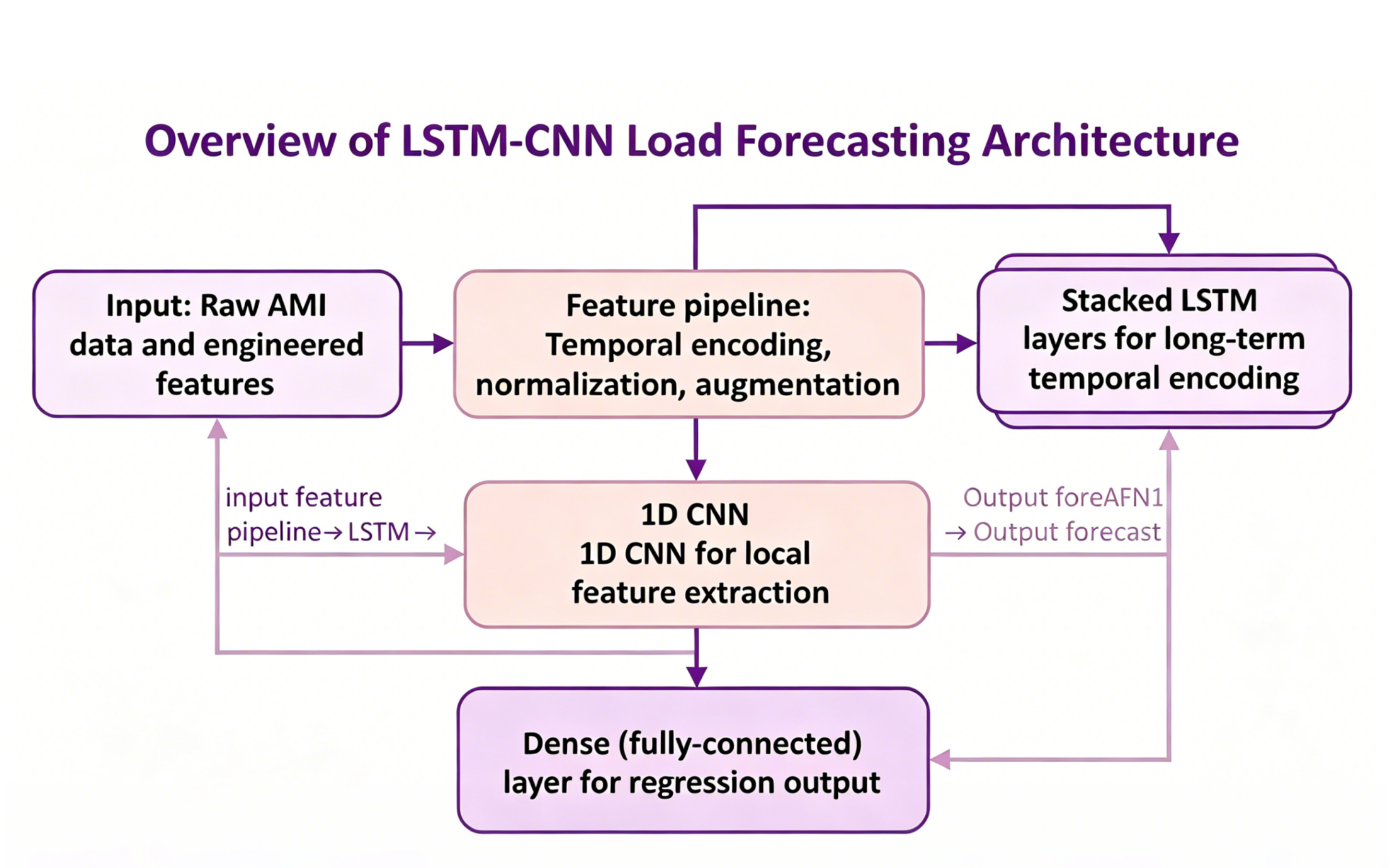
The challenging issue of electric demand forecasting in a smart grid has been resolved using computations and deep learning utilizing data-driven techniques. This research proposes a hybrid neural network model that combines CNNs and LSTM layers to solve the issues of localized feature interactions and long-term temporal dependencies in recent meter data. The model uses a highly sophisticated feature pipeline that uses time-series encoding, normalization, and other data augmentations to handle non-Gaussian noise, missing values, and multi-scale features of the advanced metering infrastructure. Real-world high-frequency datasets of residential, commercial, and industrial regions are used for testing and training. The data is divided into temporally contiguous training and validation sets. The findings of the experiment show that the LSTM-CNN hybrid has lowered the mean absolute error (MAE) and root mean squared error (RMSE) of the best-performing single models and baselines by 22.4% and 38.9%, respectively. Both architectural elements and different feature sets are required, as confirmed by ablation and sensitivity analysis. Robustness experiments demonstrate that generalization is still possible under adversarial and external conditions, and that input noise, missing data, and distribution shifts have no effect. According to the aforementioned study, the LSTM-CNN hybrid is a workable and scalable method that can be applied in real-world scenarios to accurately forecast changes in smart grids.
Downloads
Published
How to Cite
Issue
Section