Application of High-Dimensional Sensor Data Dimensionality Reduction Based on Autoencoders in Smart Factories
DOI:
https://doi.org/10.64972/dea.2023.v2i1.2911d:1-15Keywords:
Autoencoder, Dimensionality Reduction, High-Dimensional Sensors, Fault Diagnosis, Edge Intelligence, Representation LearningAbstract
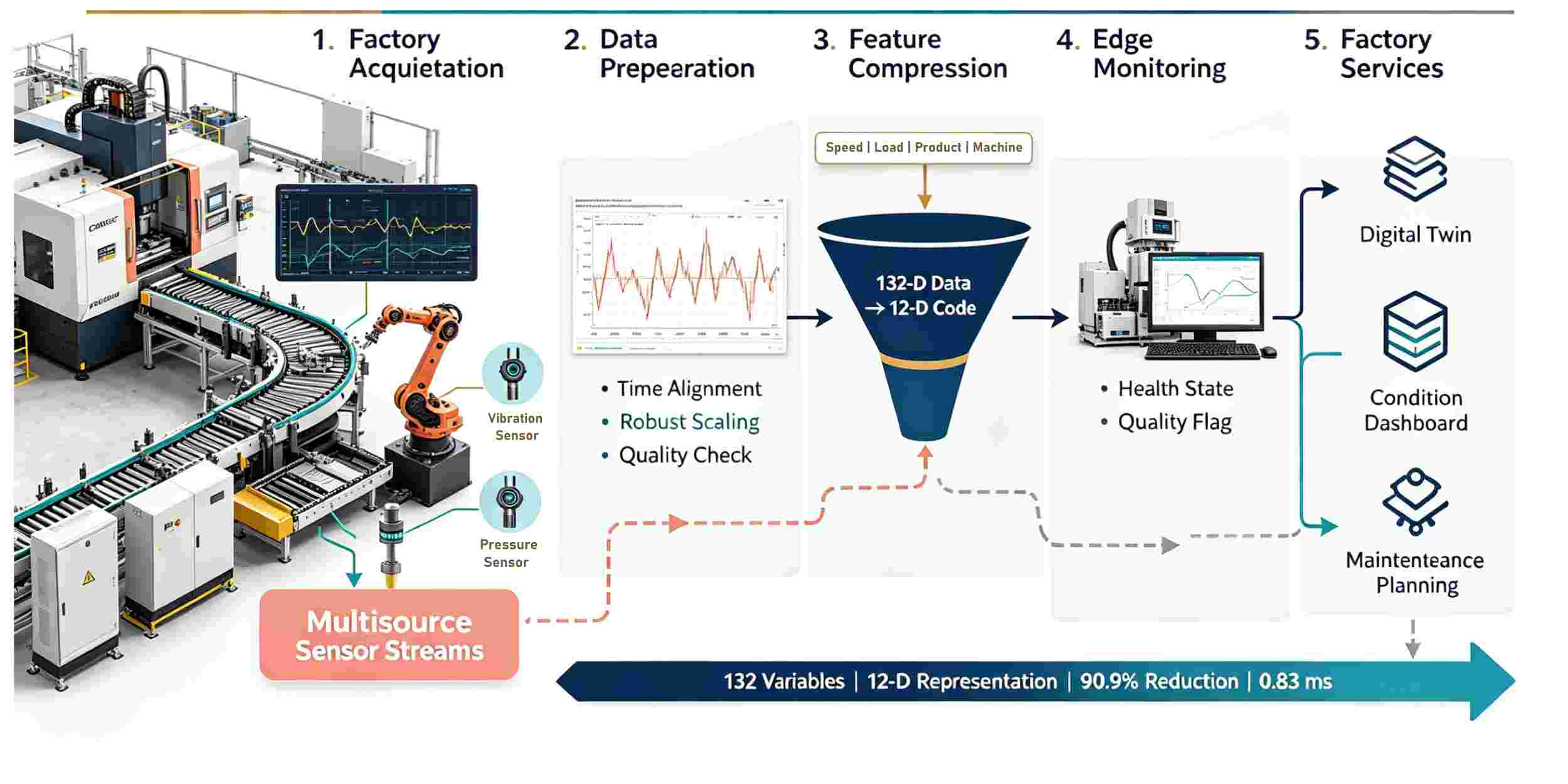
Smart factories continuously generate heterogeneous sensor streams, and the dimensions, redundancy and operating-condition dependence of these streams inhibit real-time diagnosis. Develop a context-aware sparse denoising autoencoder for compressing high-dimensional industrial measurements and retaining fault-sensitive structure in this study. The model is a single edge-deployable encoder that integrates strong channel normalization, condition embeddings, structured group sparsity and a neighbourhood-preserving regulariser. Evaluation used 1.86 million synchronous samples from 132 vibration, acoustic, current, temperature, pressure and control channels under 18 operating modes and nine health statuses. To avoid time loss and assess the stability of the asset, machine-level splitting and multiple training seeds were employed. The proposed encoder reduced the representation to 12 dimensions and achieved a 90.9% reduction in dimensions. At this time, the normalized reconstruction error was 0.031, the latent-space silhouette coefficient was 0.681, and the downstream macro-F1 score reached 0.947. Compared with principal component analysis, uniform manifold approximation, a plain autoencoder, and a variational autoencoder all improved the macro-F1 score by 9.4, 7.1, 4.1 and 2.8 percentage points, respectively. With less than 15% missing channels and a signal-to-noise ratio of 5 dB, macro-F1 was still 0.901 and 0.887. The compact encoder needed 0.83ms per sample for the industrial edge computer and performed online compression before storage and diagnostic inference. As shown in the above results, condition-aware nonlinear reduction can reduce communication and computation overhead without losing weak fault features, and a practical representation layer for large-scale smart-factory monitoring has been provided.
Downloads
Published
How to Cite
Issue
Section
License
Copyright (c) 2023 Dawid Eustachy Długosz, Ryszard Radosz

This work is licensed under a Creative Commons Attribution-NonCommercial-ShareAlike 4.0 International License.