Real-Time Surface Quality Assessment Using Patch-level Attention ResNet
DOI:
https://doi.org/10.64972/dea.2026.v5i1.1668d:101-113Keywords:
Image Processing, Surface Defect Detection, Patch-Level Attention, Hybrid Attention Mechanism, Real-Time Quality AssessmentAbstract
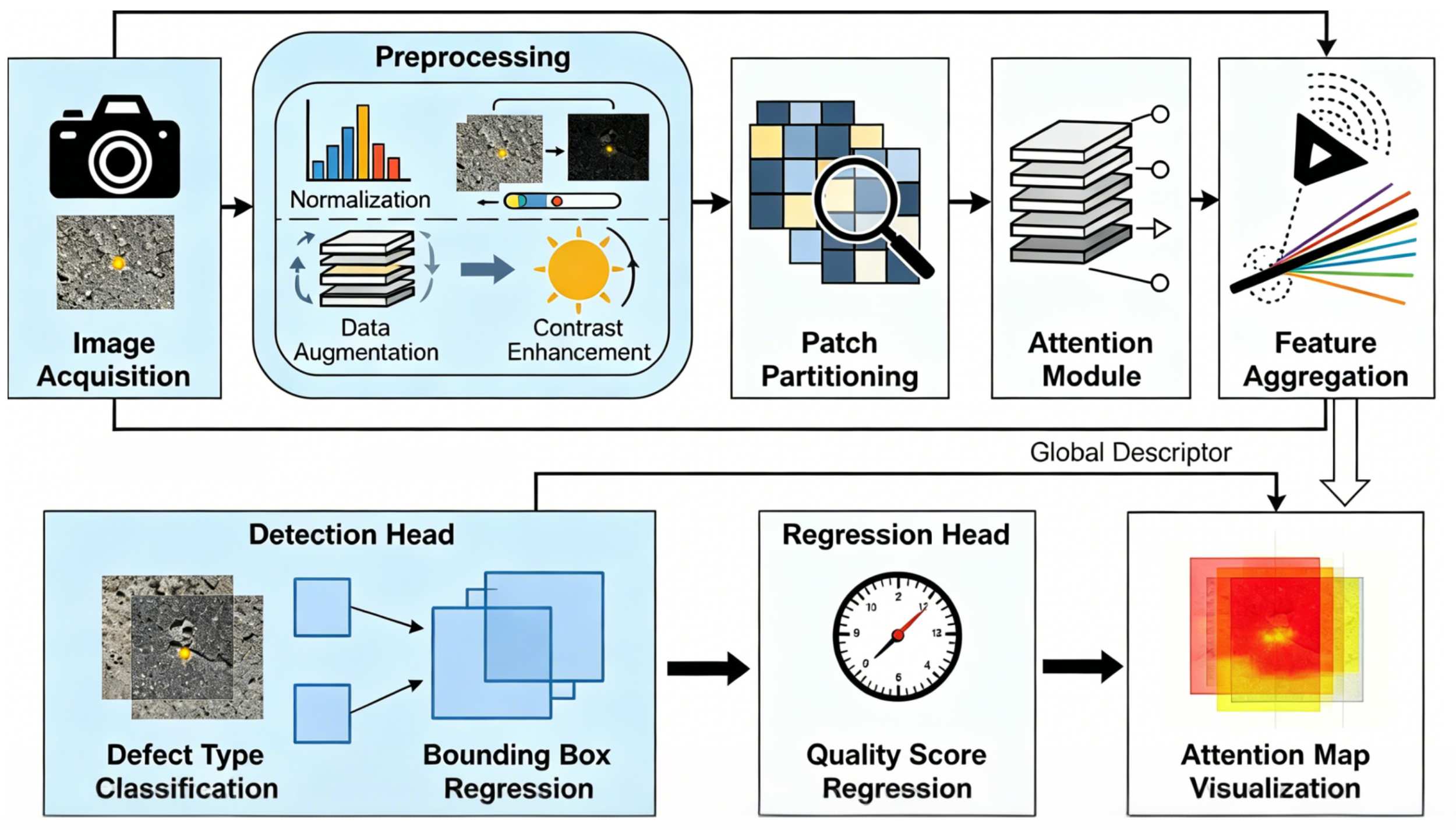
In recent years, surface quality inspection based on computer vision has frequently been used in high-precision, reliable automated manufacturing to identify defects. To address subtle, irregular, and low-contrast surface defects, this paper proposes a real-time surface quality assessment framework based on a patch-level attention-enhanced ResNet architecture. Using adaptive patch division and two different types of attention mechanisms, this new technique simultaneously captures local features and global relationships, and it is interpretable. In order to handle different environments, the preprocessing module in this paper will apply contrast limitation, random augmentation, and adaptive histogram equalization. The convolutional feature extractor divides each input image into multiple patches. Then, the channel and spatial attention modules recalibrate the feature maps based on defect relevance. Subsequently, the recalibrated features are integrated into the regression head for continuous surface quality score prediction and the classification head for defect category identification. Experiments have been conducted using large-scale public and private industrial datasets containing over 40,000 labeled images. The above results indicate that the system has an inference speed of over 38 frames per second and an average precision mean of 0.946. Therefore, it surpasses both the baseline and other top solutions in terms of accuracy and speed. Ablation studies indicate that channel attention and spatial attention are complementary, and their combination still outperforms single-path designs. The all-encompassing framework for autonomous surface inspection in manufacturing has high reliability, is easy to interpret, and performs well.
Downloads
Published
How to Cite
Issue
Section