Attention-Enhanced Generative Adversarial Networks Guided by Human Visual System Characteristics for Realistic Image Synthesis
DOI:
https://doi.org/10.64972/dea.2025.v4i3.2441d:1-12Keywords:
Computational Imaging, Generative Adversarial Networks, Visual Attention, Image SynthesisAbstract
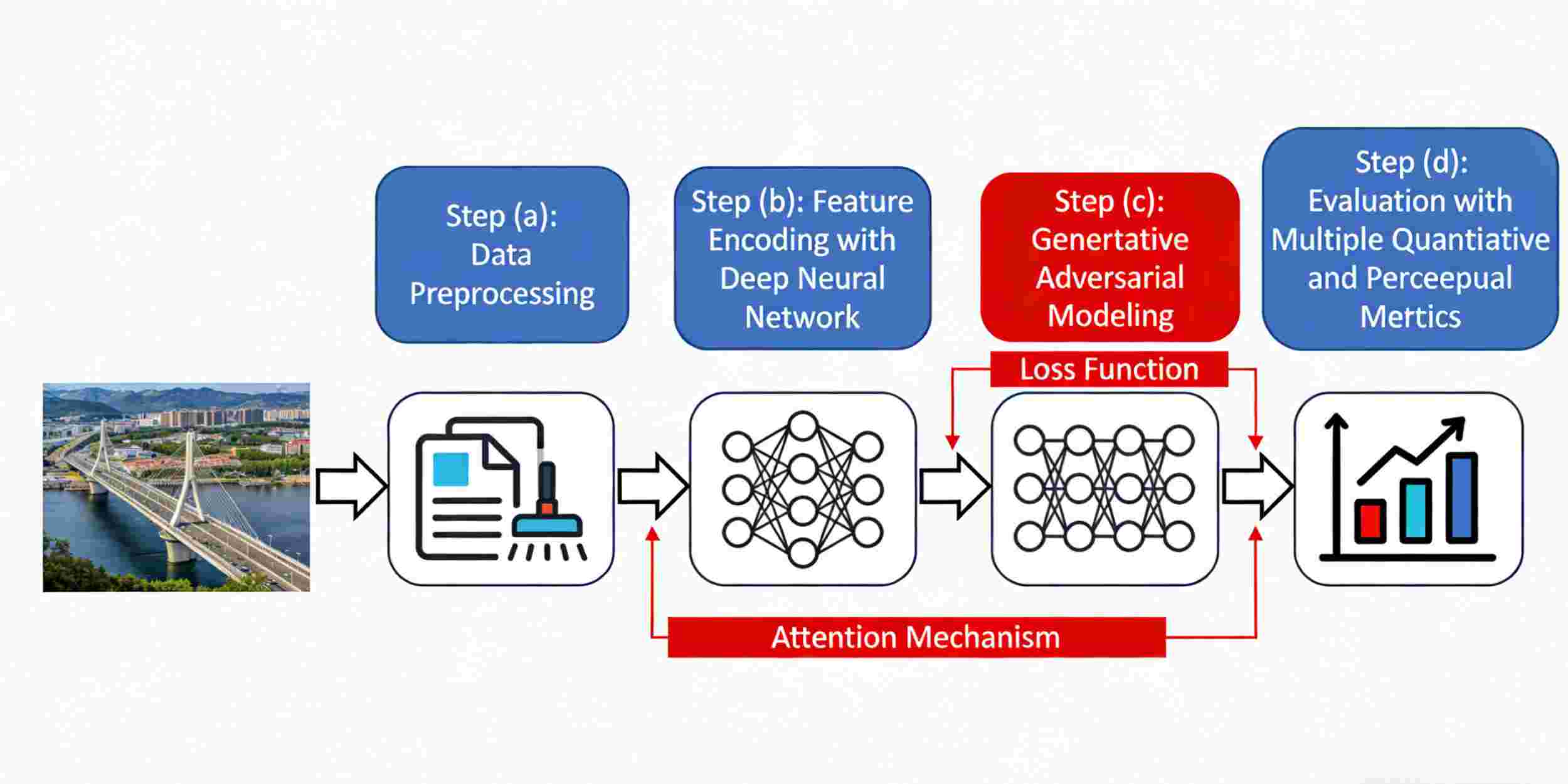
The synthesis of true-photographic images has not yet been resolved; the current state of affairs appears to be significantly different in terms of accurately measuring specific features and successfully preserving recognised visual traits. The human visual system model serves as the foundation for a generative adversarial network structure enhanced with attention mechanisms. A new framework that incorporates mathematical models for spatial selection, frequency response sensitivity, and saliency-guided feature weighting into the generator and discriminator will be developed in order to address the drawbacks of conventional attention methods. application of the suggested model with stringent control over training procedures and a number of standardised, multi-step preprocessed benchmarks. According to the experimental data, these approaches perform significantly better than previous recent works. These pathways in the human visual system can enhance error localisation and image quality, according to thorough ablation testing. Additionally, extensive subjective assessments reveal a decrease in perceptual artefacts and an improvement in user preference. As can be seen from the above, deep learning frameworks that incorporate multidisciplinary ideas for biological vision can produce more potent and comprehensible solutions for real-world image-generation tasks. As previously mentioned, this paper offers a crucial foundation for further research on perceptual-aligned generative networks in the field of scientific imaging; applications include human-machine interaction and content creation.
Downloads
Published
How to Cite
Issue
Section
License
Copyright (c) 2026 Marius Constantinescu, Petru Voicu, Adrian Țigău

This work is licensed under a Creative Commons Attribution-NonCommercial-ShareAlike 4.0 International License.