Data-Driven Prediction of Tool Wear in Additive Manufacturing Using XGBoost and Multi-Sensor Fusion
DOI:
https://doi.org/10.64972/dea.2026.v5i2.1743d:30-43Keywords:
Machine Learning, Additive Manufacturing, Tool Condition Monitoring, XGBoost, Multi-Sensor FusionAbstract
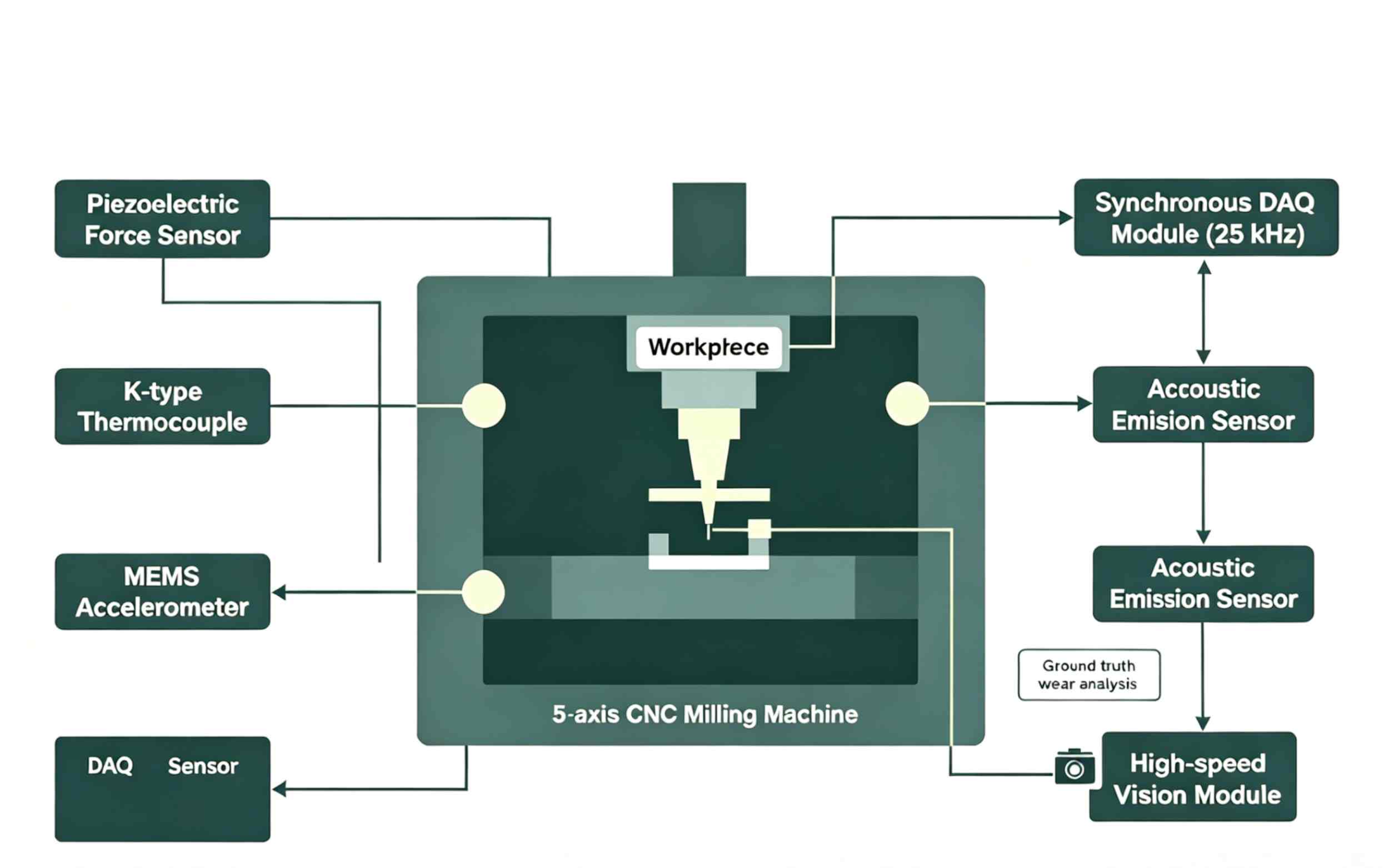
More intelligent condition monitoring for additive manufacturing is now being developed through the combination of advanced machine learning and multi-sensor data processing. In order to measure tool wear during the post-processing of additively generated parts, this study will develop a prediction framework based on XGBoost. The intricate nonlinear interactions in tool degradation have been investigated following rigorous feature engineering and dimension reduction using a variety of time-synchronized force, acoustic, vibration, and thermal sensors. For experimental verification, a high-sampling-rate hybrid machining platform with stringent ground-truth annotations was employed; all process parameters and materials have been partially covered. When compared to conventional regression, neural network, and support vector approaches, the novel model outperforms them in prediction, with an adjusted coefficient of determination of over 0.93 and a mean root mean square error of less than 0.025. The aforementioned studies indicate that the model has strong prediction stability and robustness in the presence of outliers, and it is comparatively insensitive to sensor noise and process drift. Additionally, integrated feature attribution analysis has provided support for future intelligent sensor deployment by identifying the fundamental roles of particular signal-based characteristics. In the realm of intelligent manufacturing, multi-modal data fusion and ensemble learning have been used to increase the precision of tool wear prognosis based on the aforementioned findings.
Downloads
Published
How to Cite
Issue
Section