Record-Driven Calibration of Cooling-Tower Performance Digital Twins Using Hiera-UNet
DOI:
https://doi.org/10.64972/dea.2023.v2i2.3542d:15-30Keywords:
Cooling Tower Calibration, Digital Twin, Hiera-UNet, Heat and Mass Transfer, Performance MonitoringAbstract
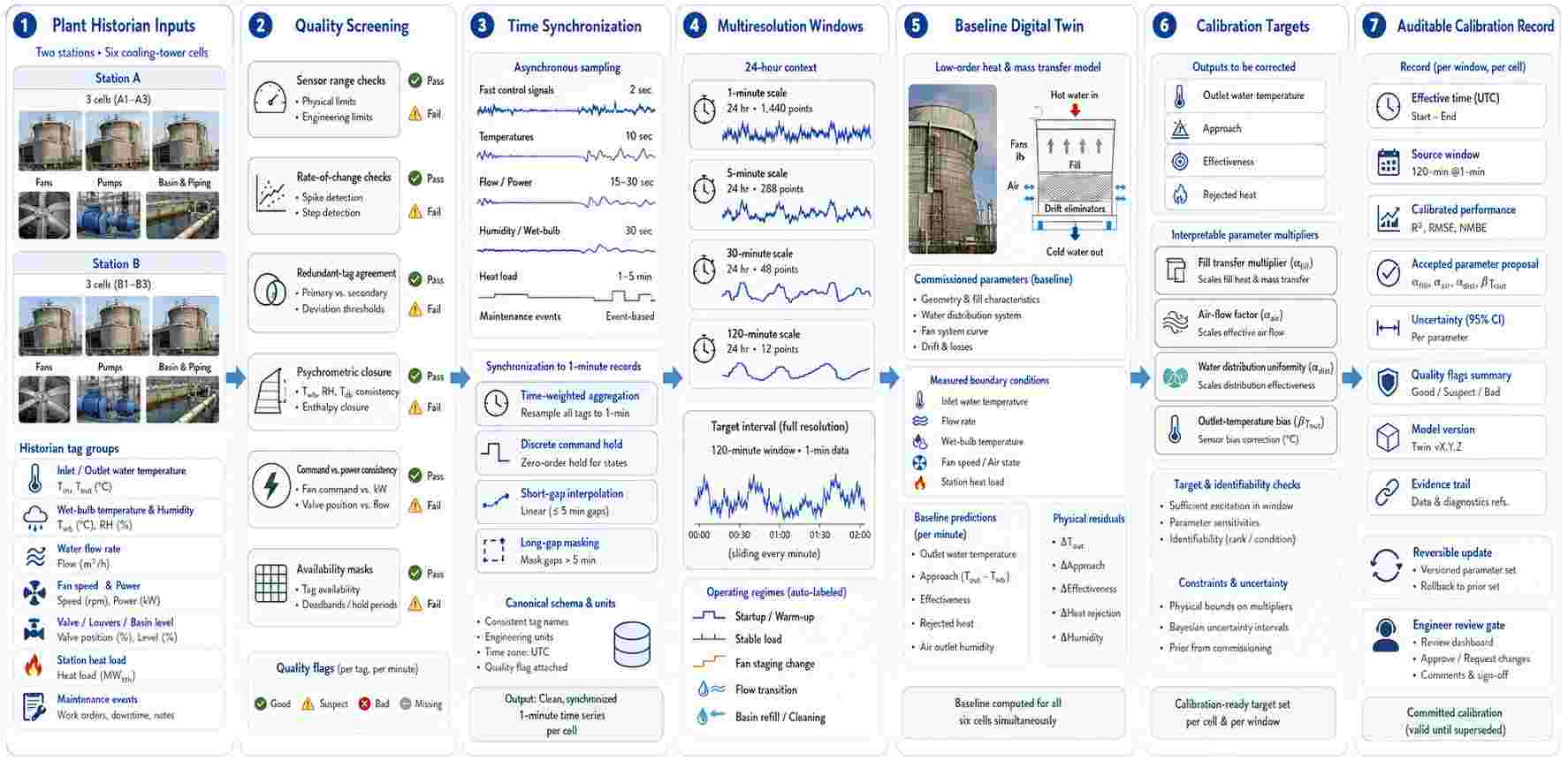
Although design equations and commissioning tests are typically used to start cooling-tower digital twins, variations in fill resistance, nozzle distribution, fan condition, instrumentation bias, and other factors cause their accuracy to decrease. Although the records are asynchronous, regime-dependent, and primarily comprise ordinary operating data rather than controlled test findings, plant historians have gathered the information required for recalibration. A record-driven Hiera-UNet model for ongoing performance calibration of wet cooling-tower digital twins is presented in this study. A low-order heat- and mass-transfer twin is contrasted with historian tags arranged into multi-resolution operational windows. Seasonal environmental variations, shift-scale loading, and rapid actuator changes are all represented by a hierarchical attention encoder. In order to calculate corrections for outlet water temperature, approach, efficacy, and the four identifying twin characteristics, a U-Net style temporal decoder uses encoder features and physical residual channels. The calibration is limited by energy-balance, monotonicity, smoothness, and uncertainty losses. Fourteen months of one-minute recordings from six tower cells at the two industrial sites served as the foundation for the technique. Hiera-UNet maintained a 90% interval coverage of 91.3% on the held-out station while lowering the approach error by 71.6% and the outlet-temperature mean absolute error for the uncalibrated twin to 0.29 °C from 1.18 °C. Additionally, fill-performance decrease at 4.1% and simulated sensor bias at 0.12 °C are found. The findings of the ablation experiment show that physical residual limitations and hierarchical encoding have added the most accuracy. The end product is a digital twin calibration layer that can be audited without changing the engineering framework.
Downloads
Published
How to Cite
Issue
Section
License
Copyright (c) 2023 Domantas Vasiliauskas, Benas Balčiūnas, Marius Pakalniškis

This work is licensed under a Creative Commons Attribution-NonCommercial-ShareAlike 4.0 International License.