Physics-Guided Graph Network-Driven State Estimation Model for Bridge Digital Twins
DOI:
https://doi.org/10.64972/dea.2023.v2i2.3564d:46-62Keywords:
Bridge Digital Twin, Physics-guided Graph Network, State-space Estimation, Structural Health MonitoringAbstract
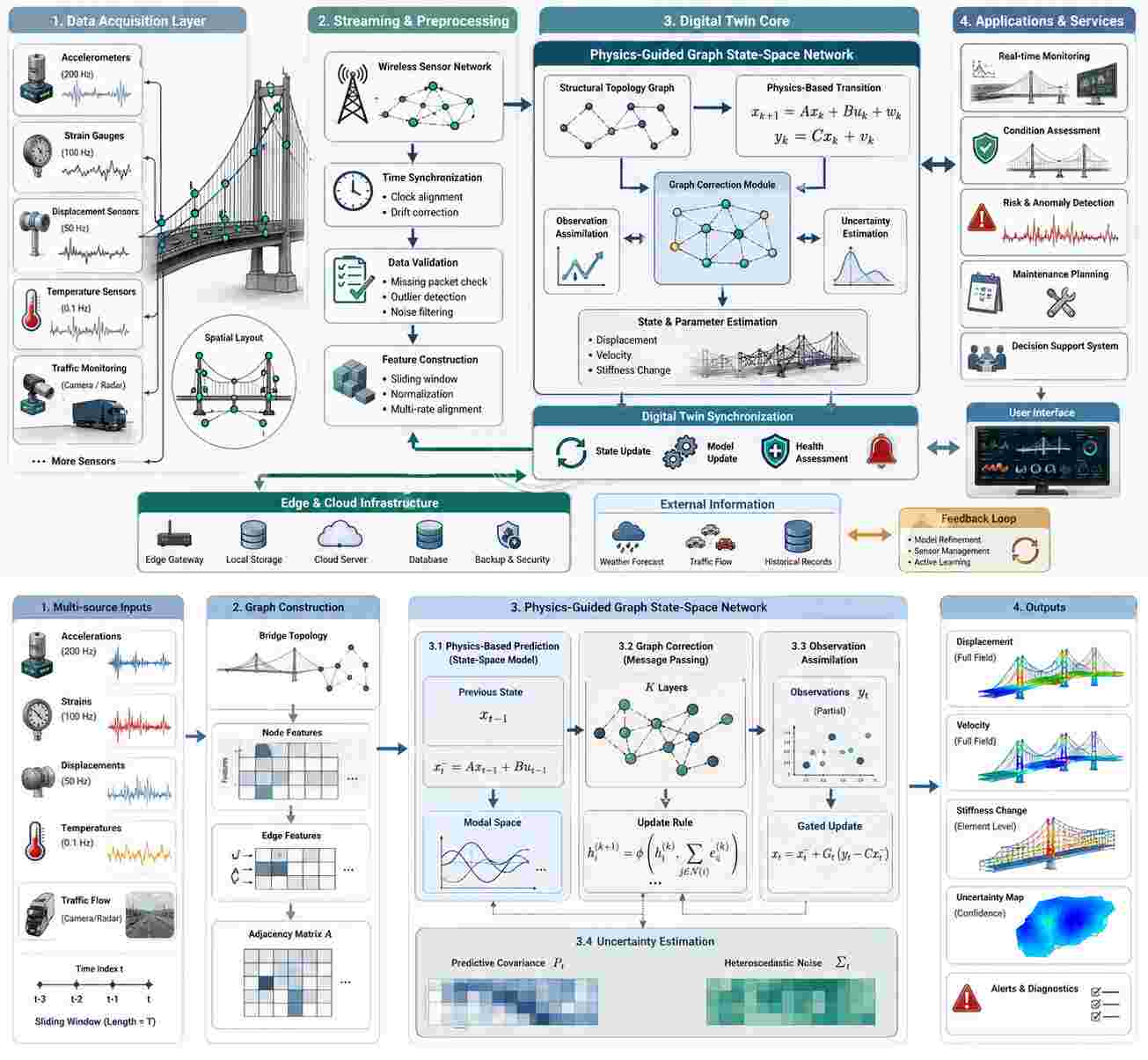
If the measurements are sparse, asynchronous, noisy, and influenced by traffic and temperature, it is not possible to continuously synchronize the physical bridge with its digital counterpart. While unconstrained deep estimators may fit the observed channels but violate equilibrium or yield implausible unmeasured responses, pure finite-element updating is interpretable but computationally limited. In this paper, we develop a graph state-space network for bridge digital-twin state estimation guided by physics. The bridge is depicted as a sensor-component graph with numerous accelerations, strain, displacement, temperature, and traffic variables as nodes. After modal displacement and velocity are predicted by a reduced structural transition operator, observations along physically significant edges are incorporated into a gated graph correction block. Equilibrium, observation, smoothness, and uncertainty-calibration losses stabilize joint state and stiffness-change estimation. Predictive covariance is propagated to the digital twin by a streaming synchronization technique that uses mask-conditioned messages to handle missing packets. Long-span bridge monitoring replay, a laboratory steel-girder test, and a calibrated finite-element benchmark with traffic and thermal stress have all been employed in the experiments. When compared to strong recurrent, graph, and Kalman baselines, the suggested model lowers the displacement root-mean-square error by 24.8%–41.6% in all three scenarios. The normalized state error is 0.086 under 30% random sensor loss, and the F1 score for stiffness-loss localization is 0.914. The model uses a 64-sample window of 18.7 ms per GPU, with an empirically covered interval of 92.8% at the nominal 95% level. According to the findings, incorporating succinct mechanics into topology-aware learning enhances real-time twin operation's accuracy, robustness, and diagnostic reliability.
Downloads
Published
How to Cite
Issue
Section
License
Copyright (c) 2023 Murat Öztürk, Selim Aydın

This work is licensed under a Creative Commons Attribution-NonCommercial-ShareAlike 4.0 International License.