GRCNN: A Gated Recurrent Convolutional Neural Network for Robust Temporal-Spatial Video Anomaly Detection
DOI:
https://doi.org/10.64972/dea.2026.v5i1.1657d:87-100Keywords:
Pattern Recognition, Video Anomaly Detection, Gated Recurrent Network, Temporal-Spatial Feature Fusion, Attention Mechanism, Multi-Modal LearningAbstract
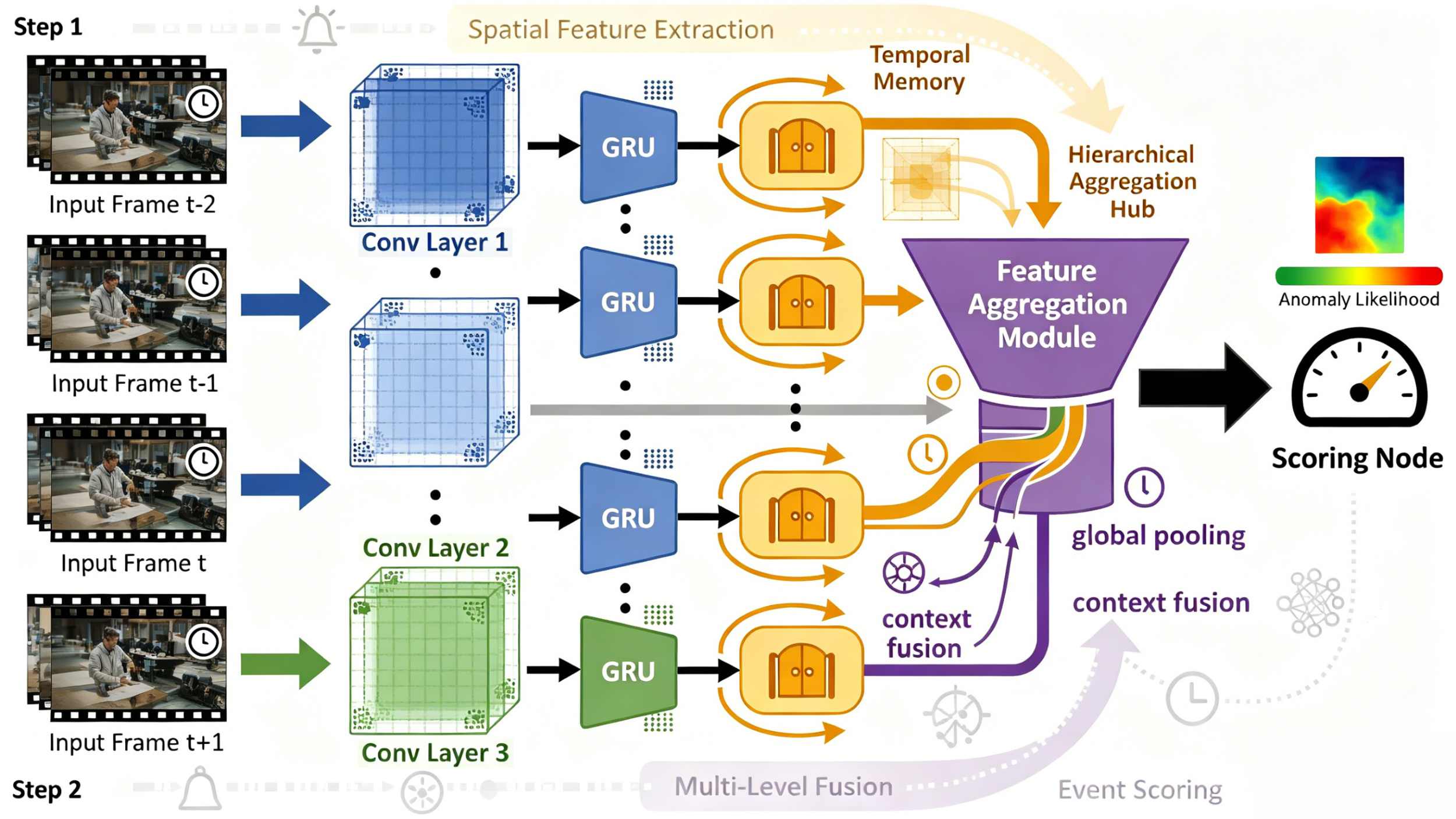
With the advancement of intelligent monitoring technology, detecting anomalous events in video streams with rich spatiotemporal correlations and dynamic backgrounds has become increasingly difficult. To address the aforementioned issues, this paper proposes a new Gated Recurrent Convolutional Neural Network (GRCNN). The network features a graph-based attention mechanism, dual-branch recursive paths, and dynamic time gating. Through end-to-end training, data augmentation, and regularization, the improved model enhances the sensitivity and noise resistance of the original model. Experiments on the UCSD Ped2, Avenue, and ShanghaiTech datasets show that GRCNN achieved an average AUC of 95.8%, an F1-score exceeding 92%, and an average detection delay reduced to 71 milliseconds. Due to its excellent design, it outperforms the current best baseline in cross-domain transfer and multimodal fusion. According to the experiments, the model remains effective under uncertain conditions. The results indicate that GRCNN has good adaptability and efficiency, making it suitable for real-time monitoring in public safety and other intelligent surveillance systems.
Downloads
Published
How to Cite
Issue
Section