Simulation Framework for Testing Autonomous Driving Strategies in Mixed Reality Environments
DOI:
https://doi.org/10.64972/jaat.2024v2.310p25e:348-360Keywords:
Autonomous Driving, Mixed Reality, Digital Twin, Strategy Testing, Risk Exposure, Scenario CoverageAbstract
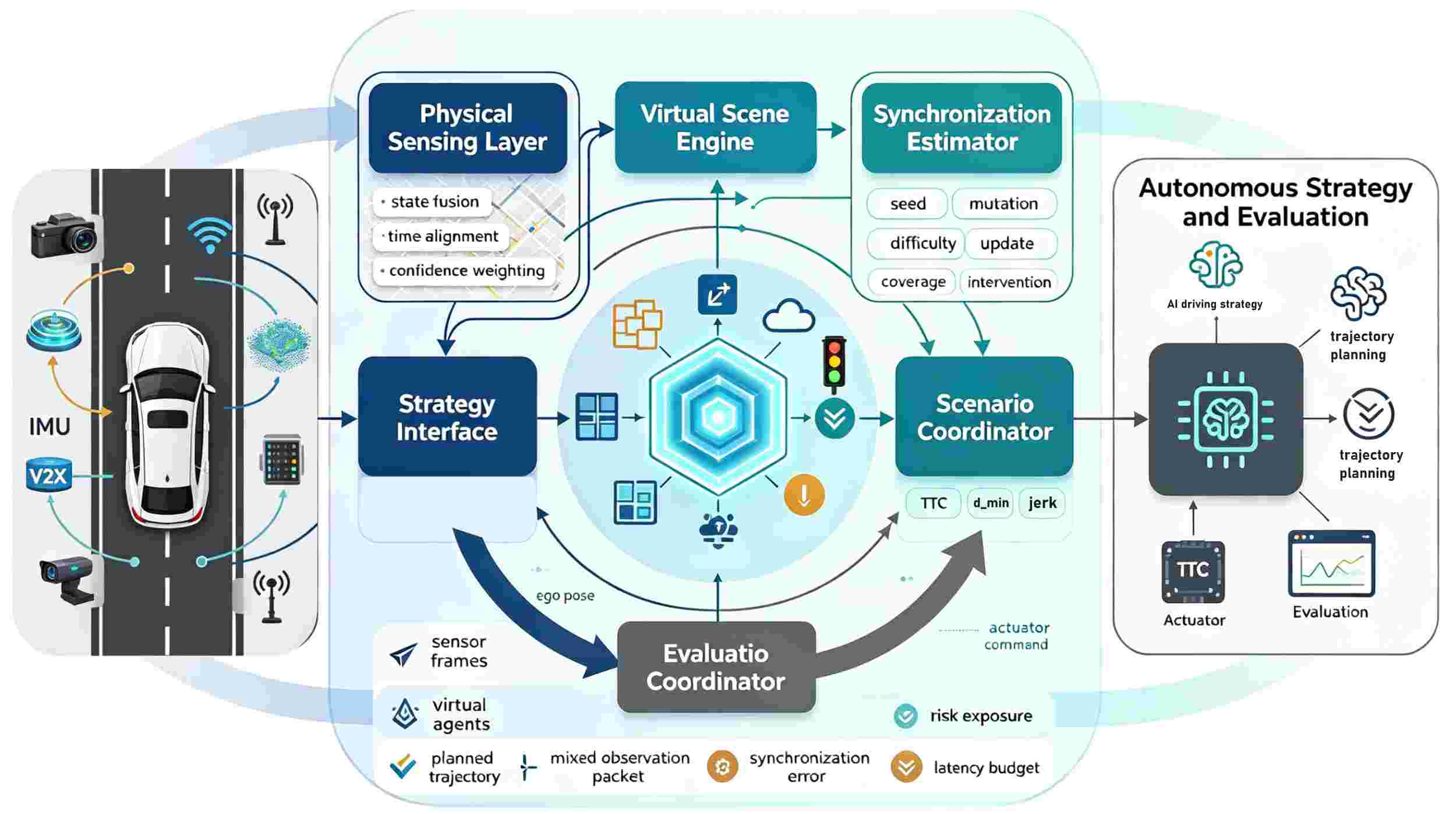
Test environments for autonomous driving strategies need to be reproducible and measurable, and they should be close to actual driving conditions so that any defects in software simulation are also exposed. This paper puts forward a closed-loop mixed-reality simulation framework for autonomous driving strategy validation. A Digital Twin State Estimator is used to connect real ego-state sensing, virtual traffic agents, synchronous environment rendering, and adaptive scenario coordination in the framework. Define a practical strategy interface and introduce metrics for synchronisation error, risk exposure, coverage, stability, comfort and latency. Experiments in urban intersections, pedestrian occlusion, highway merges, cut-in situations and signalised corridor scenarios have shown that the proposed framework can keep the median spatial synchronisation error below 0.18 m and the closed-loop latency below 40 ms in most conditions. The risk-adaptive strategy in the framework has been improved over rule-based and learning-assisted baselines by increasing the minimum distance margin, reducing the frequency of intervention, and expanding the range of valid scenarios. Based on the analysis, combined with real-world testing, large-scale simulations and road tests can be effectively conducted by considering synchronization quality and strategy performance.
Downloads
Published
How to Cite
Issue
Section
License
Copyright (c) 2024 Mariusz Jaworski, Ryszard Halik, Cyprian Górski

This work is licensed under a Creative Commons Attribution-NonCommercial-ShareAlike 4.0 International License.