Automatic Traffic Incident Detection Algorithm for Surveillance Videos Using Spatio-Temporal Graph Neural Networks
DOI:
https://doi.org/10.64972/jaat.2024v2.272p17e:235-249Keywords:
Traffic incident detectionTraffic incident detection, Surveillance video, Spatio-temporal graph neural network, Intelligent transportation, Video analyticsAbstract
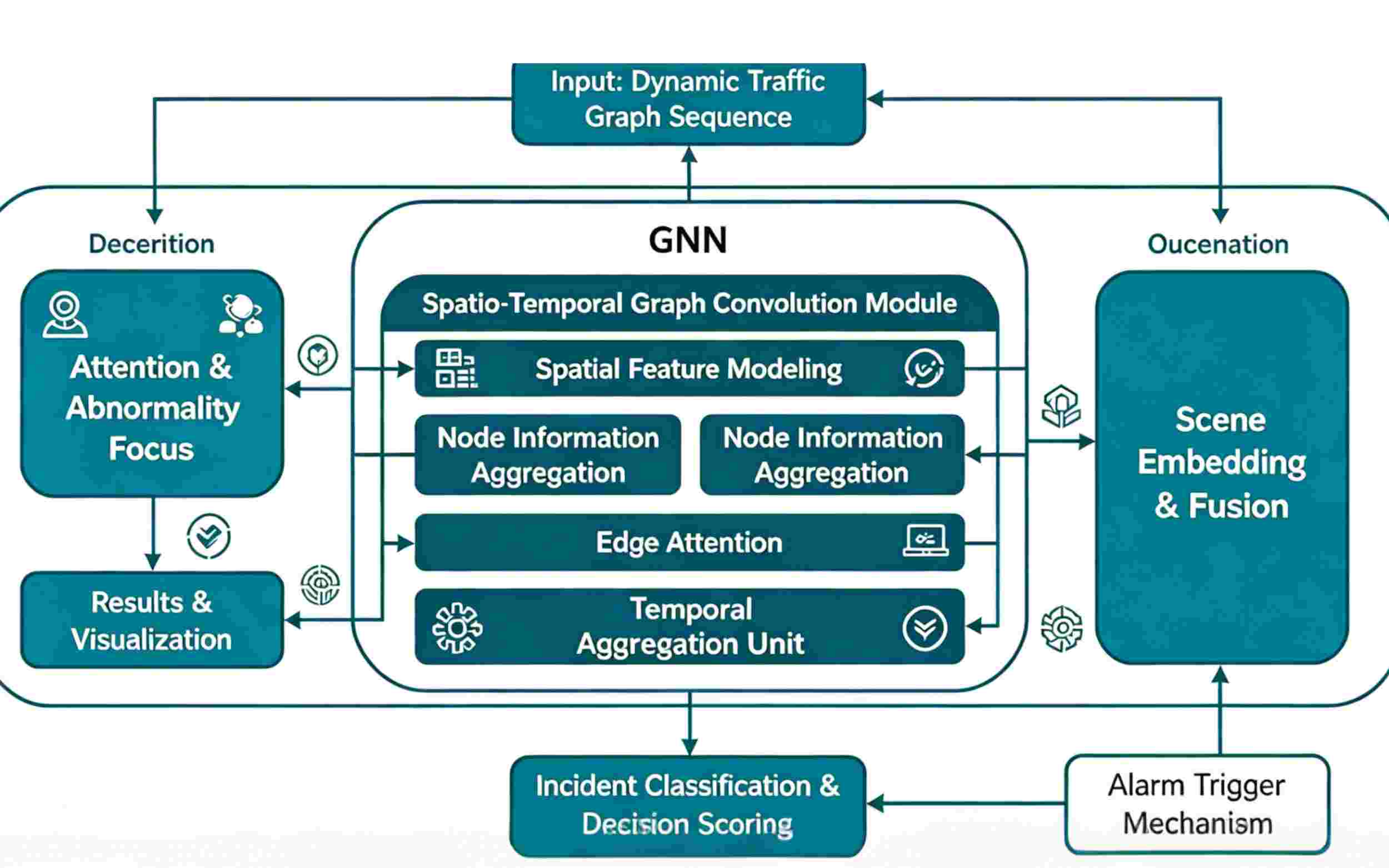
An intelligent transportation system's primary goal is to automatically identify traffic accidents in surveillance footage; otherwise, collisions, unauthorized parking, unexpected traffic jams, lane crossings, and other safety and traffic issues would soon arise. The majority of current video detection techniques are either short-term motion cues or frame-level visual feature descriptions; as a result, they are unable to characterize organized interactions between vehicles, lanes, and traffic flow conditions. This research proposes a framework for automatically detecting traffic accidents using spatiotemporal graph neural networks. Following the extraction of traffic objects from surveillance footage, dynamic traffic graphs are constructed using the position, velocity, lane affiliation, motion variation, and spatial closeness of these items. After that, a Spatio-temporal Graph Learning Module is implemented to compile the incident's temporal evolution patterns and local interaction features for classification. The experiment's components are arranged as follows: robustness under occlusion and heavy traffic, detection accuracy, false alarm rate, response time, incident-type identification, and ablation comparison. In comparison to frame-level deep models, the novel approach may increase the detection accuracy to 93.84%, decrease the false alarm rate to 5.21%, and lower the average response delay to 1.37. Thus, the challenge of real-time traffic video surveillance is a good fit for a graph-based model of time-series data.
Downloads
Published
How to Cite
Issue
Section
License
Copyright (c) 2024 Mariusz Jaworski, Cyprian Górski, Ryszard Halik

This work is licensed under a Creative Commons Attribution-NonCommercial-ShareAlike 4.0 International License.