Multimodal Traffic Flow Prediction Model Based on Long Short-Term Memory and Graph Convolutional Networks
DOI:
https://doi.org/10.64972/jaat.2024v2.271p16e:221-234Keywords:
Multimodal fusion, Long short-term memory, Graph convolutional network, Intelligent transportation systems, Spatiotemporal learningAbstract
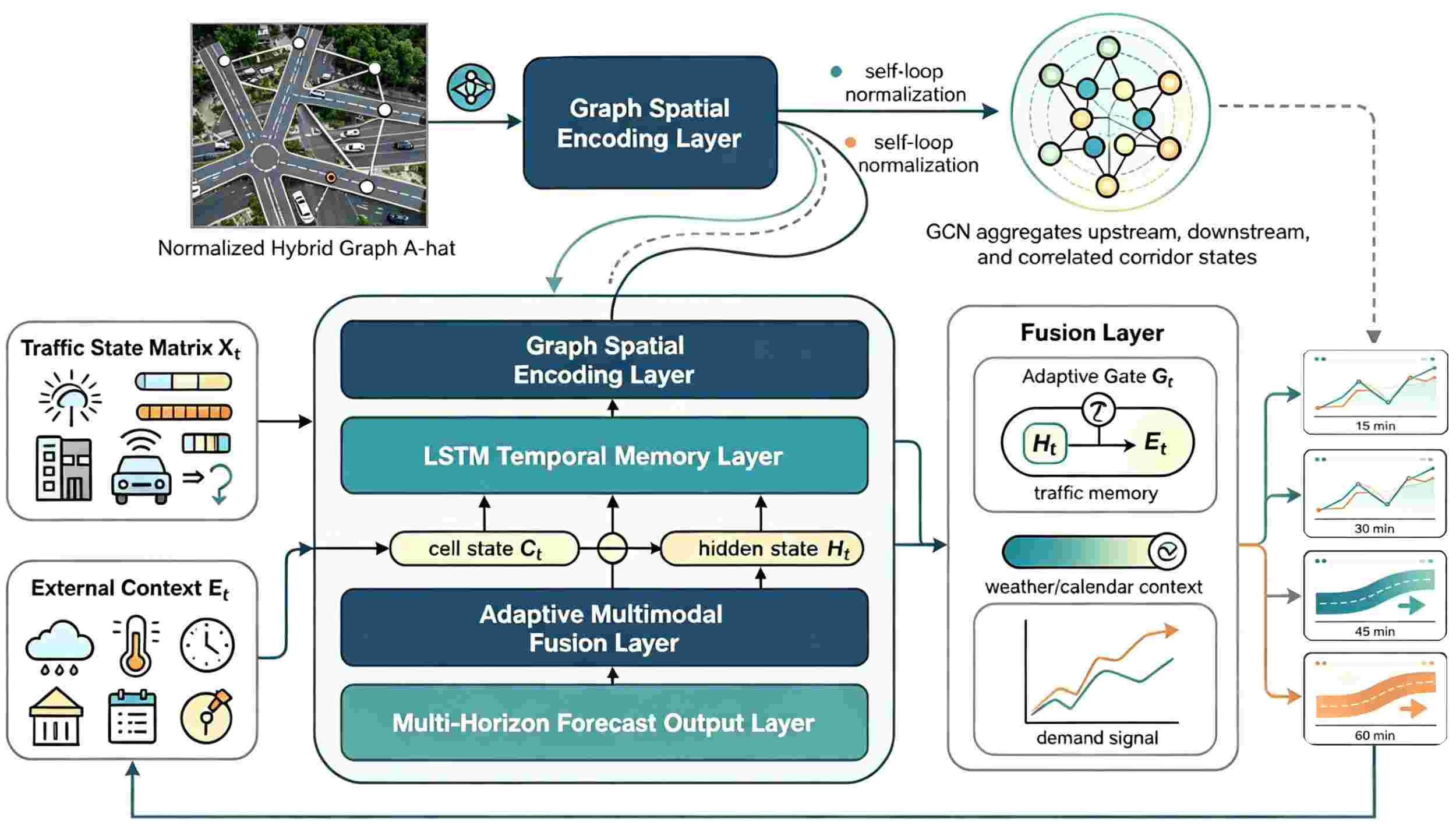
Accurate short-term traffic flow prediction is needed for the adaptive signal control, route guidance, incident response, and energy-saving urban mobility services. Although the accuracy of temporal forecasting by the current deep learning models has increased, most of them treat road segments as independent sequences or fail to consider the physical network structure in the integration of external factors. Propose a multimodal traffic flow prediction model based on long short-term memory and graph convolutional networks in this paper. Combine the attributes of road detector flow, speed, occupancy, weather, time-of-day calendar and local demand into a unified feature tensor for the model. A normalised Graph Convolutional Network (GCN) module extracts spatial correlations from both topological adjacency and data-driven similarity, and an LSTM module learns recurrent temporal dependencies to generate multi-horizon traffic flow forecasts. A Gated Multimodal Fusion Layer is added to adjust the weight given to different kinds of input data dynamically in peak, off-peak and bad-weather periods. A study area of an urban traffic network is set up, with 214 sensor nodes and 62 days of five-minute observations. Among the baselines of ARIMA, SVR, LSTM, GCN and STGCN, the proposed LSTM-GCN model reduced the 30-minute MAE by 13.8% compared with the best baseline and exhibited stable performance in congestion regimes. Based on the above experiments, both explicit spatial graph construction and disciplined multi-modal fusion are required for stable engineering applications.
Downloads
Published
How to Cite
Issue
Section
License
Copyright (c) 2024 Sławomir Cyra, Jarosław Bogdan Kalisz

This work is licensed under a Creative Commons Attribution-NonCommercial-ShareAlike 4.0 International License.