Federated Spatiotemporal Deep Learning for Privacy-Preserving Urban Traffic Flow Prediction
DOI:
https://doi.org/10.64972/jaat.2025v3.230p34e:461-475Keywords:
Federated Learning, Spatiotemporal Modeling, Urban Traffic Prediction, Privacy PreservationAbstract
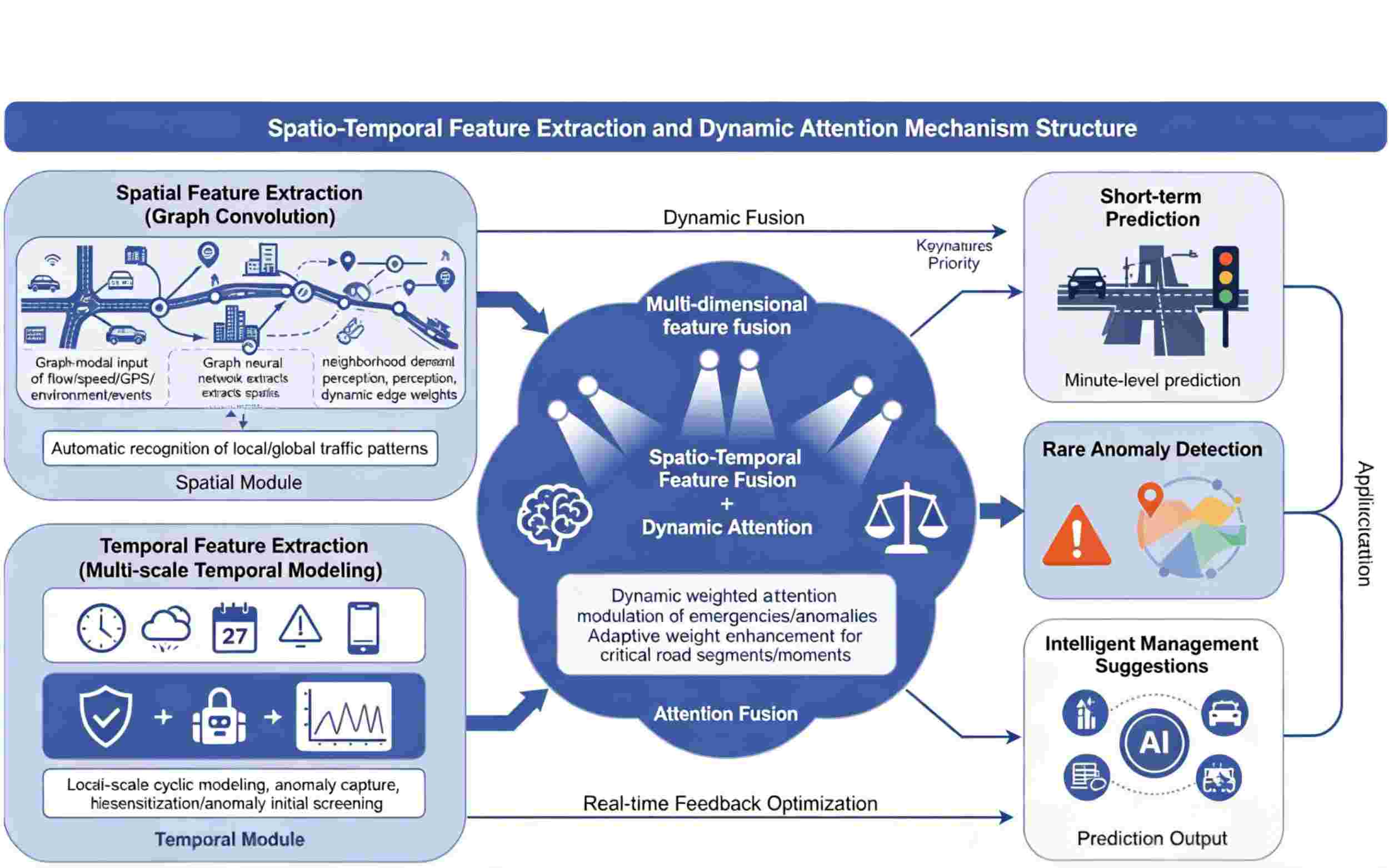
This work explores the use of federated spatiotemporal deep learning to achieve accurate predictions of urban traffic flow in practice under real-world privacy restrictions. The primary objective is to create a private, scalable system that can deliver accurate forecasts throughout the entire city. This method uses adaptive attention mechanisms and graph-based neural networks to extract complex spatiotemporal properties from the dispersed sensor data without exchanging raw data. To guarantee generality and model robustness, a customized aggregation algorithm dynamically adjusts to local pattern variance and node dependability. The approach outperforms conventional centralized and federated baselines, with an increase of up to 12.7% in Root Mean Squared Error and up to 14.1% in rare congestion event F1 scores, according to experiments done on three large-scale metropolitan datasets. If the budget for privacy is high, the communication overhead can be lowered by up to 22%. The aforementioned findings demonstrate that the suggested framework can currently accomplish comparatively high forecast accuracy and operating efficiency in a variety of complex urban situations. In summary, by satisfying the requirements of technical viability, expandability, and the new data protection standard, this article offers a strong basis for the future development of smart city traffic management.
Downloads
Published
How to Cite
Issue
Section
License
Copyright (c) 2025 Sławomir Cyra, Jarosław Bogdan Kalisz

This work is licensed under a Creative Commons Attribution-NonCommercial-ShareAlike 4.0 International License.