Concrete Pouring Quality Assessment S4D-Transformer Model Driven by Thermal Video and Pump Pressure Data
DOI:
https://doi.org/10.64972/dea.2026.v5i2.3958d:101-113Keywords:
Thermal Video Assessment, Pump Pressure Sequence, Concrete Pouring Quality, S4D-Transformer, Cold Joint Detection, Construction Process MonitoringAbstract
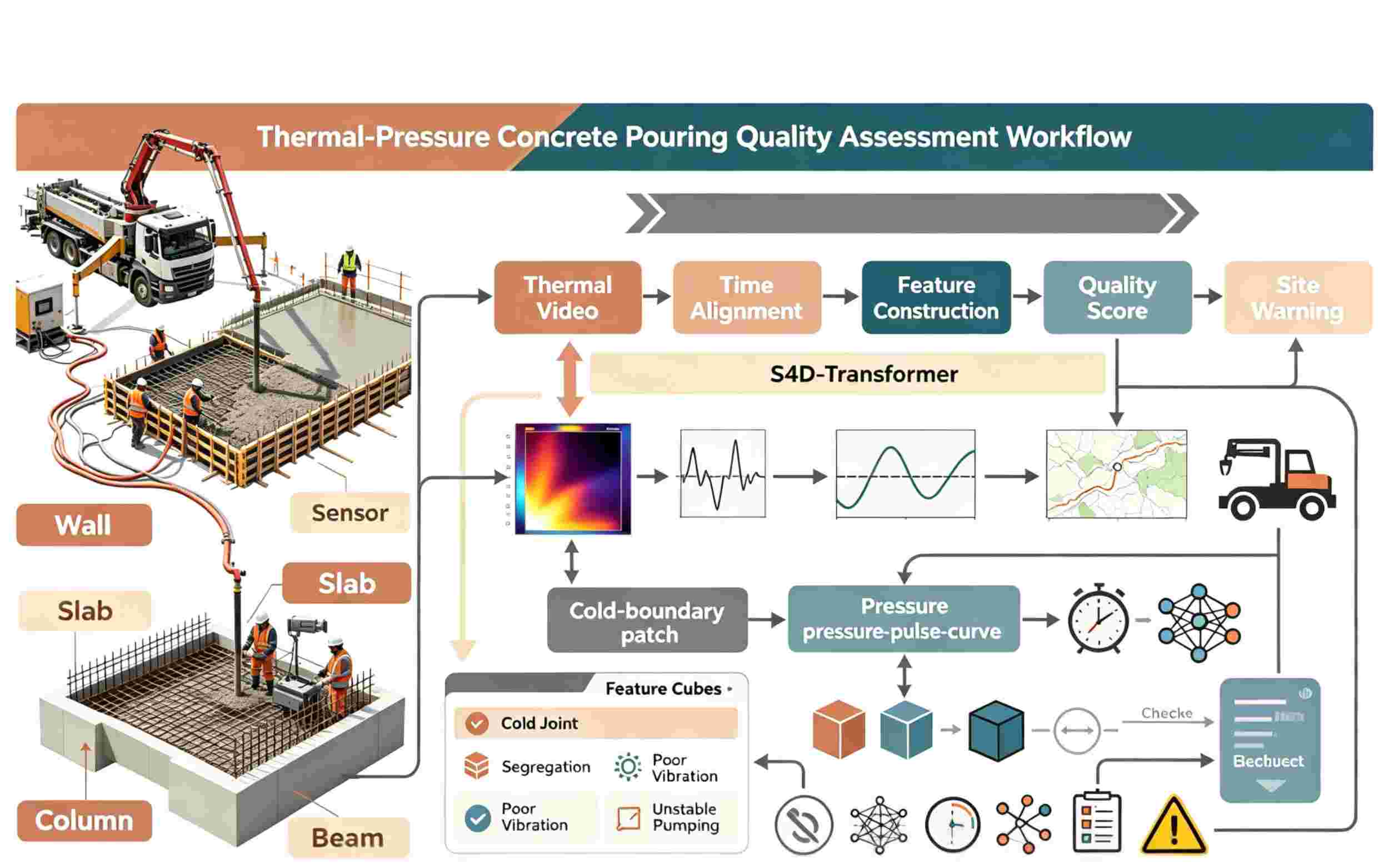
This study develops an S4D-Transformer model for concrete pouring quality assessment driven by thermal video and pump-pressure data. The task aims to detect cold-joint risk, segregation, inadequate vibration, pressure interruption, unstable pumping, and abnormal hydration-temperature response before defects become difficult to correct after hardening. A simulated construction dataset is built with 9,800 pouring windows, 420 thermal video sequences, 18 pump-pressure channels, 36 structural zones, and four member types: wall, slab, column, and beam sections. The proposed workflow aligns thermal frames and pressure pulses in fixed pouring windows, extracts surface-temperature texture, pressure fluctuation, flow stability, pumping pause, vibration-response, pouring-route, and zone-context features, and then combines S4D long-range state memory with Transformer cross-modal fusion. Compared with pressure-only, thermal CNN, LSTM fusion, temporal convolution, and Vision Transformer baselines, the model improves pouring-quality classification accuracy to 92.8%, raises cold-joint recall to 90.7%, and reduces false alarms by 26.3%. Average inference delay is 41 ms per window, supporting near-real-time site review. The method should be interpreted as an engineering decision-support tool and still requires validation with real thermal cameras, pump-controller logs, vibration records, field inspection labels, and project-specific acceptance criteria.
Downloads
Published
How to Cite
Issue
Section
License
Copyright (c) 2026 Sultan Al-Dhaheri, Abdullah Al-Zaabi, Juma Al-Sharqi

This work is licensed under a Creative Commons Attribution-NonCommercial-ShareAlike 4.0 International License.