Improved FedProx-TinyViT Model for Low-Voltage Distribution Area Topology Identification Under Smart Meter Voltage-Related Data
DOI:
https://doi.org/10.64972/dea.2025.v4i4.3942d:17-29Keywords:
Smart Meter Voltage Topology, Low-Voltage Distribution Area, FedProx-TinyViT, Federated Grid Analytics, Voltage Correlation Matrix, Topology Change DetectionAbstract
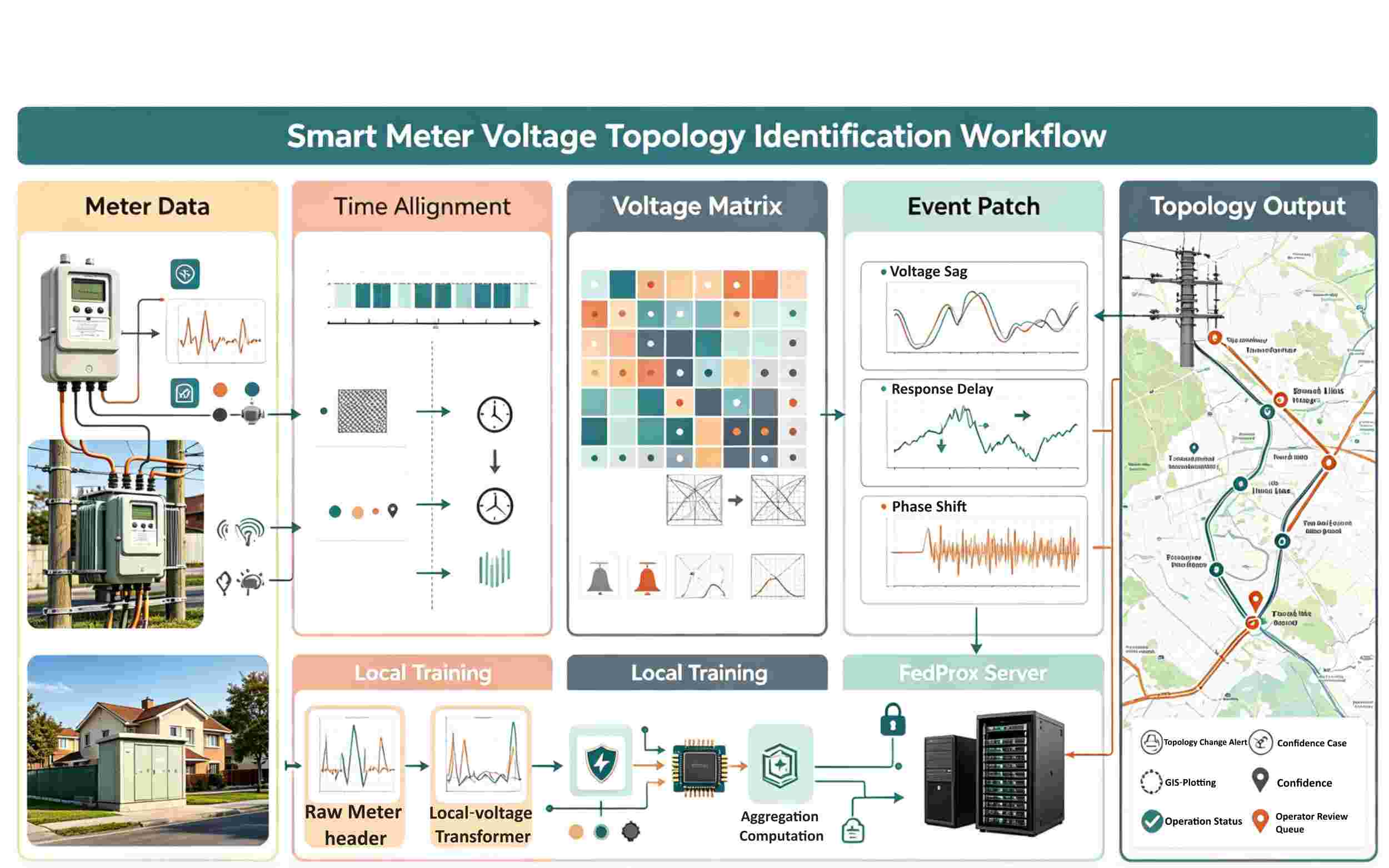
This work presents an improved FedProx-TinyViT model for low-voltage distribution-area topology identification using smart-meter voltage-related data under asynchronous sampling, missing meter packets, partial feeder records, and privacy constraints. The simulated dataset includes 126 transformer regions, 18,400 smart meters, 12 months of voltage, current, power-factor, outage, and event records, and 42 controlled topology-change scenarios. Voltage-correlation matrices, fluctuation-response patches, missingness masks, and feeder-event descriptors are constructed as topology-sensitive inputs. A TinyViT branch learns compact local relation patterns, while FedProx aggregation limits client drift across non-independent transformer areas without centralizing raw customer curves. Compared with centralized graph learning, local-only TinyViT, FedAvg-TinyViT, and voltage-correlation baselines, the proposed model reaches 94.6% topology identification accuracy, a branch-user F1 of 0.927, a 1.4-day topology-change detection delay, and a 28.5% reduction in cross-area false association. The findings suggest that proximal federated optimization and lightweight voltage-relation patches can support privacy-preserving topology governance, while final topology-file updates still require operator review and field evidence.
Downloads
Published
How to Cite
Issue
Section
License
Copyright (c) 2025 Matej Blažević, Luka Lovrić

This work is licensed under a Creative Commons Attribution-NonCommercial-ShareAlike 4.0 International License.