Data-Driven Port Perception Sequence Modelling with Graphormer-KAN for Autonomous Surface Vessel Berthing
DOI:
https://doi.org/10.64972/dea.2023.v2i2.3608d:105-118Keywords:
Autonomous Vessel Berthing, Port Perception Sequence, Graphormer-KAN, Uncertainty Calibration, Safety-Constrained ControlAbstract
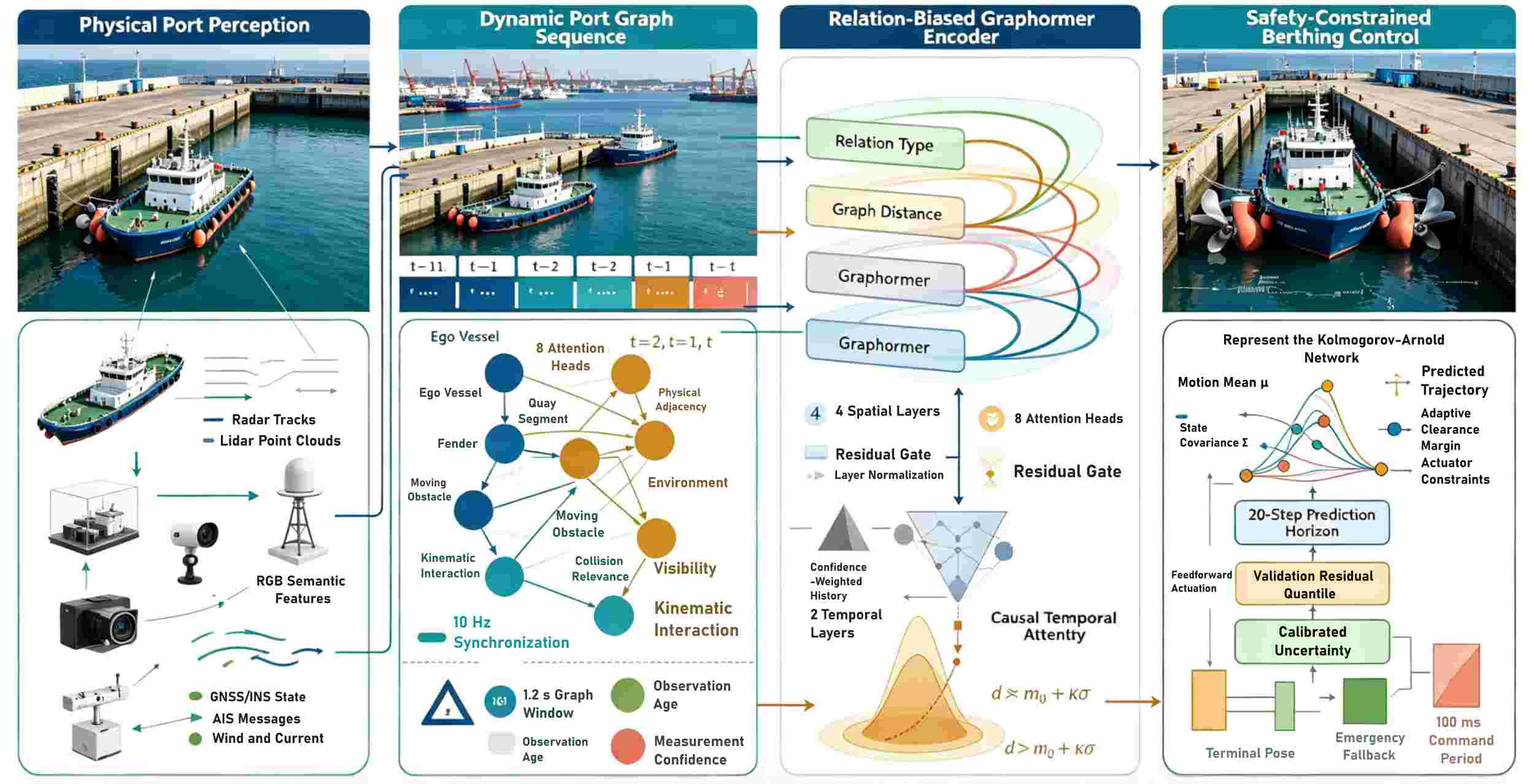
Close-quarters berthing is still a difficult autonomy problem because useful control decisions need to be derived from asynchronous port observations, and hydrodynamic response changes rapidly near the quay. This paper proposes a port-perception-sequence-driven Graphormer-KAN model that converts synchronized Lidar, radar, camera, positioning and vessel-state measurements into dynamic heterogeneous graphs. Spatial relation biases in the Graphormer are berth topology, visibility and collision relevance; a Kolmogorov-Arnold Network decoder generates distributional motion increments and actuator references. Predicted Uncertainty Expands Clearance Constraints in a Receding-Horizon Safety Controller. A model of a 9.2m twin-propeller vessel was used to study 2,400 random berthing episodes under four berth layouts, five disturbance levels, three payload states and structured sensor degradation. The proposed model had a successful berthing rate of 94.8%, a median terminal-position error of 0.19 m, a median heading error of 1.42°, and a fifth-percentile minimum clearance of 0.46 m. Success increased by 6.9 percentage points and collision incidence decreased from 5.7% to 1.8% compared with the strongest transformer baseline. Calibration error was 0.031, and the median inference time on an embedded graphics processor was still 18.6ms. Based on ablation experiments, relation-biased attention, spline-based KAN decoding and uncertainty-conditioned margins are all beneficial. According to the above results, graph-structured perception sequences can perform accurate, calibrated and computationally feasible autonomous berthing in heterogeneous port environments.
Downloads
Published
How to Cite
Issue
Section
License
Copyright (c) 2023 Hamdan Al-Suwaidi, Ahmed Al-Mansoori, Rashid Al-Jabri, Zayed Al-Tamimi

This work is licensed under a Creative Commons Attribution-NonCommercial-ShareAlike 4.0 International License.