Grain-Boundary Image Parsing with Structure-Preserving Feature Fusion and a Q-Learning-MPc Model
DOI:
https://doi.org/10.64972/dea.2023.v2i2.3586d:77-89Keywords:
Grain Boundary Parsing, Structure-Preserving Fusion, Q-Learning Control, Model Predictive Correction, Junction ConsistencyAbstract
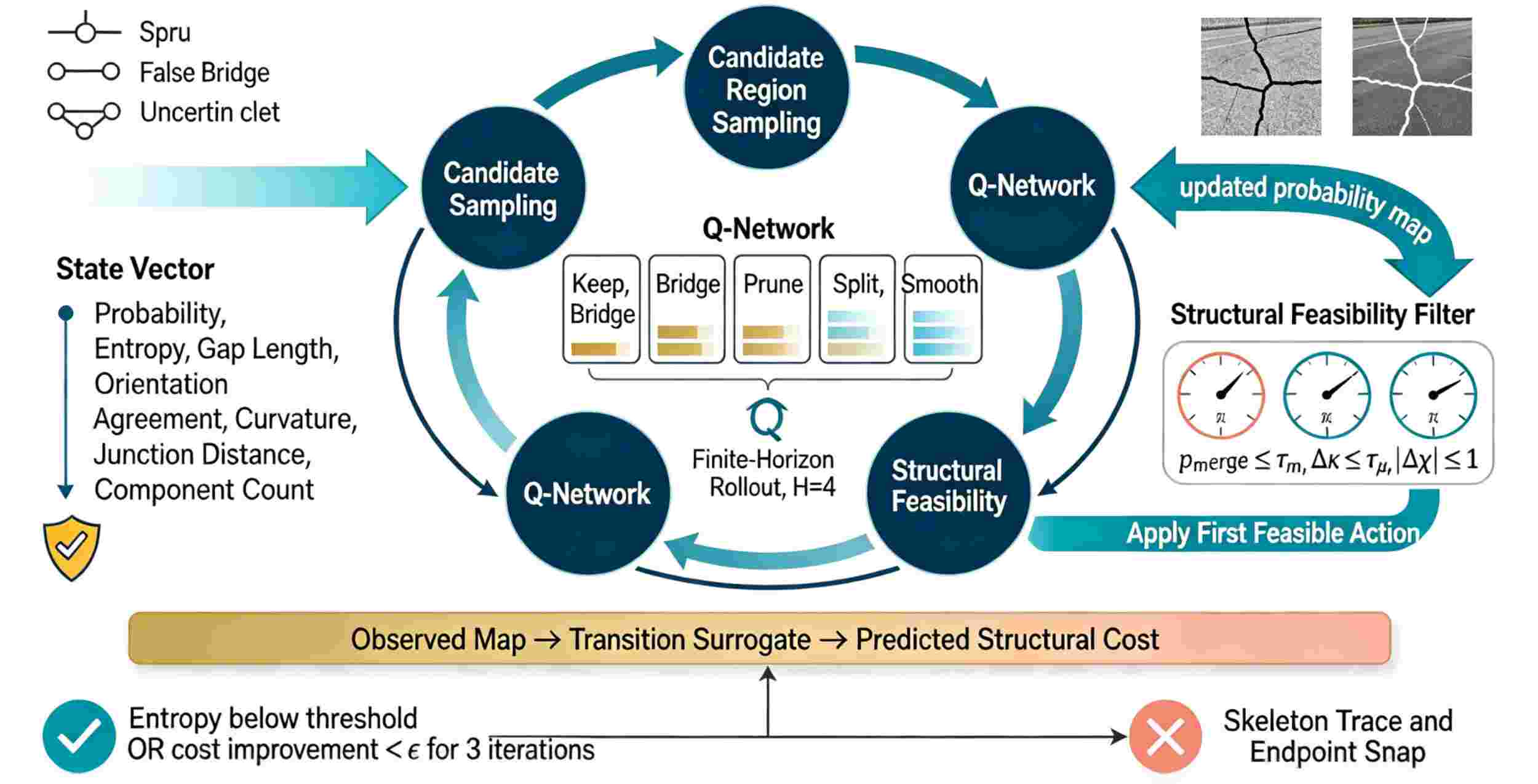
Robust grain-boundary parsing needs local edge sensitivity and, at the same time, should have long-range contour consistency. This paper introduces SPF-QMPc, a structure-preserving feature fusion network combined with a Q-learning controller and a finite-horizon model predictive correction module. Topology-aware gates are used to align multiscale intensity, orientation and junction features, and an initial boundary map is obtained in which weak but coherent segments can still be recovered. The controller describes uncertain areas with probability, entropy, curvature, component count and junction proximity, then selects bridge, prune, split, smooth or keep actions. Predictive Control rejects actions that cause the predicted trajectory to violate the false-merge, curvature or topology constraints. Evaluation used 2,400 specimen-separated microscopy patches of the three classes of metallic materials and multiple imaging disturbances. SPF-QMPc achieves 93.6% boundary F1, 90.8% intersection-over-union, a 1.26-pixel symmetric boundary distance and a 1.84-pixel junction error. Reduce contour breaks by 42.7% compared to the strongest baseline, maintain an F1 of 89.7% at a 15 dB signal-to-noise ratio, and process a 512×512 image in 47 ms. Grain-size distributions derived from the contours have a 2.1 μm Wasserstein distance to the manual measurements. Based on the above results, adaptive editing selection and constraint prediction can improve boundary localization and network connectivity without sacrificing inference speed.
Downloads
Published
How to Cite
Issue
Section
License
Copyright (c) 2023 Marko Kovač, Tomislav Petrović, Stjepan Vuković

This work is licensed under a Creative Commons Attribution-NonCommercial-ShareAlike 4.0 International License.