Cluster Consistency Constrained Informer Model for Long-Term Battery Health Prediction in Energy Storage Stations
DOI:
https://doi.org/10.64972/jaat.2024v2.345p37e:511-526Keywords:
Battery Health Estimation, Cluster Consistency, Long-Sequence Informer, Degradation-Stress AttentionAbstract
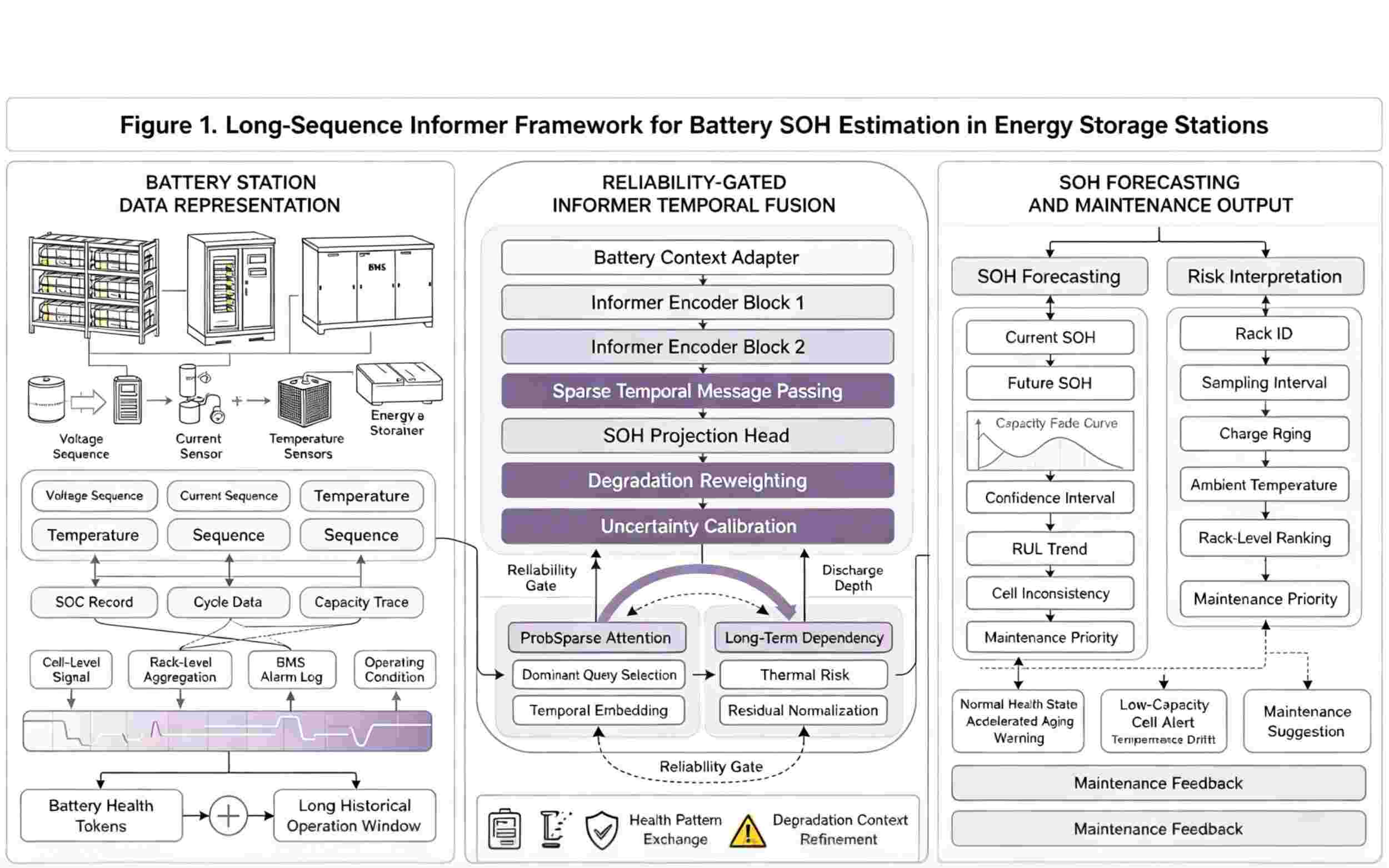
Numerous battery packs and clusters operating under different current, temperature, and ageing conditions are found in the energy storage systems. In these situations, the battery state-of-health's long-term deterioration and pack-to-pack variability must be taken into account for estimate. This research proposes a cluster-aware long-sequence Informer model for battery SOH estimation in energy storage facilities. The model includes degradation-stress sparse attention and consistency-constrained estimate after reconstructing degradation sequences from voltage, current, temperature, capacity, internal resistance, charge-discharge depth, and operational stress variables. The suggested model obtained 0.82% MAE, 1.17% RMSE, and 0.974 R² in experiments based on station-level battery operating data; concurrently, the cross-cluster SOH dispersion error was lowered by 23.6% in comparison to the conventional Informer. The findings demonstrate how long-sequence attention may increase SOH estimation accuracy under challenging energy storage operating settings and solve the issue of slow-degradation trends.
Downloads
Published
How to Cite
Issue
Section
License
Copyright (c) 2024 Elżbieta Nowosad, Genowefa Pacholska, Stefania Wioletta Gajewska

This work is licensed under a Creative Commons Attribution-NonCommercial-ShareAlike 4.0 International License.