Critic-Guided Diffusion Policy for Stable and High-Precision Trajectory Generation in Contact-Dense Robotic Polishing
DOI:
https://doi.org/10.64972/jaat.2024v2.344p36e:497-510Keywords:
Robot Polishing, Contact-Dense Manipulation, Actor-Critic Learning, Trajectory Generation, Force ControlAbstract
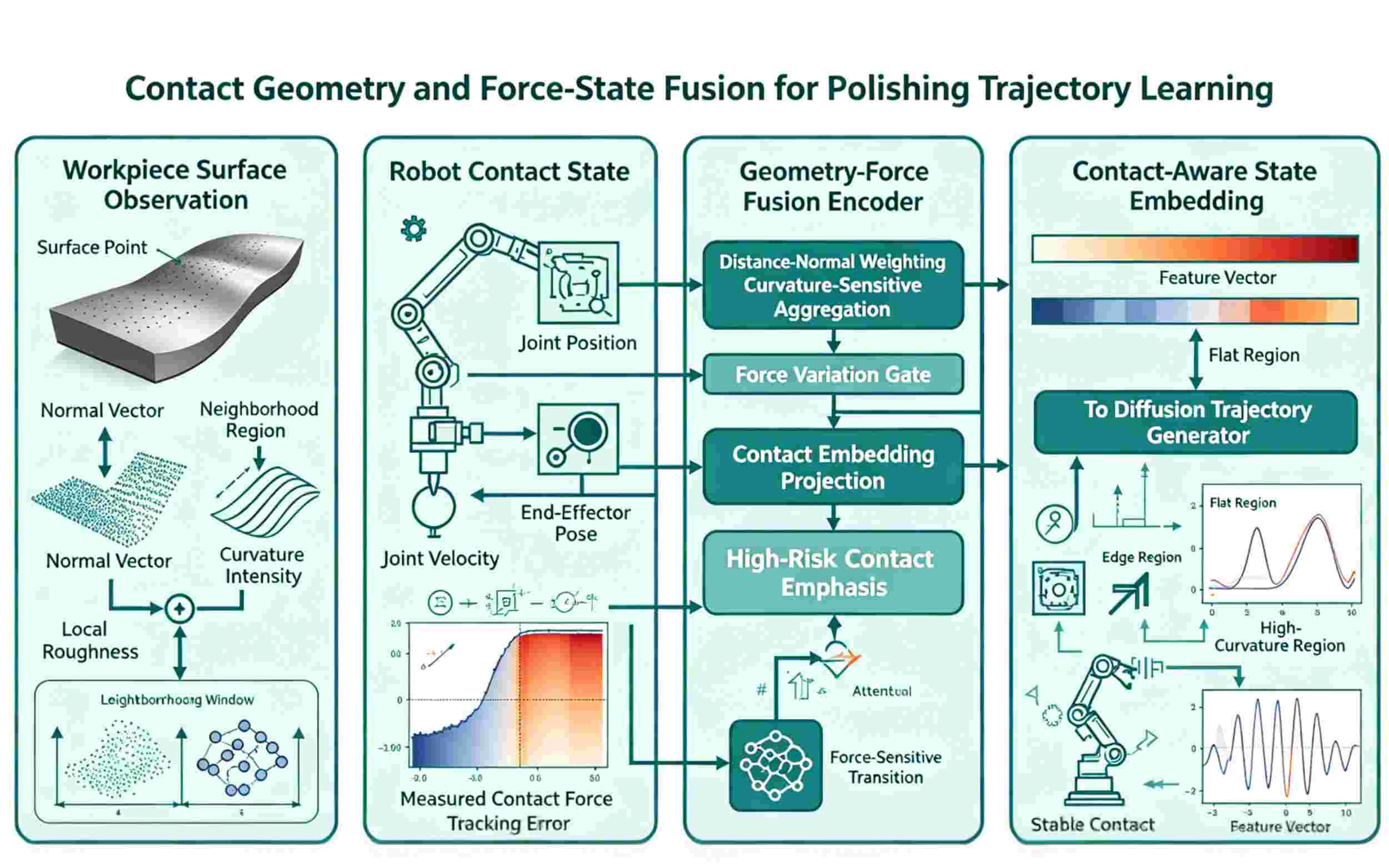
A trajectory generating technique that can provide stable tool-surface contact on a curved surface with varying local roughness, force variations, and uncertainty in the polishing region is necessary for contact-dense robotic polishing. The majority of conventional planning techniques rely on set force-control principles or geometric templates, and thus are not particularly reliable when there are concave transitions, thin edges, or uneven surface material removal needs. This work proposes a DiffusionActor-Critic model for contact-dense robot polishing trajectory creation. A diffusion generator creates different candidate trajectories, an actor-critic module evaluates contact stability, polishing coverage, and motion smoothness, and the approach formulates polishing as a restricted sequential choice problem. In order to suppress physically unstable trajectory samples before to execution, a contact-state encoder combines surface curvature, force feedback, tool posture, local roughness and polishing history, and critic-guided denoising. Comparing the suggested approach to strong reinforcement learning and diffusion policy baselines, quantitative analysis reveals that it has improved surface coverage to 96.8%, decreased the average normal-force error to 2.7 N, and decreased the contact-loss frequency by 38.4%. The findings demonstrate that a practical trajectory generating technique for high-precision robotic polishing with dense contact is provided by critic-guided diffusion sampling.
Downloads
Published
How to Cite
Issue
Section
License
Copyright (c) 2024 Weronika Czarnecka, Emilia Barańska

This work is licensed under a Creative Commons Attribution-NonCommercial-ShareAlike 4.0 International License.