Low-Latency LiDAR Perception Based on Point Transformer-Voxel Model for Underground Robot Autonomous Obstacle Avoidance
DOI:
https://doi.org/10.64972/jaat.2024v2.342p34e:470-483Keywords:
Sparse Voxel Perception, Underground Robot Navigation, Collision-Risk Estimation, Embedded LiDAR InferenceAbstract
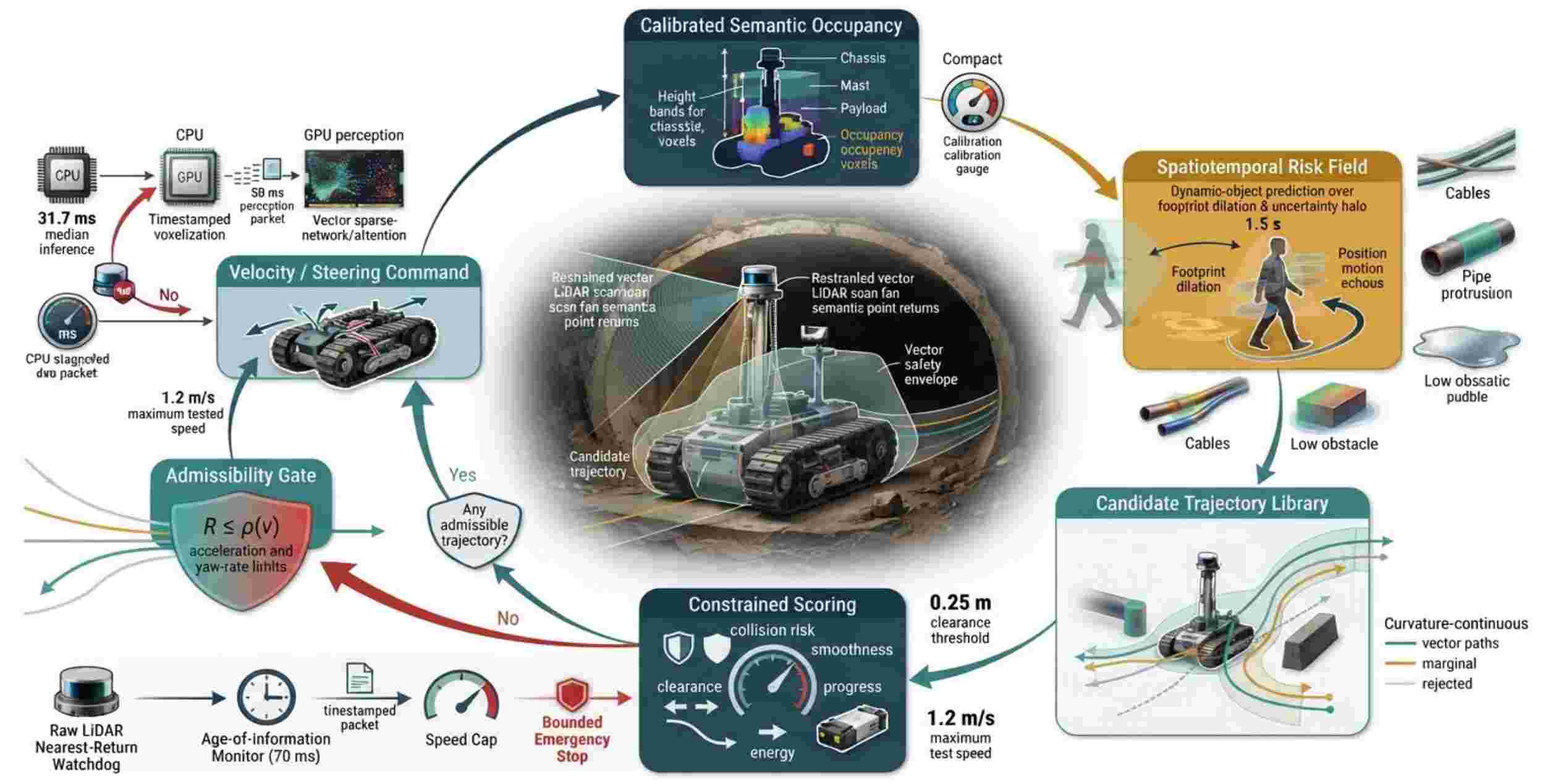
Underground corridors have repetitive geometry, weak illumination, airborne dust and narrow clearances, and are thus unreliable for image-only obstacle perception. This paper introduces a geometry-first point transformer-voxel network that voxelizes streaming LiDAR data, uses neighborhood attention to recover local boundary details, and combines calibrated collision probabilities with a speed-aware local controller. Tests on 18.6 km of tunnel runs and 42,000 labelled frames show a mean intersection-over-union of 74.8%, a small-obstacle recall of 92.6% and an end-to-end latency of 31.7ms on an embedded GPU. At a speed of 1.2 m/s, the robot has completed 97.8% of the routes without collision and outperformed the strongest compact baseline by 4.9%, reducing perception energy by 18.3%. Based on the above evidence, sparse voxel context and point-level refinement are complementary in the context of latency and memory constraints for underground inspection.
Downloads
Published
How to Cite
Issue
Section
License
Copyright (c) 2024 Paulina Ziemba, Irena Sadlak, Olga Gnatowa

This work is licensed under a Creative Commons Attribution-NonCommercial-ShareAlike 4.0 International License.