Mamba-TSMixer Model for Tool Chatter Prediction Based on Spindle Acoustic Emission Signal Fusion
DOI:
https://doi.org/10.64972/jaat.2024v2.341p33e:456-469Keywords:
Time-Series Modeling, Mamba Network, TSMixer, Acoustic Emission, Predictive ManufacturingAbstract
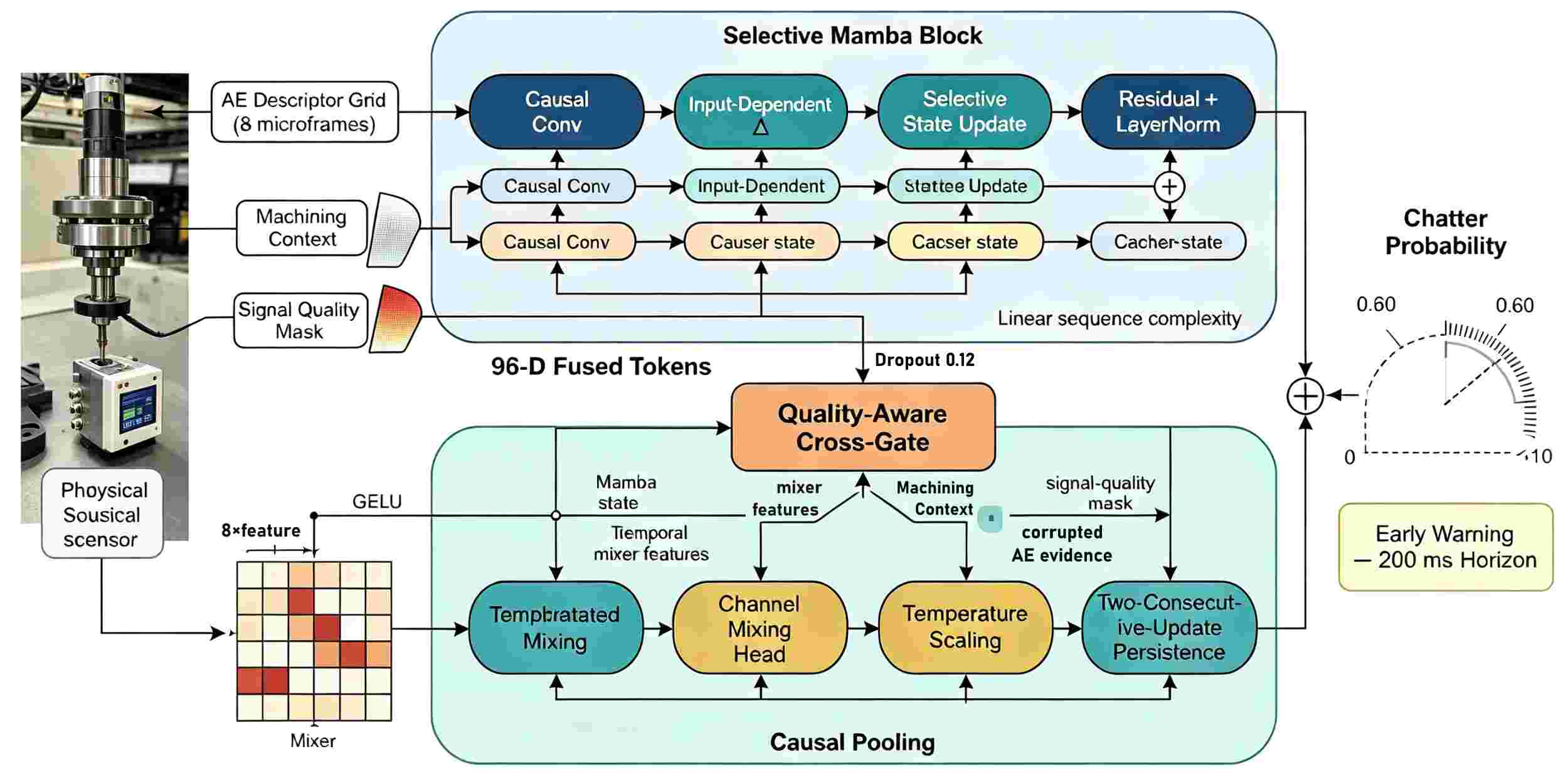
Reliable warning of regenerative chatter is still an issue because spindle speed, engagement and tool wear change the observable vibration signature. Develop a causal Mamba-TSMixer model in this paper that integrates spindle-mounted acoustic-emission data with rotational and process context for horizon-based chatter prediction. Raw emission signals are converted into synchronous envelope, impulsiveness, spectral and order-aware descriptors. A selective state-space path retains the extended-time dependency; a temporal-channel mixer handles local cross-feature correlations; and cross-gated fusion avoids context-inconsistent emission bursts. There are 1,260 milling experiments, five speed ranges, four wear conditions and two unseen-range experiments. At a prediction horizon of 200ms, the model has an F1 score of 0.943 for events, an area under the receiver operating characteristic curve (AUC) of 0.961, and a median warning lead of 184ms. Compared with the best-performing baseline, event F1 is up by 3.8% and false alarms have dropped from 0.31 to 0.18 per cutting minute. Performance is still 0.912 F1 after masking one group of acoustic-emission features, and causal inference needs 1.8ms per update. Ablation shows that selective memory and gated fusion contribute to the gain independently. Run the grouped split and retention speed-wear combinations to further test whether the predictor has exceeded the familiar cutting adjacent window. Based on the above experiments, high-frequency spindle emission can be used as an early warning indicator under different machining conditions, and models have been developed for both long-term and short-term analysis. The constructed structure offers a high-performance platform for the unstable operating environment of real-time monitoring.
Downloads
Published
How to Cite
Issue
Section
License
Copyright (c) 2024 Karolina Tatiana Kuśowa, Ludwik Lupa

This work is licensed under a Creative Commons Attribution-NonCommercial-ShareAlike 4.0 International License.