Interaction-Behaviour-Driven Lancin-Mamba for Trajectory Prediction at Unsignalized Intersections
DOI:
https://doi.org/10.64972/jaat.2024v2.326p31e:427-442Keywords:
Unsignalized Intersection, Trajectory Prediction, Interaction Behavior, Lancin, Mamba, Selective State-space ModelAbstract
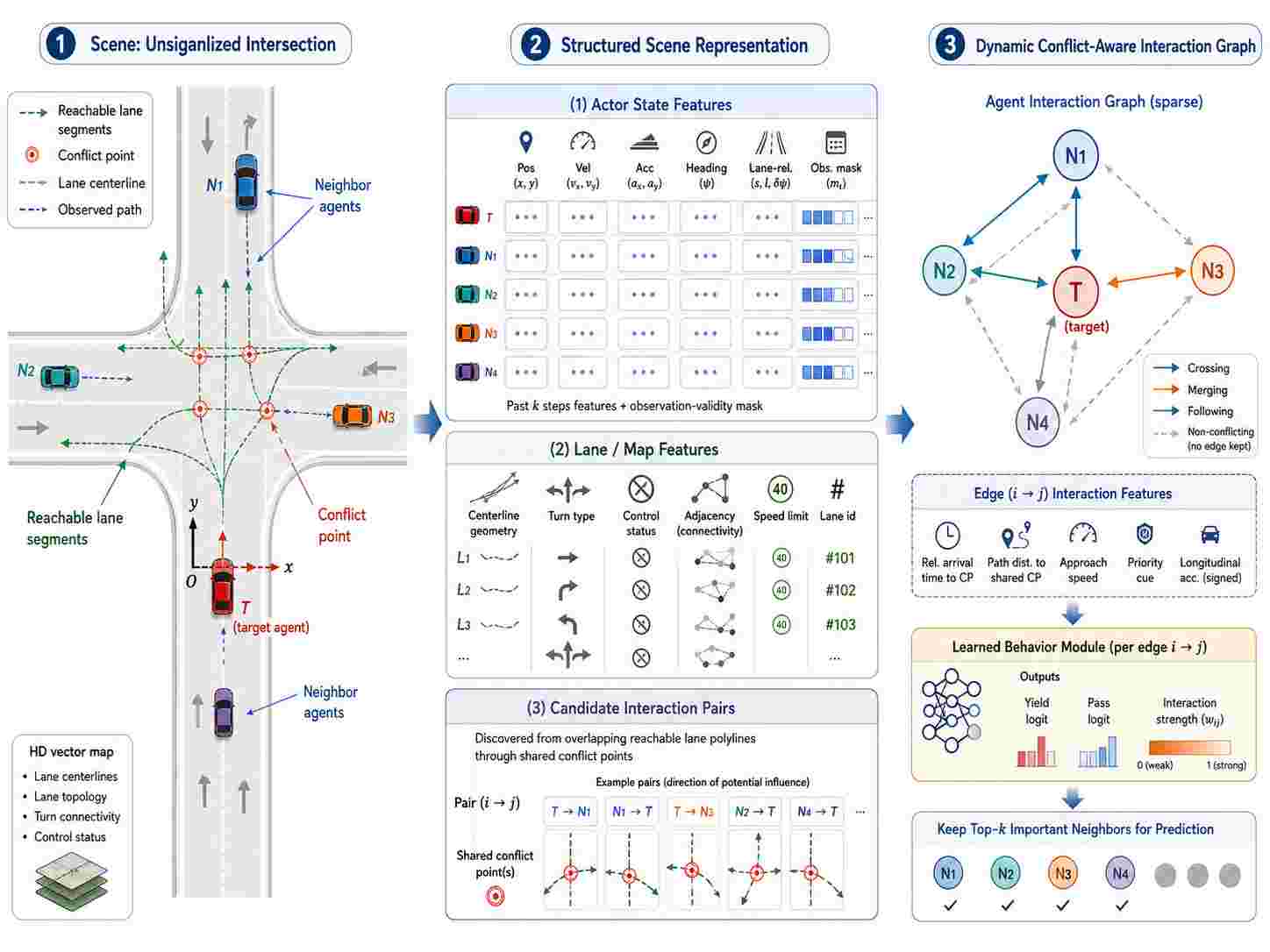
Rather than merely extending individual kinematics, accurate motion forecasting at unsignalized junctions must take into account the reasons behind driver behavior, such as adjusting to priority ambiguity, perceived gaps, and anticipated actions by other drivers. An interaction-behavior-driven Lancin-Mamba model with lane-topology reasoning and selective state-space sequence modeling is presented in this study. First, create a conflict-aware interaction graph based on lane conflict sites, relative arrival times, approach priority, and observed yielding data. Long observation histories are summarized by a bidirectional selective Mamba block without the quadratic temporal penalty of self-attention, and Lancin presents agent-to-lane and lane-to-lane constraints. The multimodal decoder is reduced by the fused representation to produce mode probabilities and route-consistent trajectories. A differentiable conflict loss lowers simultaneous occupancy close to shared conflict spots, while a behavior-consistency goal penalizes futures that deviate from the anticipated yield/pass connection. The suggested model lowers the 6-s minimum final displacement error from 2.31 m to 1.92 m and the miss rate from 13.8% to 10.4% when compared to a strong Lancin baseline, according to experiments conducted on a controlled unsignalized-intersection benchmark with packed, moderate, and sparse traffic regimes. maintained scene delay at 31.7 ms while reducing the anticipated conflict frequency by 28.6%. The explicit interaction edges are responsible for the greatest increase in accuracy, whereas selective state-space temporal modeling is responsible for the greatest efficiency gain. Based on the aforementioned tests, a tiny predictor for planning-oriented intelligent vehicle systems can incorporate both structured map context and behavioral negotiation.
Downloads
Published
How to Cite
Issue
Section
License
Copyright (c) 2024 Oliver Jõgi, Taavi Rannik, Egert Võsa

This work is licensed under a Creative Commons Attribution-NonCommercial-ShareAlike 4.0 International License.