Data-Augmented Diffusion Modeling for Safety Assessment in Human–Robot Collaborative Assembly Workstations
DOI:
https://doi.org/10.64972/jaat.2024v2.323p28e:386-397Keywords:
Diffusion Model, Data Augmentation, Human–Robot Collaboration, Safety Assessment, Rare Event DetectionAbstract
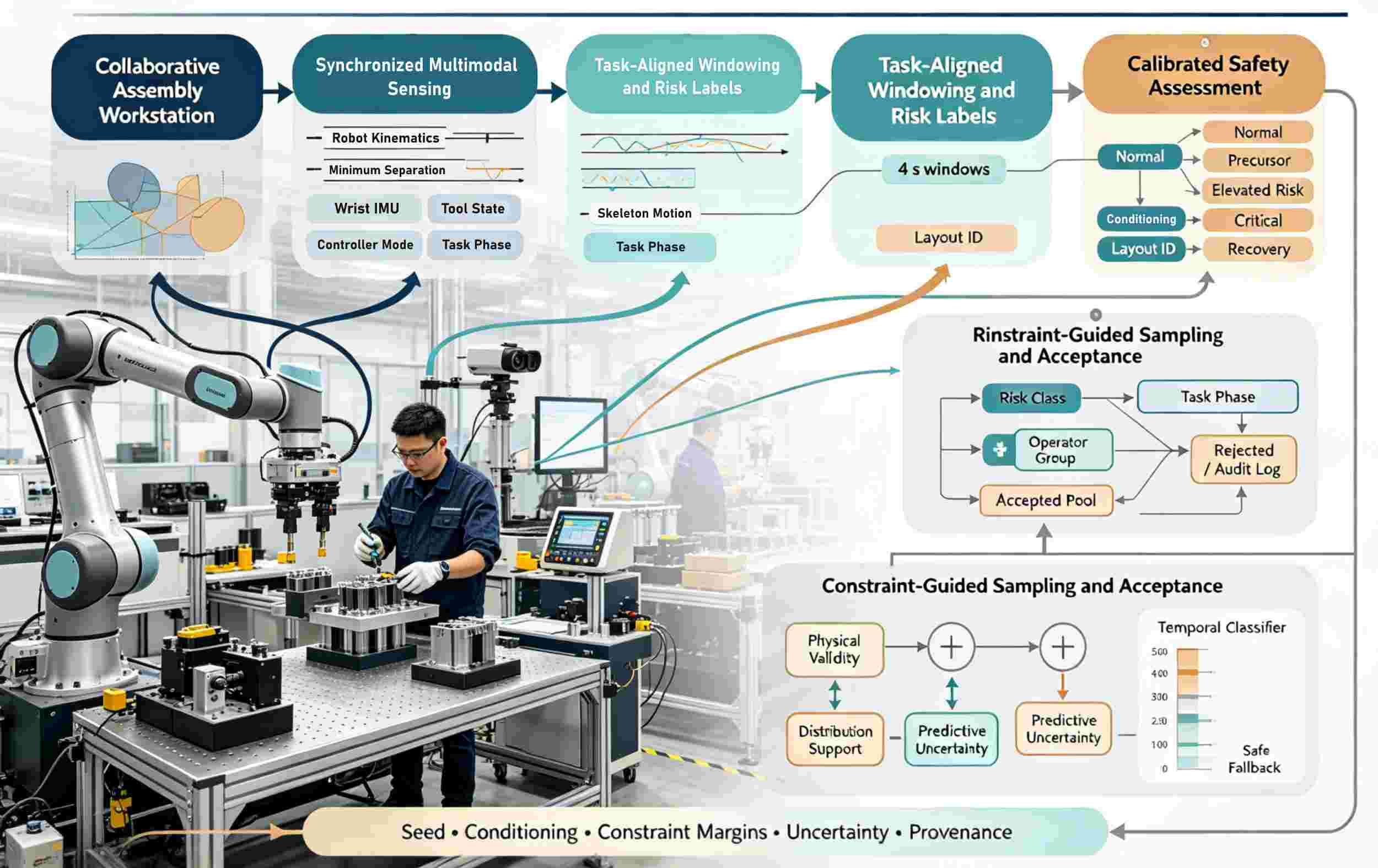
Reliable safety assessment for human-robot collaborative assembly workstations faces problems such as severe class imbalance, sensor heterogeneity, and a lack of ethically recorded hazardous events. This paper presents a risk-conditioned diffusion model that extends the synchronized kinematic, proximity, ergonomic and control-state sequences without violating physical safety constraints. The model integrates risk stratification conditions, constraint-guided denoising, temporal consistency regularization, and uncertainty-aware sample filtering. Experiments use 18,640 observed windows from a collaborative fastening and inspection cell and 31,200 accepted synthetic windows. Augmentation increased the macro-F1 from 0.821 to 0.902 compared with training on observed data alone, raised critical-event recall from 0.714 to 0.893, and reduced expected calibration error from 0.087 to 0.036. Given a fixed false-alarm rate of 5%, the proposed assessment identifies 91.6% of high-risk windows and is 8.9% higher than the conditional adversarial baseline. Ablation results show that without constraint guidance, physically invalid samples increased from 1.8% to 12.7%, and uncertainty filtering added 3.4 percentage points to the macro-F1 score. Diffusion-based augmentation can increase the sensitivity of rare-event detection while maintaining operational feasibility and calibrated confidence; thus, an auditable data-centric pathway for workstation safety evaluation has been established.
Downloads
Published
How to Cite
Issue
Section
License
Copyright (c) 2024 Haruki Tanaka, Kaito Yamamoto, Daiki Yamada, Yi-hsuan Chiu, Shu-yu Peng

This work is licensed under a Creative Commons Attribution-NonCommercial-ShareAlike 4.0 International License.