DeepONet-Kalman Modeling for Real-Time Parameter Updating in Compressor Digital Twins
DOI:
https://doi.org/10.64972/jaat.2024v2.322p27e:374-385Keywords:
Digital Twin, DeepONet, Kalman Filtering, CompressorAbstract
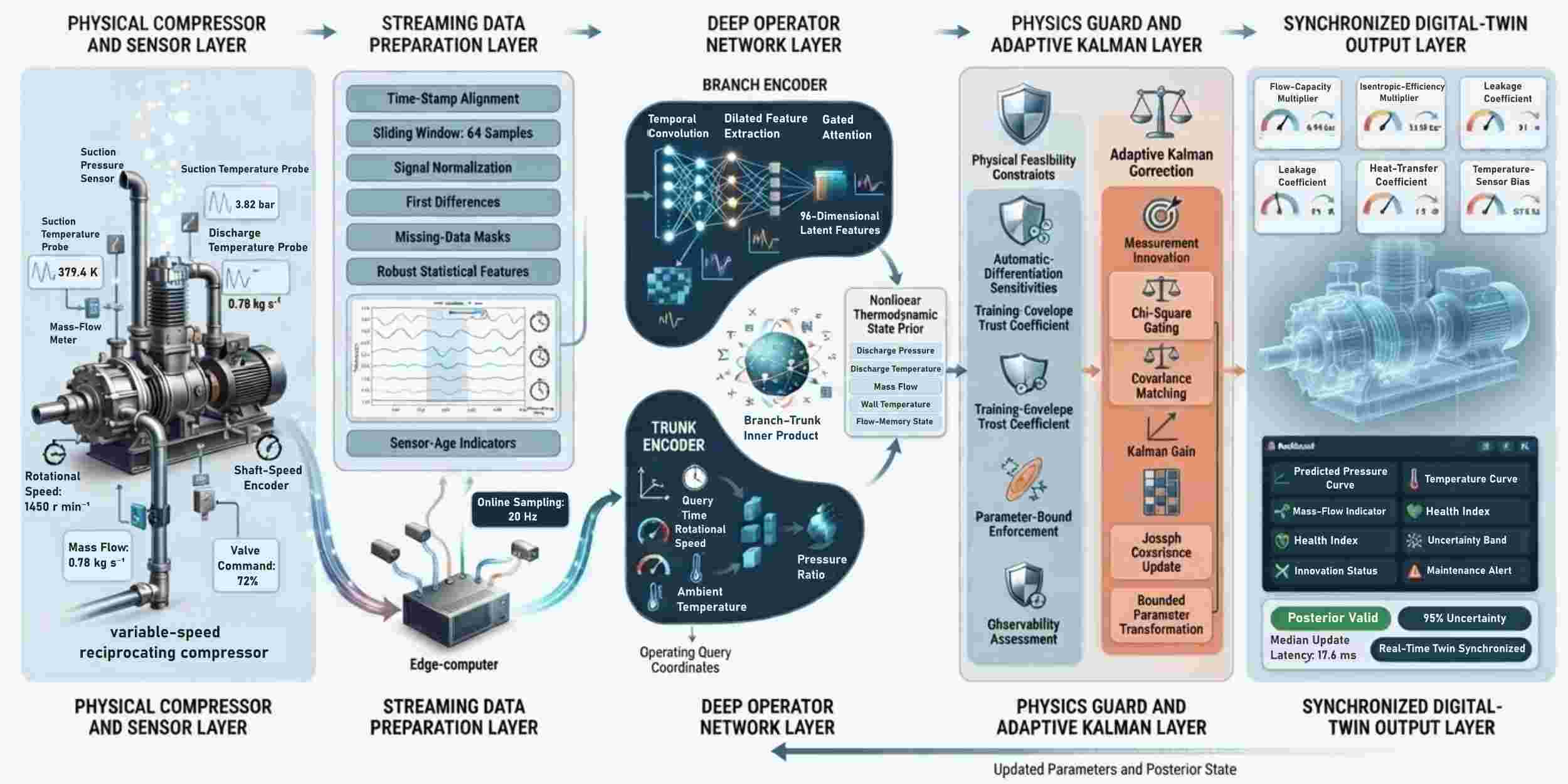
Compressor digital twins need to rapidly adjust parameters when fouling, clearance change, sensor bias or load transients occur and the nominal model is no longer valid. A DeepONet-Kalman model is presented in this paper to separate nonlinear operator prediction from covariance-aware measurement assimilation. A branch encoder receives a sliding window of pressure, temperature, rotational speed, valve command and flow signals, and a trunk encoder queries the state at the current operating coordinate. The latent product is the predicted output of the compressor. An adaptive extended Kalman layer then updates the flow-capacity, thermal-efficiency, leakage, heat-transfer and sensor-bias parameters based on innovation statistics and bounded covariance inflation. Experiments use a physics-consistent variable-speed compressor simulator with 42 operating sequences, 1.26 million samples, four degradation patterns, two disturbance families, and controlled sensor corruption. The proposed model has achieved a 0.72% pressure error, a 0.88% discharge-temperature error and a 2.6% mean parameter error, and is better than the strongest recurrent baseline at 1.34%, 1.57% and 5.9% respectively. Median online latency is 17.6 ms per update, and 94.1% of the measured states fall within the predicted 95% uncertainty interval. According to the ablation experiments, innovation-conditioned covariance adaptation is required to deal with sudden fouling and bias generation. Based on the above results, neural operator inference and recursive statistical correction can be used to achieve accurate, stable and computationally feasible real-time updates of compressor digital twins.
Downloads
Published
How to Cite
Issue
Section
License
Copyright (c) 2024 Nathan Roux, Clément Lambert, Mathéo Masson

This work is licensed under a Creative Commons Attribution-NonCommercial-ShareAlike 4.0 International License.