A Temporal-Consistency-Enhanced BiLSTM Method for Photovoltaic Power Forecasting in Distributed PV Stations
DOI:
https://doi.org/10.64972/jaat.2024v2.316p26e:361-373Keywords:
BiLSTM, Temporal Consistency, Photovoltaic Power Forecasting, Distributed PV Stations, Renewable Energy DispatchAbstract
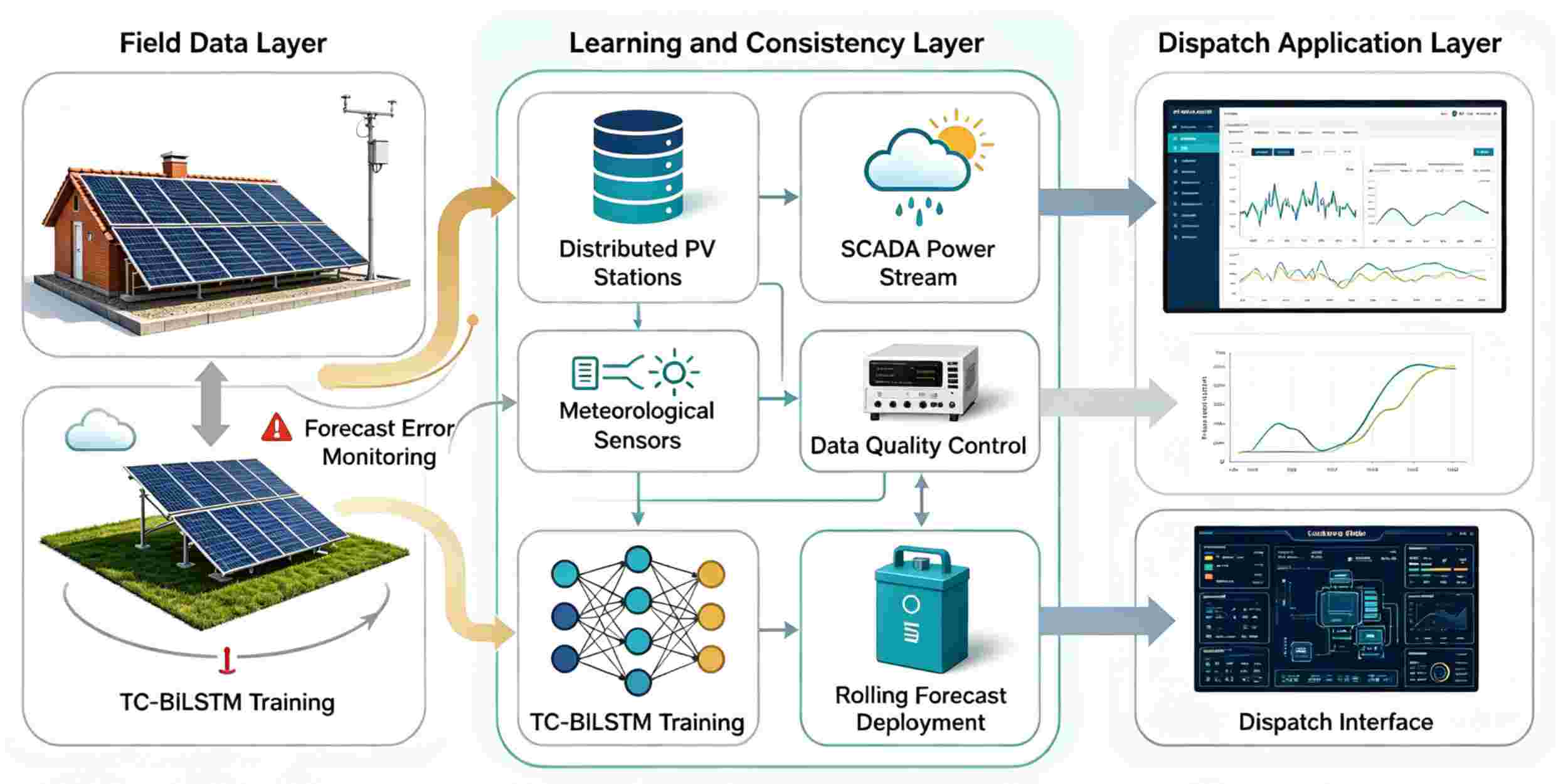
Distributed photovoltaic stations are increasingly operated as dense, weather-sensitive generation clusters, yet their short-term power forecasts often contain discontinuous ramps that are inconsistent with plant physics and recent temporal evolution. This paper proposes a temporal-consistency-enhanced bidirectional long short-term memory method, termed TC-BiLSTM, for 15-min-ahead to 4-h-ahead photovoltaic power forecasting in distributed PV stations. The method integrates normalized station measurements, meteorological variables, solar-position descriptors, and historical ramp features into a two-stream BiLSTM encoder. A compact consistency module then constrains adjacent forecast horizons by combining ramp-aware smoothness, irradiance-response monotonicity, and capacity-normalized error terms. Experiments are organized on a multi-station dataset containing 38 distributed PV stations, 18 months of operation, 96 daily sampling points, and four weather categories. Compared with persistence, SVR, CNN-LSTM, vanilla LSTM, and standard BiLSTM baselines, TC-BiLSTM reduces RMSE from 8.74% to 6.58% of installed capacity, decreases MAE from 5.21% to 3.91%, and improves ramp-event F1-score from 0.704 to 0.823. The gain is most visible on partly cloudy days, where the average ramp error falls by 22.6%. The results indicate that temporal consistency is a practical regularization principle for distributed PV forecasting because it improves point accuracy while producing smoother and more dispatchable forecast trajectories.
Downloads
Published
How to Cite
Issue
Section
License
Copyright (c) 2024 Rasha Al-Qarni, Zuhaira Al-Buainain, Obeida Al-Zabeidi

This work is licensed under a Creative Commons Attribution-NonCommercial-ShareAlike 4.0 International License.