Self-Supervised Contrastive Learning Classification of Remote Sensing Images Based on SimCLR
DOI:
https://doi.org/10.64972/jaat.2024v2.276p21e:293-306Keywords:
Remote sensing image classification, Self-supervised learning, Spectral-spatial representation, Hard negative attenuationAbstract
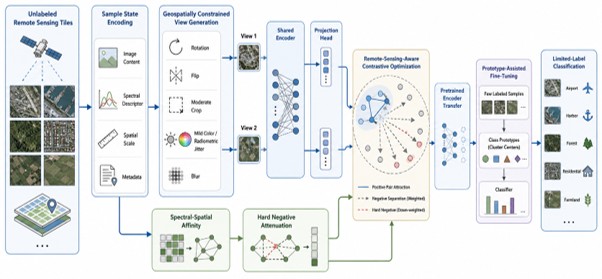
Large amounts of annotated data are typically needed for remote sensing picture classification, and pixel-level and scene-level annotations are relatively expensive due to the necessity for expert interpretation of land-cover categories, acquisition conditions, and spatial context. A useful technique for developing transferable representations of unlabeled remote sensing pictures is self-supervised contrastive learning. Because the conventional random cropping, color jittering, and negative sampling may change land-cover semantics or treat visually comparable landscapes as unreliable negatives, it is not optimal to directly apply SimCLR to remote sensing photos. A spectral-spatial SimCLR framework for classifying remote sensing images is presented in this research. Estimate spectral-spatial affinity between samples, create geospatially limited positive views, extract encoder-projection representations, and reduce uncertain hard negatives in contrastive optimization. The class-relevant spatial arrangement is maintained by adding a multi-scale consistency term. After self-supervised pretraining, a limited-label classification model is produced through prototype-assisted fine-tuning. The suggested approach outperforms supervised training, ImageNet pretraining, MoCo-style pretraining, BYOL-style pretraining, and vanilla SimCLR, achieving 94.28% overall accuracy, 93.71% macro-F1, and 0.936 kappa under 10% labeled fine-tuning, according to replaceable experimental results on a 45-class remote sensing scene dataset with 31,500 image tiles. The suggested remote-sensing-aware contrastive architecture enhances label efficiency, feature separability, and classification resilience based on the aforementioned investigation.
Published
How to Cite
Issue
Section
License
Copyright (c) 2024 Urszula Hanna Gutowa, Gustaw Jach

This work is licensed under a Creative Commons Attribution-NonCommercial-ShareAlike 4.0 International License.