A Joint Model Predictive Control and Deep Neural Network Optimization Approach for Smooth Trajectory Tracking of Tiltrotor Transition
DOI:
https://doi.org/10.64972/jaat.2024v2.275p20e:279-292Keywords:
Intelligent Control, Deep Learning, Trajectory Tracking, Predictive OptimalityAbstract
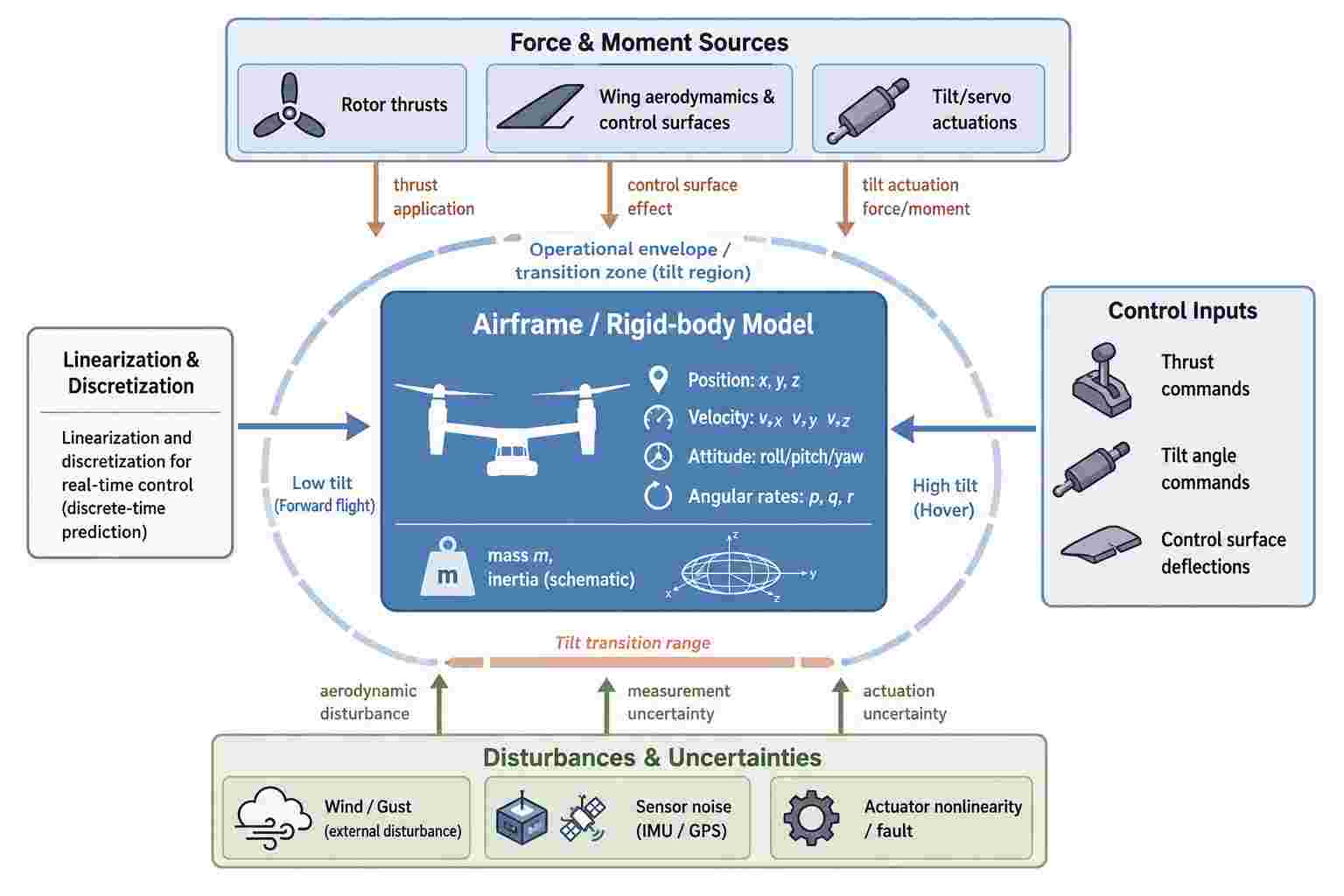
Although tiltrotor aircraft are designed to combine the energy-efficient, high-speed cruise of fixed-wing aircraft with the agility of vertical takeoff and landing, their trajectory tracking capability during a rapid-mode transition is not optimal. The initial model-based controllers are no longer appropriate due to the addition of significant disturbances and complex non-linearities during these times. In order to provide steady, high-precision trajectory tracking over the whole transition range, this research presents a new framework that combines model predictive control with a deep neural network. A neural network module is utilized to learn unmodeled dynamics adaptively and compensate for time-varying uncertainties online, while a real-time optimization procedure ensures constraint satisfaction and predictive optimality for the model predictive controller. MPC and PID controllers have been considerably outperformed in high-fidelity simulations of a calibrated six-degree-of-freedom tiltrotor platform under various wind conditions, actuator nonlinearities, and sensor disturbances. The MPC-DNN approach can lower tracking error, speed up disturbance rejection, lessen control input variations, and increase energy efficiency, as seen by the data above. It is comparatively steady and resilient to some outside influences, according to statistical study. Based on the aforementioned findings, the MPC-DNN joint approach has been used to offer theoretical and practical support for the upcoming generation of unmanned aerial vehicles (UAVs) and is appropriate for resolving the issue of intelligent flight control in complicated situations.
Downloads
Published
How to Cite
Issue
Section
License
Copyright (c) 2024 Gabriela Górska, Beata Cicha, Elżbieta Zosia Szymańska

This work is licensed under a Creative Commons Attribution-NonCommercial-ShareAlike 4.0 International License.