Hybrid Quantum-Inspired Algorithm for Optimizing Fuel Efficiency of Autonomous Vehicle Fleets
DOI:
https://doi.org/10.64972/jaat.2024v2.273p19e:263-278Keywords:
Autonomous Vehicle Fleet, Fuel Efficiency Optimization, Quantum-Inspired Algorithm, Intelligent Transportation, Cooperative DrivingAbstract
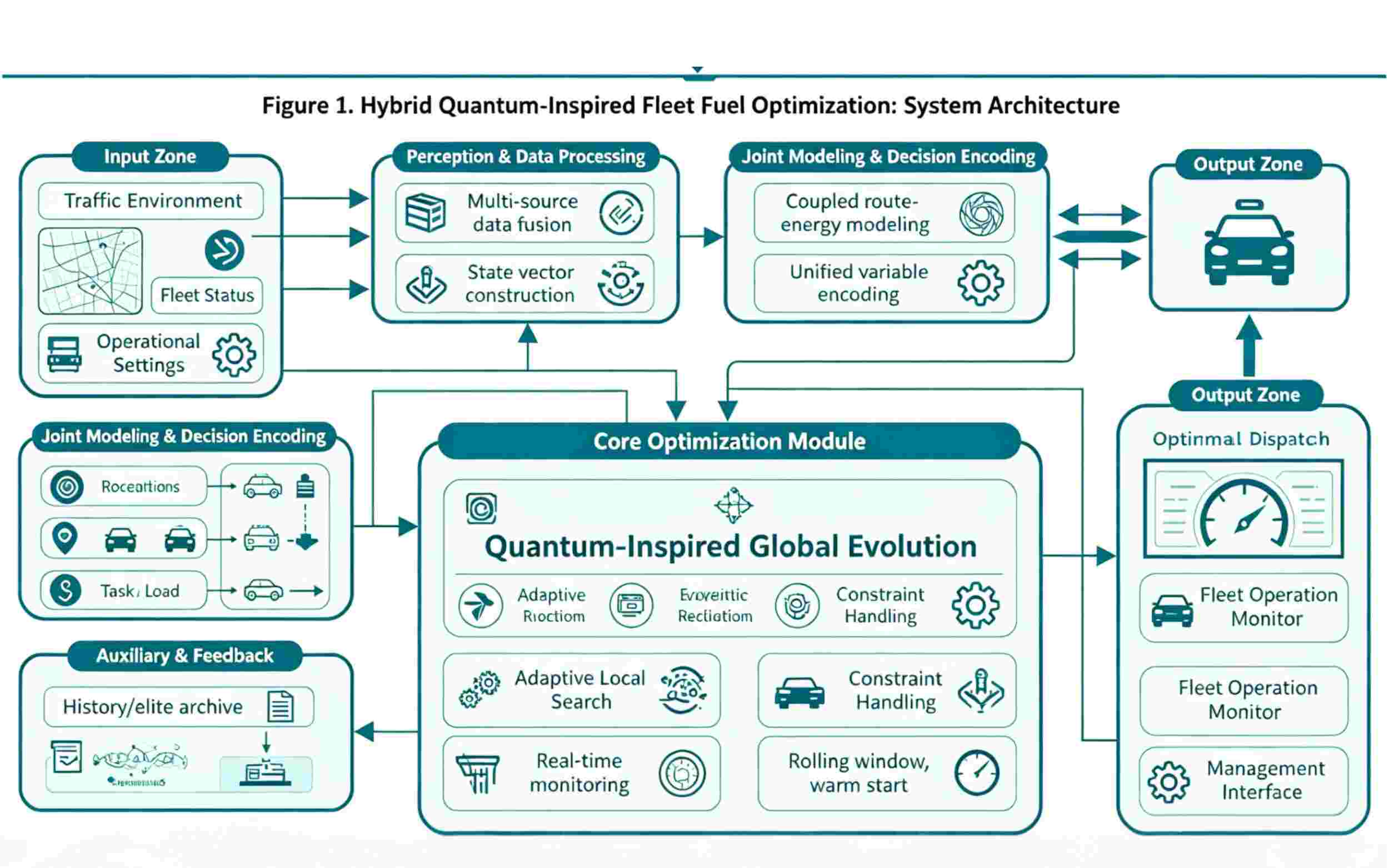
Fuel Efficiency Optimization for Autonomous Vehicle Fleets is a challenge in intelligent transportation systems with dynamic traffic, different vehicle states, unpredictable road conditions, and cooperative driving limitations. Conventional fleet optimization techniques are less appropriate for large-scale, non-linear, and multi-objective decision problems because they often use deterministic routes or local control rules. A hybrid quantum-inspired method for autonomous fleet fuel-efficiency optimization is presented in this research. This approach consists of four parts: cooperative velocity planning, adaptive route-energy coupling, quantum-inspired population encoding, and local search refinement. Fuel consumption, trip time, vehicle load, distance between vehicles, traffic congestion, and route assignment are all taken into account simultaneously via a fleet-level optimization framework. Mixed-road, urban, and arterial scenarios have all been simulated. When compared to the conventional genetic and particle swarm optimization baselines, the new approach decreased the average fuel consumption by 12.8%, the total fleet energy cost by 9.6%, and the convergence speed by 15.3%. According to the analysis, quantum-inspired search algorithms can enhance the fleet of intelligent vehicles' autonomy and offer strong computational support for environmentally friendly intelligent transportation.
Downloads
Published
How to Cite
Issue
Section
License
Copyright (c) 2024 Kacper Dmochowski, Eryk Gierak

This work is licensed under a Creative Commons Attribution-NonCommercial-ShareAlike 4.0 International License.