Application of Quantum Path Planning Algorithms in Three-Dimensional Manufacturing
DOI:
https://doi.org/10.64972/jaat.2024v2.270p15e:207-220Keywords:
Quantum path planning, Three-dimensional manufacturing, Additive manufacturing, Hybrid quantum-classical optimization, multi-axis roboticsAbstract
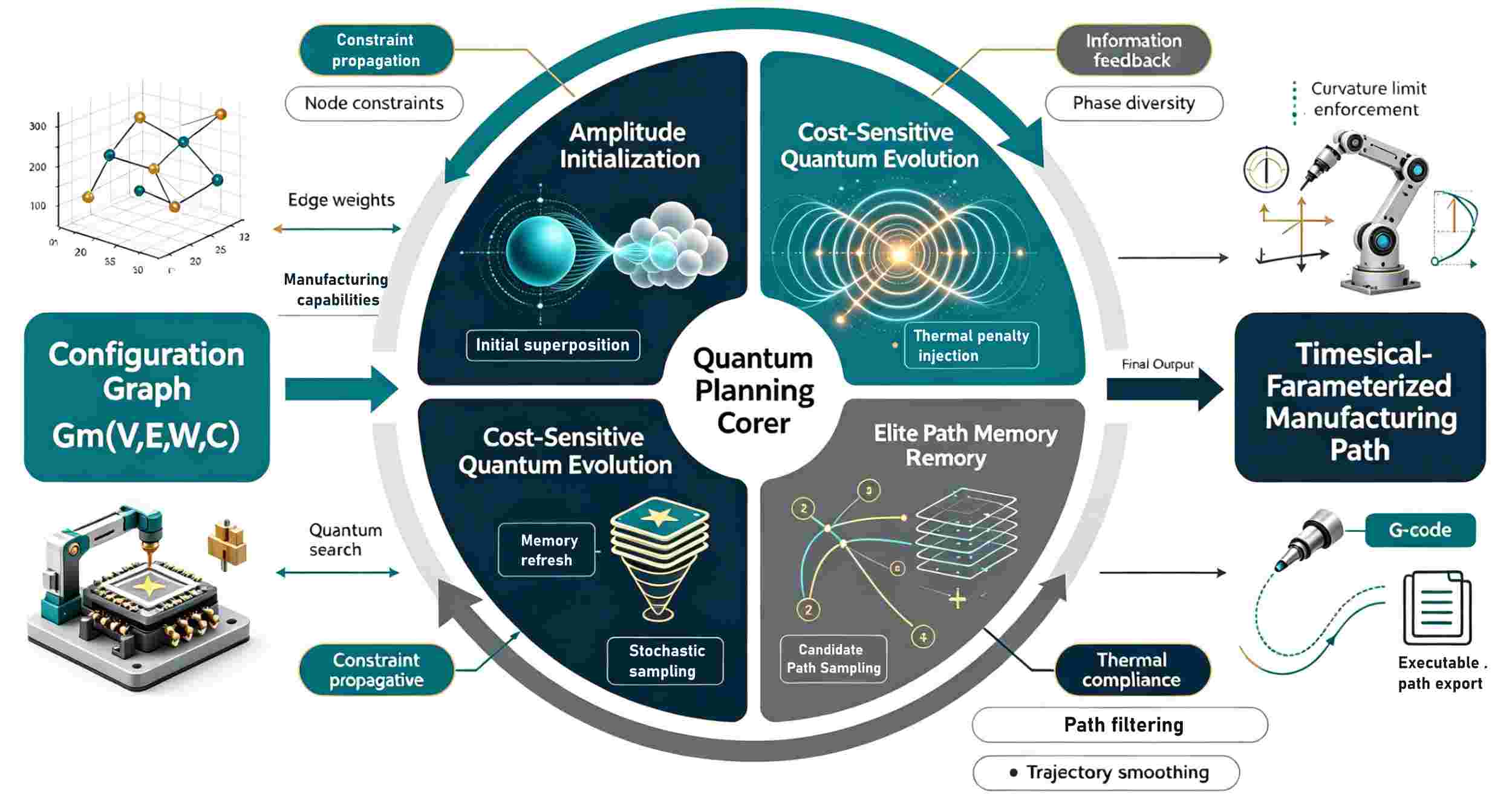
Three-dimensional manufacturing is gradually moving towards high-density toolpath planning, multi-axis motion coordination and closed-loop correction under geometric, thermal and collision constraints. Graph search, sampling-based planning and evolutionary optimisation have all been applied to many practical systems, but they perform poorly when both local build quality and global production efficiency need to be optimised simultaneously. This paper proposes a hybrid quantum path planning algorithm for three-dimensional manufacturing that maps manufacturing states to a weighted configuration graph, uses quantum-inspired amplitude evolution to bias candidate path discovery, and applies classical feasibility restoration to generate executable trajectories. The method is for additive and hybrid manufacturing cells, and the planner needs to consider path length, curvature, support-zone avoidance, temperature accumulation, energy consumption, and machine kinematic limits simultaneously. Four representative parts of the experiment are selected as the cases: lattice, turbine bracket, conformal channel and freeform shell. The proposed method has reduced the mean path cost by 12.8%, shortened the planning time by 34.6%, and lowered the peak thermal deviation by 18.3% compared with A*, RRT*, ant colony optimisation and a genetic planner, while maintaining collision-free manufacturability. Based on the results, quantum path planning can be considered a theoretical acceleration method and may improve the coordination efficiency of complex 3D production in conventional engineering systems.
Downloads
Published
How to Cite
Issue
Section
License
Copyright (c) 2024 Konrad Duch, Borys Gawlikowski, Mieczysław Kaczmar

This work is licensed under a Creative Commons Attribution-NonCommercial-ShareAlike 4.0 International License.