Distributed Quantum Computing Framework for Smart Grid Optimization
DOI:
https://doi.org/10.64972/jaat.2024v2.269p14e:192-206Keywords:
Distributed quantum computing, smart grid optimization, variational quantum algorithm, QUBO, consensus coordination, renewable energyAbstract
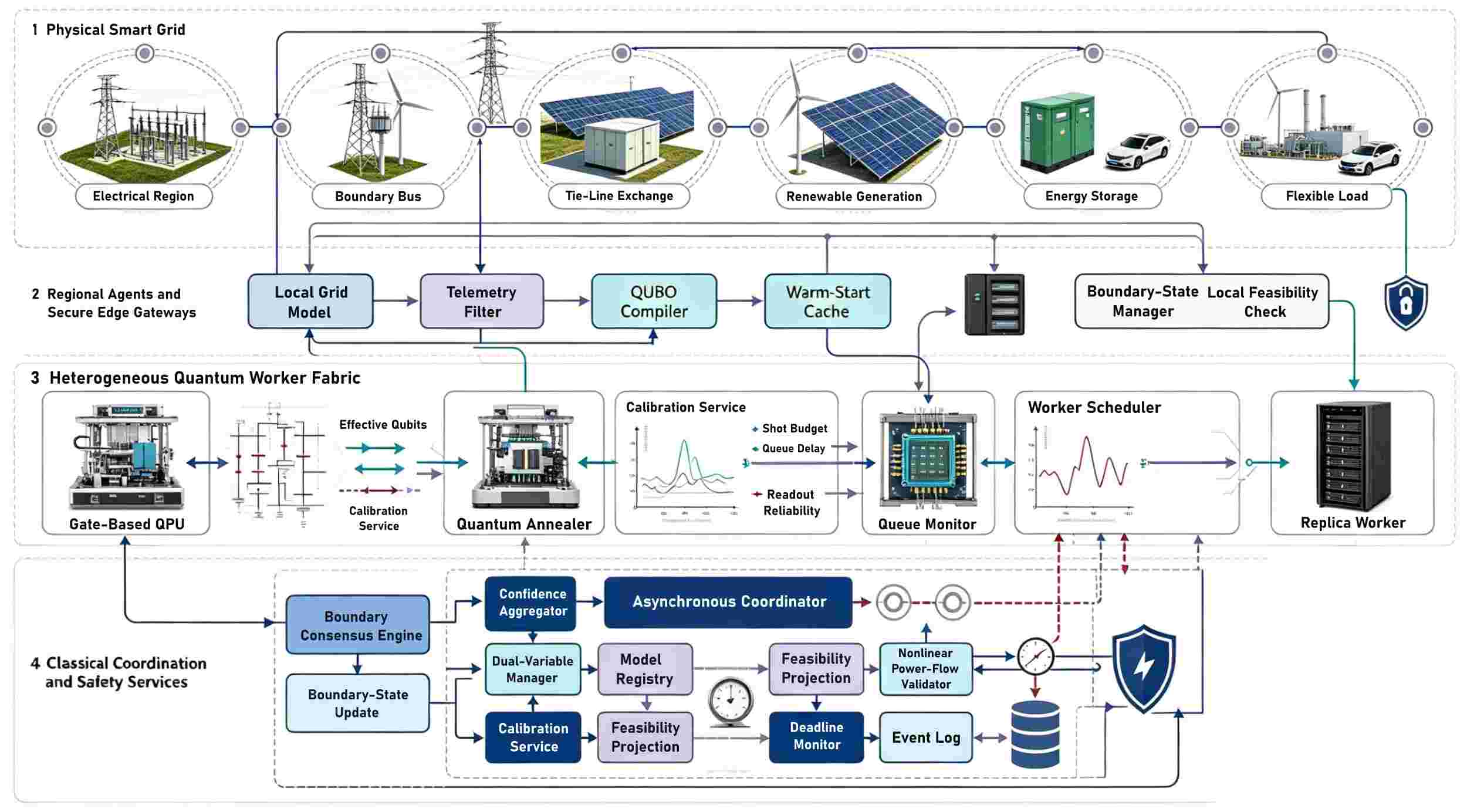
Optimization models for large smart grids need to consider network constraints, renewable energy uncertainty, storage dynamics and flexible demand simultaneously. The mixed discrete-continuous nature of these problems is not suitable for the operational time constraints, and a single quantum processor cannot yet handle real grid instances. A distributed quantum computing framework for an electrical network is proposed in this paper, which divides the network into coupled regions, assigns compact quadratic unconstrained binary optimisation subproblems to heterogeneous quantum workers, and employs an asynchronous classical coordinator to enforce boundary consensus. The four components of the framework are adaptive penalty encoding, warm-started variational circuits, confidence-aware result aggregation and projection-based feasibility repair. A reproducible simulation study is constructed for modified 33-bus, 118-bus, 300-bus and 1354-bus systems with renewable generation, batteries and responsive loads. In all the test cases, the proposed method reduced the operating cost and constraint violation compared with centralised QAOA, quantum annealing, ADMM, and mixed-integer programming under the same time budget. It still performs reasonably well under high worker latency and depolarising noise. Based on the above results, near-term quantum resources will be more credible as coordinated regional accelerators than as a single grid optimizer. Therefore, it will be presented as an engineering architecture, an explicit optimisation map and a multi-metric evaluation system for scalable quantum-assisted smart grid operation.
Downloads
Published
How to Cite
Issue
Section
License
Copyright (c) 2024 Agata Jolanta Jachowa, Ludwik Kłos

This work is licensed under a Creative Commons Attribution-NonCommercial-ShareAlike 4.0 International License.