Quantum Random Walk-Enhanced Framework for Social Network Analysis
DOI:
https://doi.org/10.64972/jaat.2025v3.236p40e:547-560Keywords:
Quantum Computing, Social Network Analysis, Complex Networks, Graph Algorithms, Network DynamicsAbstract
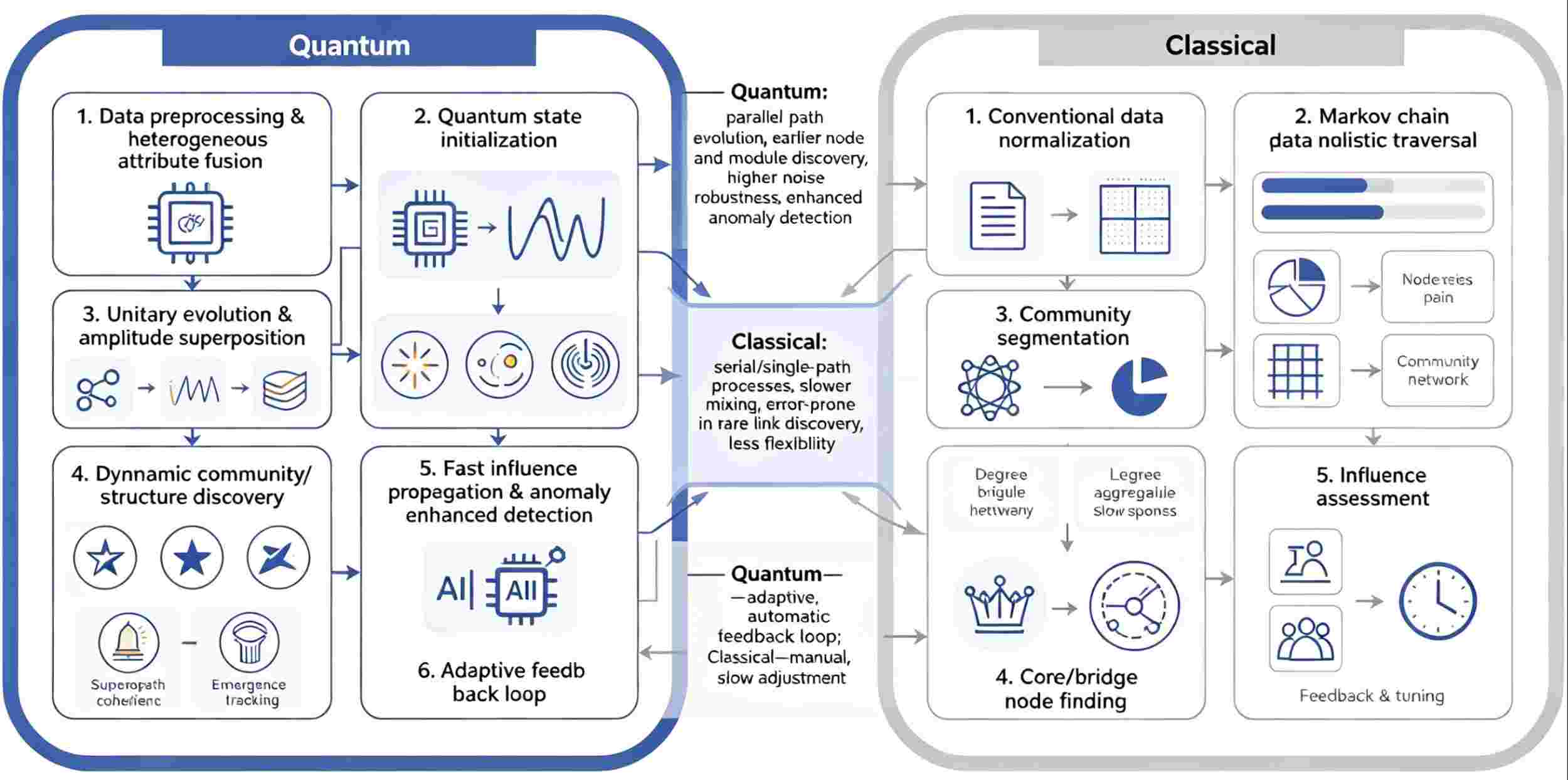
In this research, the computational efficiency of large-scale social network analysis is enhanced by the use of quantum random walk algorithms. The goal of this project is to address the need for high-efficiency centralized analysis of large-scale, heterogeneous social networks, community discovery, and dynamic effect mapping. In a theoretically sound framework of quantum random walks, amplitude superposition and unitary evolution principles have been used to improve both the sensitivity to local and global aspects. The solution uses real social network data with up to 5,000 nodes and more than 60,000 edges, and the testing results demonstrate its excellent scalability and fast convergence. Quantum algorithms have discovered community divisions and cut the mixing time by roughly 2.3 times after multiple optimizations. The performance indicators demonstrate that the above method has greatly improved key node detection accuracy and computation time as compared to the conventional baseline model in noisy situations. According to the aforementioned research, quantum-inspired algorithms have been used to expedite the analysis of large-scale data and reveal hidden structures that are challenging to identify using conventional techniques, such as bridge nodes and core-periphery distributions. The research assist data-driven choices in digital social ecosystems and lay the groundwork for in-depth network analysis.
Downloads
Published
How to Cite
Issue
Section
License
Copyright (c) 2025 Weronika Iga Halikowa, Norbert Głębocki

This work is licensed under a Creative Commons Attribution-NonCommercial-ShareAlike 4.0 International License.