Noise Reduction in Multi-Sensor Systems Using Graph Neural Networks
DOI:
https://doi.org/10.64972/jaat.2025v3.203p15e:188-202Keywords:
Sensor Networks, Data Denoising, Signal Processing, Graph Neural NetworksAbstract
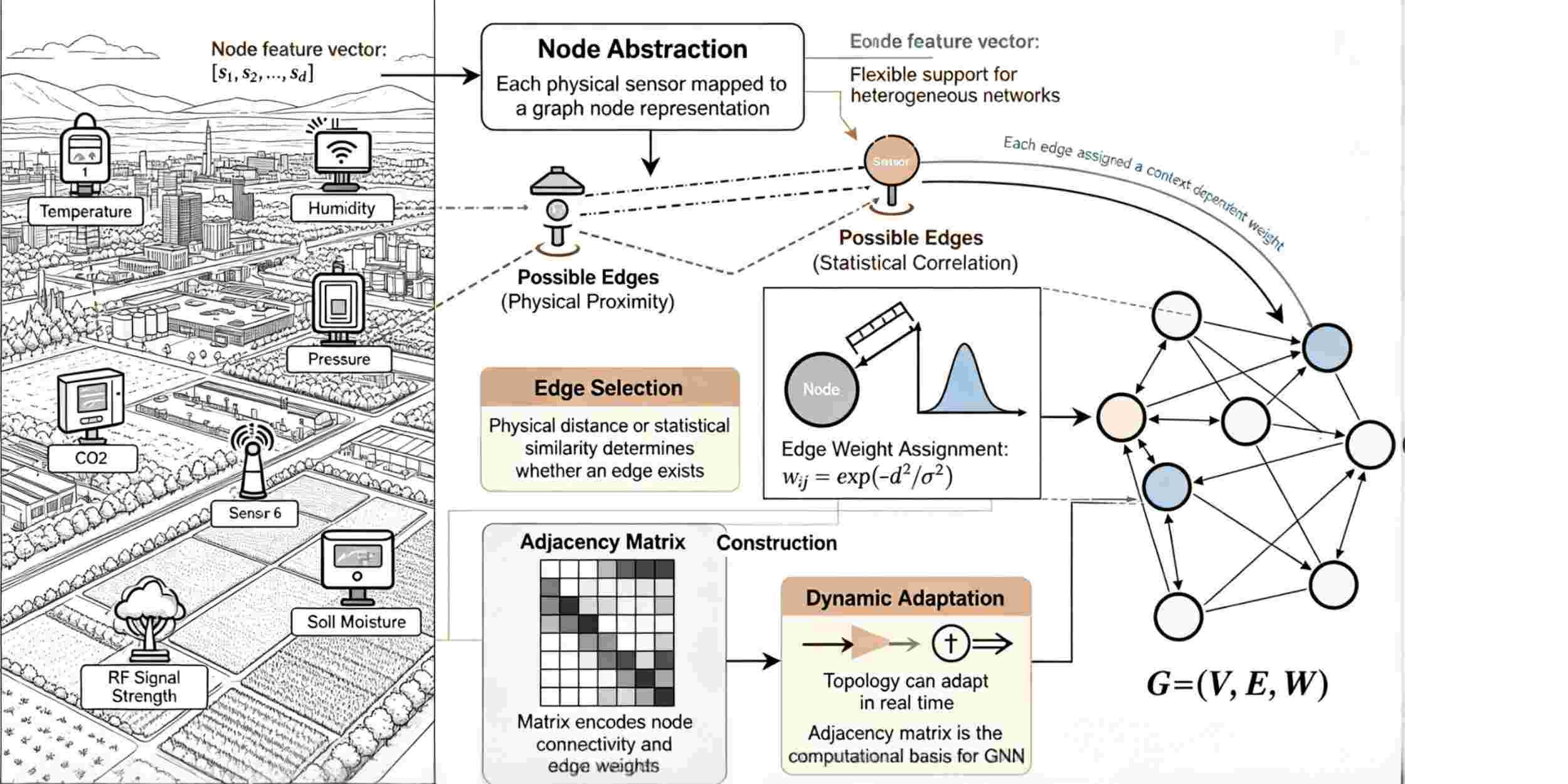
Multi-sensor networks have solved several issues in the era of smart agriculture and autonomous driving. Nevertheless, there are numerous sources of noise in the sensor data, which lowers the quality of the information and thus impairs the performance of later phases. In order to solve the issue of sensor data noise and enhance the dependability of spatially correlated sensor arrays, this paper uses Graph Neural Networks (GNNs). This creates a weighted graph of the sensor network, builds an adjacency matrix based on the statistical similarity and physical distance between sensors, and then uses a specific Graph Neural Network (GNN) architecture to guarantee consistent signal recovery. In a series of tests, varying levels of Gaussian and impulse noise, as well as different rates of missing data, were routinely added to both synthetic and real-world sensor datasets. The experiment's findings indicate that the new technique has improved the signal-to-noise ratio by an average of about 17.5 dB and is always better than previous denoising techniques like filtering and autoencoders. Additionally, the framework maintains acceptable performance across all deployment scenarios and sensor kinds, and it has good scalability for large networks of up to 2,000 sensor nodes. In summary, this article has demonstrated the great effectiveness and adaptability of Graph Neural Networks (GNNs) for noise reduction in multi-sensor fusion, offering a reliable method of reducing noise and obtaining high-quality data from a variety of real-world scenarios.
Downloads
Published
How to Cite
Issue
Section
License
Copyright (c) 2025 Ludmiła Antczakowa, Marianna Ciołek

This work is licensed under a Creative Commons Attribution-NonCommercial-ShareAlike 4.0 International License.