Real-Time Hybrid Fault Monitoring Method for Electromechanical Systems Based on Autoencoders
DOI:
https://doi.org/10.64972/jaat.2025v3.181p9e:104-116Keywords:
Autoencoder, Unsupervised Learning, Fault Diagnosis, Hybrid Fault, Signal Processing, Electromechanical SystemsAbstract
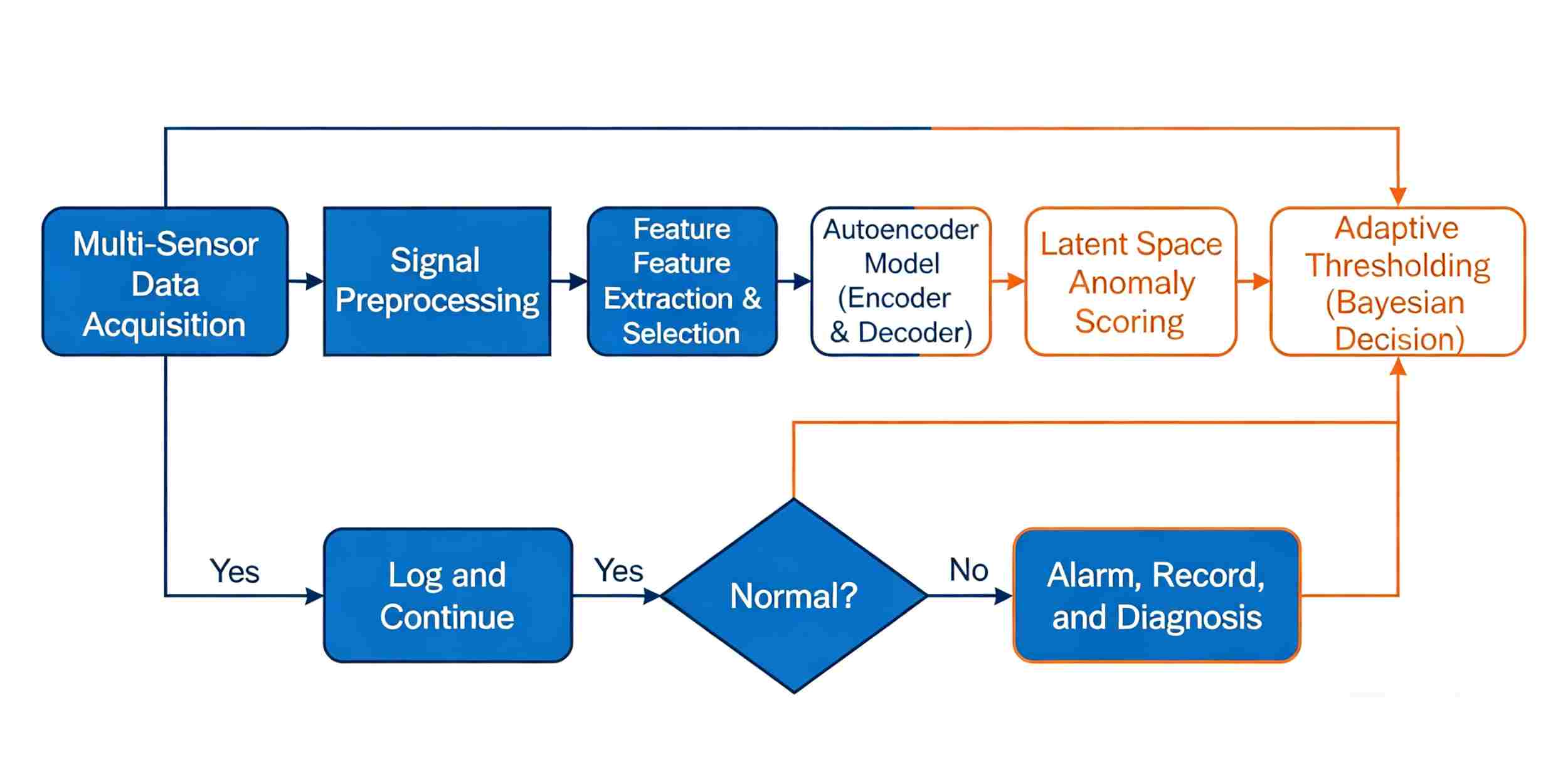
Computer-based autoencoding methods have significant advantages in real-time monitoring of hybrid fault states in motor systems, which is becoming increasingly important in modern industries. Due to high data heterogeneity, constantly changing degradation mechanisms, and limited labeled fault records, adaptive fault diagnosis is urgently needed. Develop and validate new unsupervised learning systems. This system does not require extensive manual supervision and extracts features based on raw sensor data from heterogeneous domains using advanced autoencoders. The new fault diagnosis method uses rigorous high-resolution signal processing, latent feature extraction modeling, and adaptive Bayesian decision criteria to accurately identify smooth and burst mixed defects. In order to conduct laboratory tests under various working environments and fault types, a multifunctional fault validation environment has been established. The results show that, compared to traditional methods and single-component monitoring systems, the proposed system achieves extremely accurate identification in any situation (including multi-fault cases and multi-environment conditions). The real-time stability and extremely low false alarm rate are very practical. This article first summarizes the research literature on "electromechanical asset management," providing a reference for further research by subsequent researchers.
Downloads
Published
How to Cite
Issue
Section
License
Copyright (c) 2025 Dominik Jankowski, Ireneusz Kaczmarczyk, Norbert Kostecki

This work is licensed under a Creative Commons Attribution-NonCommercial-ShareAlike 4.0 International License.