Variational Autoencoder-Based Detection of Covert Channels in Smart Grid Communications
DOI:
https://doi.org/10.64972/jaat.2024v2.129p1e:1-14Keywords:
Smart Grid, Anomaly Detection, Covert Channel, Deep LearningAbstract
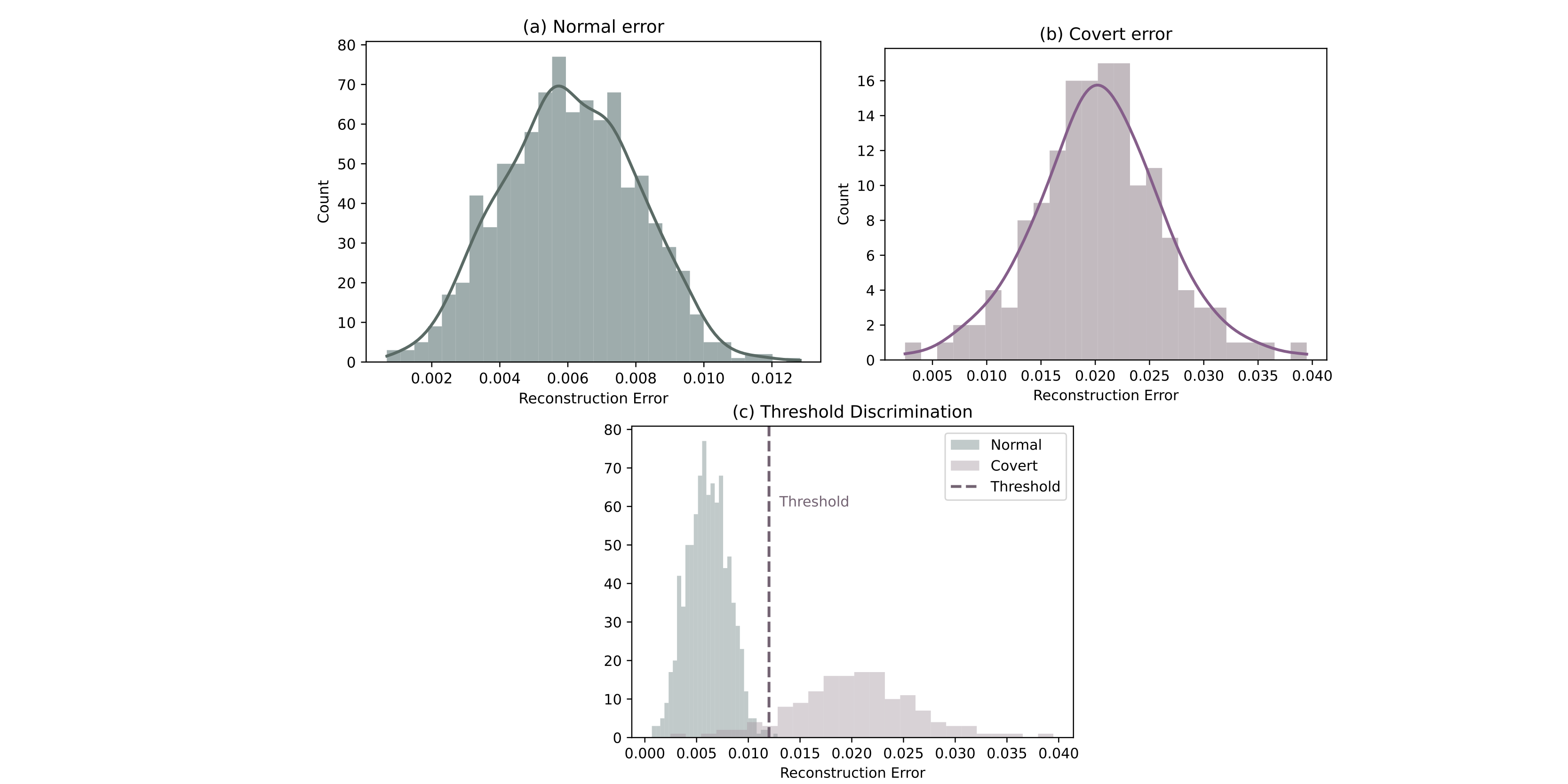
New communication technologies that allow for flexible control and real-time monitoring have been brought about by the digitalization of power infrastructure, but new cybersecurity concerns have also emerged. Covert channel assaults are extremely challenging to identify in smart grids because they conceal the communication of unwanted parties within normal traffic. This research proposes a novel variational autoencoder-based detection framework for covert channel identification in smart grid communication networks. To enhance the quality of model inputs, multi-level data collection, thorough feature extraction in the time and protocol domains, and stringent pre-processing procedures will be employed. Experiments were conducted using a combination of hardware-based simulation settings and publicly accessible smart grid statistics, yielding 20,000 synthetic covert channel events and 75,000 flow samples. Figure 5.3 displays the proposed system's good detection results and AUC of 0.977; it can accurately distinguish between normal and hidden traffic, and its stability and recall rate surpass those of existing benchmark anomaly detection techniques. Furthermore, the approach was appropriate for real-time use and had a quick inference speed of less than 1 second for 1,000 data. Consequently, deep generative models can be used to improve smart grid operating security. For the early detection and reaction to new-type hidden-channel attacks on contemporary power systems, a reasonably robust, high-capacity solution has been created.
Downloads
Published
How to Cite
Issue
Section
License
Copyright (c) 2024 Dana Al Shamsi, Zayed Al Mansoor, Omar Al Zayed

This work is licensed under a Creative Commons Attribution-NonCommercial-ShareAlike 4.0 International License.