RWKV-TS for Underwater Robot Station Keeping from Ocean-Current-Disturbed Navigation Data
DOI:
https://doi.org/10.64972/dea.2022.v1i1.4127d:84-99Keywords:
Underwater robot, Station keeping, Ocean Current Disturbance, RWKV-TS, Navigation Time Series, Adaptive ControlAbstract
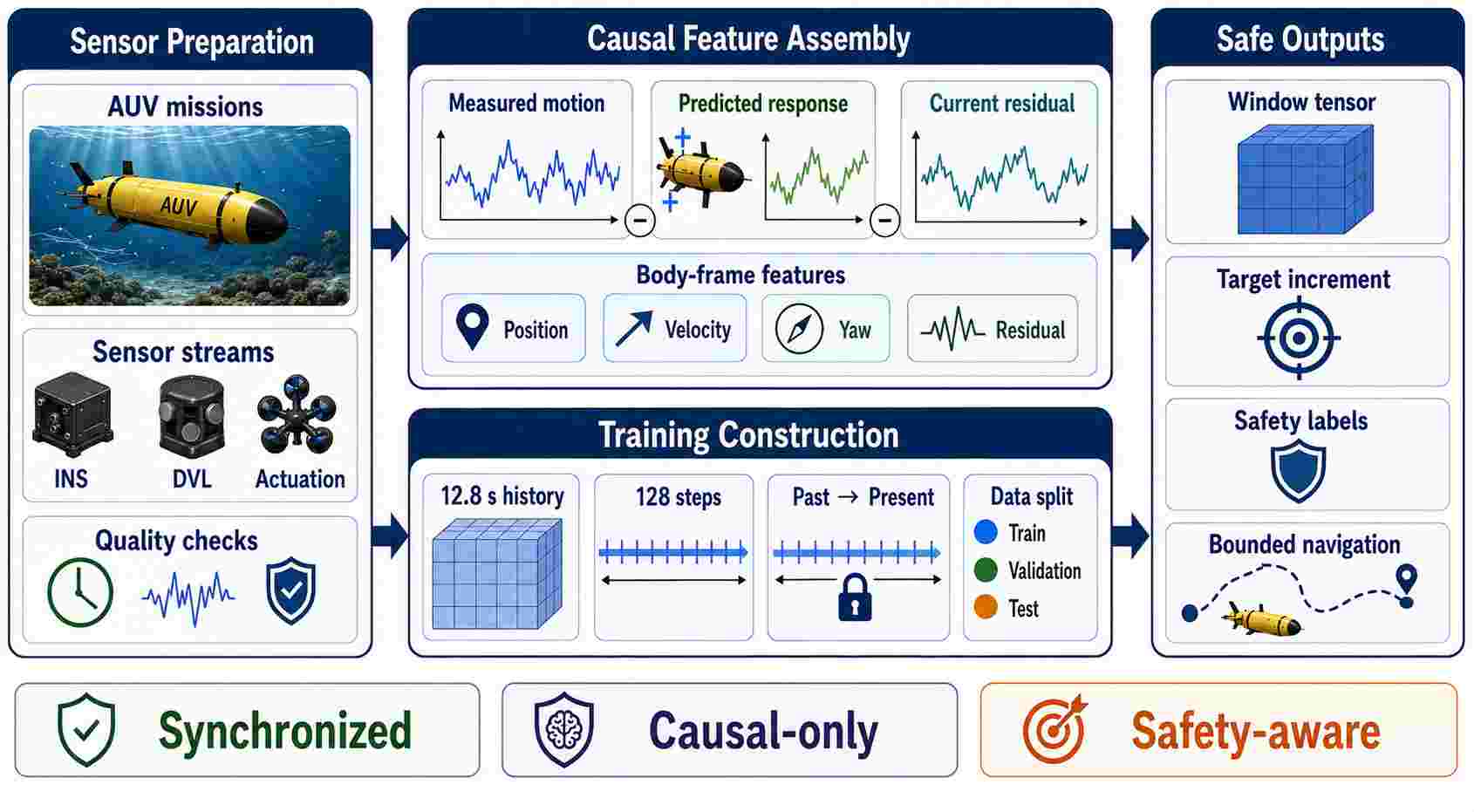
In this study, a linear-time recurrent sequence model called RWKV-TS is used to map current-disturbed navigation histories to constrained thruster increments for horizontal-plane station-keeping. Doppler velocity, body acceleration, previous actuation, inertial position and orientation, and a causal current residual are the inputs. A channel-mixing gate differentiates between a short impulsive perturbation and a steadily increasing current bias, while a time-mixing block achieves a lengthy disturbance history without quadratic attention. A deterministic safety solution, which involves adding the learned increment to a low-gain stabilizing controller and using a saturation-aware allocator, will be applied if the sequence estimate is not provided. 63.4 hours of tank and coastal data from 18 flights in sheared, oscillatory, turbulent, and stable currents were analyzed. RWKV-TS is compared with PID, sliding-mode control, nonlinear model predictive control, LSTM-TS, and a causal Transformer using leave-one-current-profile-out testing. RWKV-TS has a root-mean-square position error of 0.23 m and a 95th-percentile error of 0.51 m with a medium current. The root-mean-square error was lowered by 18.0% when compared to the causal Transformer and by 27.1% when compared to the nonlinear model predictive control since the comparable values for the most turbulent profile were 0.41m and 0.88m. The recovery time following a 0.7 m/s lateral-current step was 6.8 s, and the average electrical energy was 11.6% less than that of sliding-mode control. Ablation experiments have demonstrated the effectiveness of current-residual conditioning, recurrent time mixing, and saturation feedback. With a measured inference delay of 2.7 ms on an embedded graphics module and a cautious fallback mode for out-of-distribution currents, the results show that RWKV-TS is a moderately effective data-driven augmentation for station-keeping.
Downloads
Published
How to Cite
Issue
Section
License
Copyright (c) 2022 Ghassan Al-Marri, Hadi Al-Suhaimi

This work is licensed under a Creative Commons Attribution-NonCommercial-ShareAlike 4.0 International License.