A Density-Adaptive DBSCAN-Based Federated Model Training Method for Distributed IoT Terminals
DOI:
https://doi.org/10.64972/dea.2022.v1i2.3991d:1-15Keywords:
Density-Adaptive DBSCAN, Federated Learning, IoT Terminals, Client Clustering, Non-IID DataAbstract
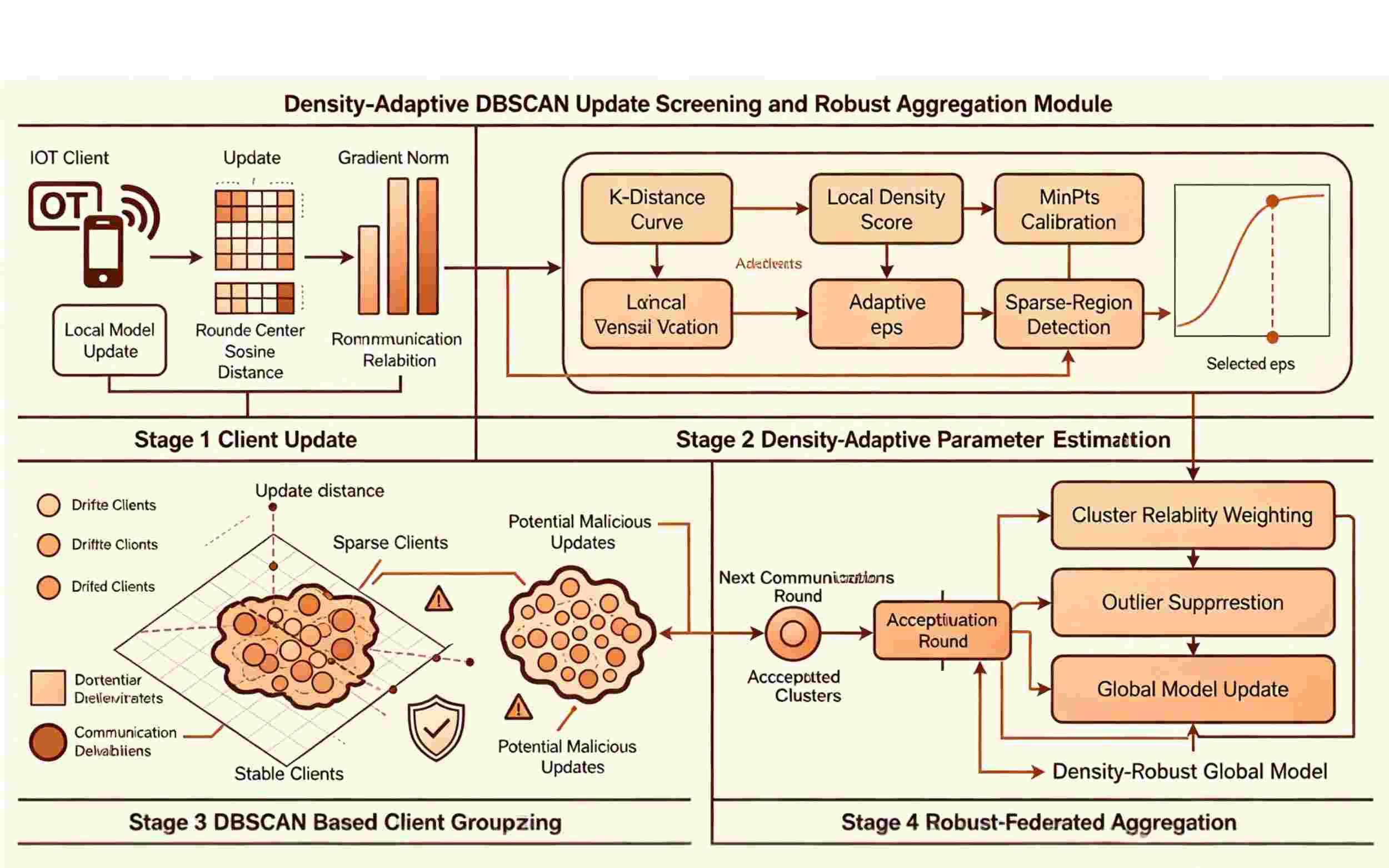
Traditional federated learning is vulnerable to client noise, irregular local updates, and unequal device involvement because distributed IoT terminals provide diverse, sparse, and non-independent data streams. For dispersed IoT terminals, this research suggests a density-adaptive federated model training approach based on DBSCAN. Incorporate density-aware client grouping in federated aggregation, identify anomalous update patterns without a set number of clusters, and enhance the client clustering approach using adaptive neighborhood estimation. To lessen the impact of unstable terminals and preserve the helpful edge-side knowledge in the suggested strategy, combine local update statistics, gradient similarity, communication reliability, and data-density indicators. The suggested approach is evaluated experimentally against FedAvg, FedProx, clustered federated learning, Krum, trimmed-mean aggregation, and anomaly-filtered aggregation in the presence of non-independent data, communication fluctuation, terminal dropout, and malicious update disturbance. The findings show that in a heterogeneous IoT context, density-adaptive clustering shortened convergence by 28 communication rounds, increased general accuracy from 89.6% to 94.8%, and decreased aggregation deviation by 37.4%. The study offers a workable federated training paradigm for large-scale IoT networks under challenging communication contexts, non-IID data distribution, and terminal quality fluctuations.
Downloads
Published
How to Cite
Issue
Section
License
Copyright (c) 2022 Liviu Kovași

This work is licensed under a Creative Commons Attribution-NonCommercial-ShareAlike 4.0 International License.