Freight-Signal-Corridor-Driven Cooperative Speed Guidance Using a DeepONet-GRU Model
DOI:
https://doi.org/10.64972/dea.2023.v2i4.3784d:41-53Keywords:
Freight Signal Corridor, Cooperative Speed Guidance, Deep Operator Network, Gated Recurrent Unit, Queue-Aware ControlAbstract
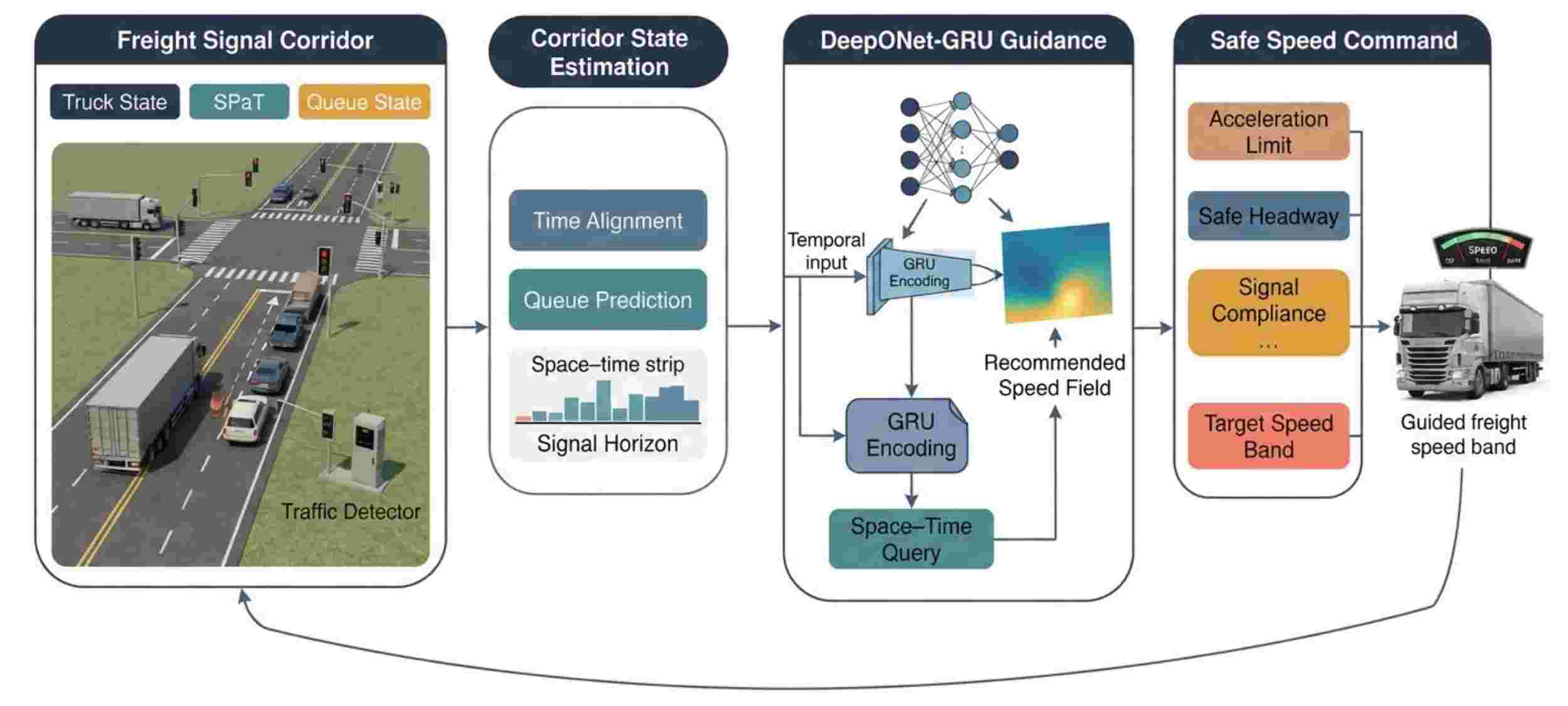
Freight signal corridors combine slow heavy-vehicle responses, heterogeneous payloads, and interacting queue spillbacks, which can make isolated eco-driving rules unreliable. A cooperative speed guidance model based on operator learning and gated recurrent units is proposed in this paper. The branch network encodes the rolling truck trajectory, signal plan, queue estimate, grade and payload descriptor, and the trunk network queries the future space-time position. A Feasibility projection maps the predicted corridor speed field to bounded vehicle commands. A model was trained using 1.94 million truck-state records from 420 calibrated simulation hours and tested on unseen demand, cycle, grade, penetration and communication conditions. In a six-intersection corridor, it reduced mean delay by 18.7%, stops by 31.4%, and energy-equivalent consumption by 12.6% compared with unguided actuated control. Speed mean absolute error was 2.06 m/s, 10.8% lower than the compact transformer baseline, and the 90th-percentile transferred-condition error was still 2.18 m/s. Median roadside inference for batches of 8-128 trucks increased from 3.6ms to 21.4ms, and the 99th percentile was still below 47ms. Heavy 34-40t trucks achieved an energy saving of 14.6%, and no projected commands exceeded the modelled red-light envelope. The simulation evidence indicates that a queryable corridor response operator can connect signal-state prediction with computationally feasible truck-level guidance; field validity remains to be established.
Downloads
Published
How to Cite
Issue
Section
License
Copyright (c) 2023 Kaido Hirt, Rainer Rebane

This work is licensed under a Creative Commons Attribution-NonCommercial-ShareAlike 4.0 International License.