Diffusion Policy Learning for Cooperative Ramp Merge Control from Vehicle–Infrastructure Collaborative Perception Data
DOI:
https://doi.org/10.64972/dea.2023.v2i3.3748d:96-107Keywords:
Vehicle–Infrastructure Cooperation, Diffusion Policy, Ramp Merging, Risk GuidanceAbstract
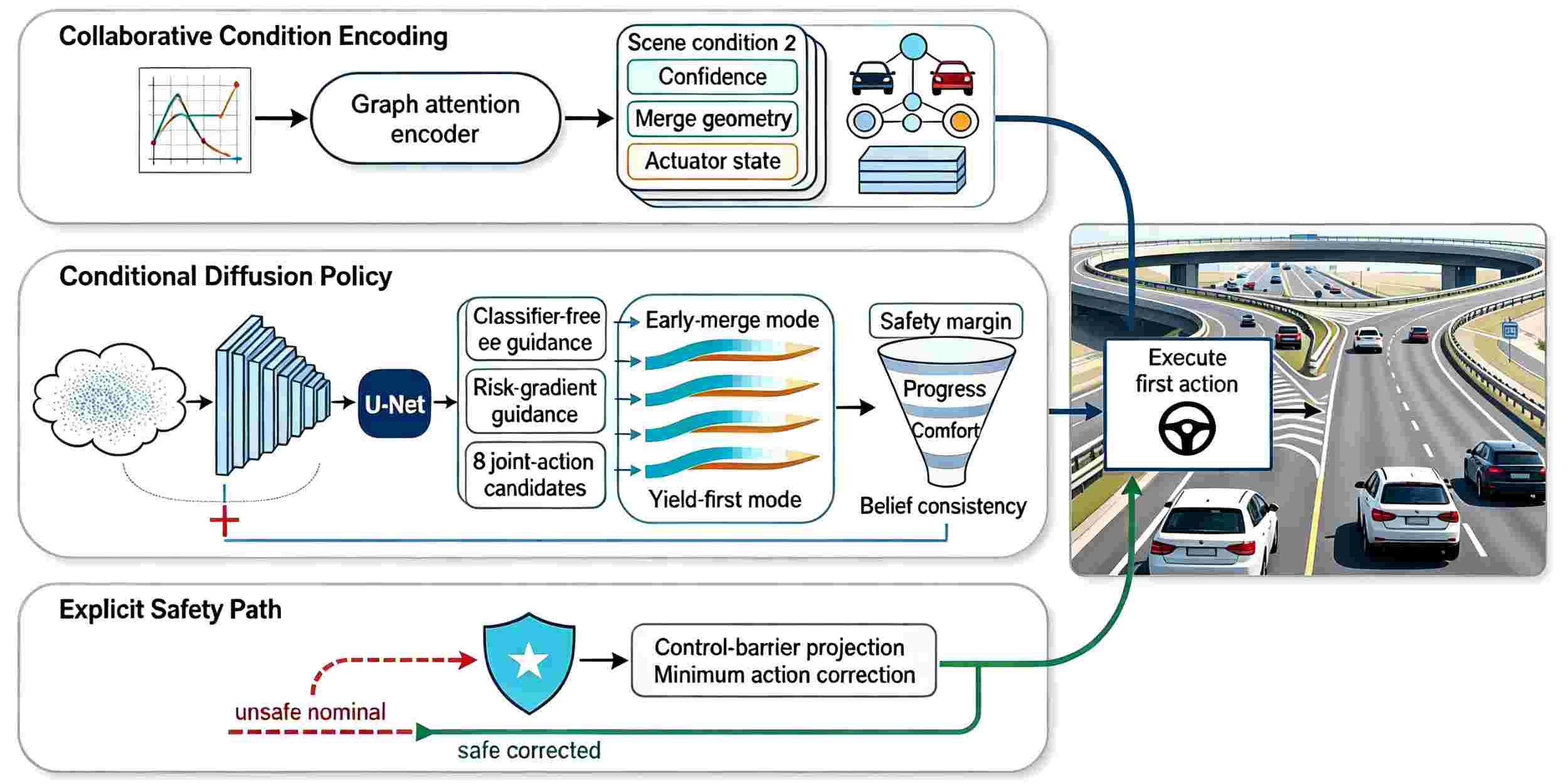
Cooperative ramp merging is still difficult due to the delayed, partially occluded and heterogeneous observations of connected vehicles. Develop a safety-shielded diffusion policy in this paper that converts vehicle-infrastructure collaborative perception into coordinated longitudinal control. Roadside and onboard tracks are aligned in time and associated to form a confidence-aware interaction graph. A conditional denoising process then samples joint acceleration sequences, and risk guidance biases the reverse trajectory towards acceptable gaps, while a lightweight safety projection repairs residual constraint violations. Optimize auxiliary demonstrations for training strategies and test various traffic demand, penetration rates, sensor noise, occlusion, and communication delay scenarios in a closed-loop micro-simulator. Compared with a rule-based cooperative controller, model predictive control, behavior cloning and an unshielded diffusion policy, the proposed method has reduced the average ramp delay by 24.7%, decreased speed variance by 31.2%, and increased successful merges to 98.1%. The 5th-percentile time-to-collision is 1.54 seconds for the strongest non-diffusion baseline and 2.06 seconds; only 3.8% of the executed actions modify the safety projection. Under 300ms communication delay, the success rate is 94.6%, and confidence conditioning and receding-horizon resampling avoid a sharp drop. Therefore, the above results show that diffusion-based multimodal action generation can effectively and stably support merge coordination when combined with explicit uncertainty representation and a minimally intrusive safety layer.
Downloads
Published
How to Cite
Issue
Section
License
Copyright (c) 2023 Nasser Al-Qasimi, Humaid Al-Mulla, Ibrahim Al-Balushi

This work is licensed under a Creative Commons Attribution-NonCommercial-ShareAlike 4.0 International License.