SchNet-AL: Data-Driven Atomistic Representation and Uncertainty-Calibrated Active Learning for Sodium-Ion Cathode Screening
DOI:
https://doi.org/10.64972/dea.2023.v2i2.3619d:119-133Keywords:
Sodium-Ion Cathodes, SchNet Representation, Active Learning, Uncertainty Calibration, Multi-Objective ScreeningAbstract
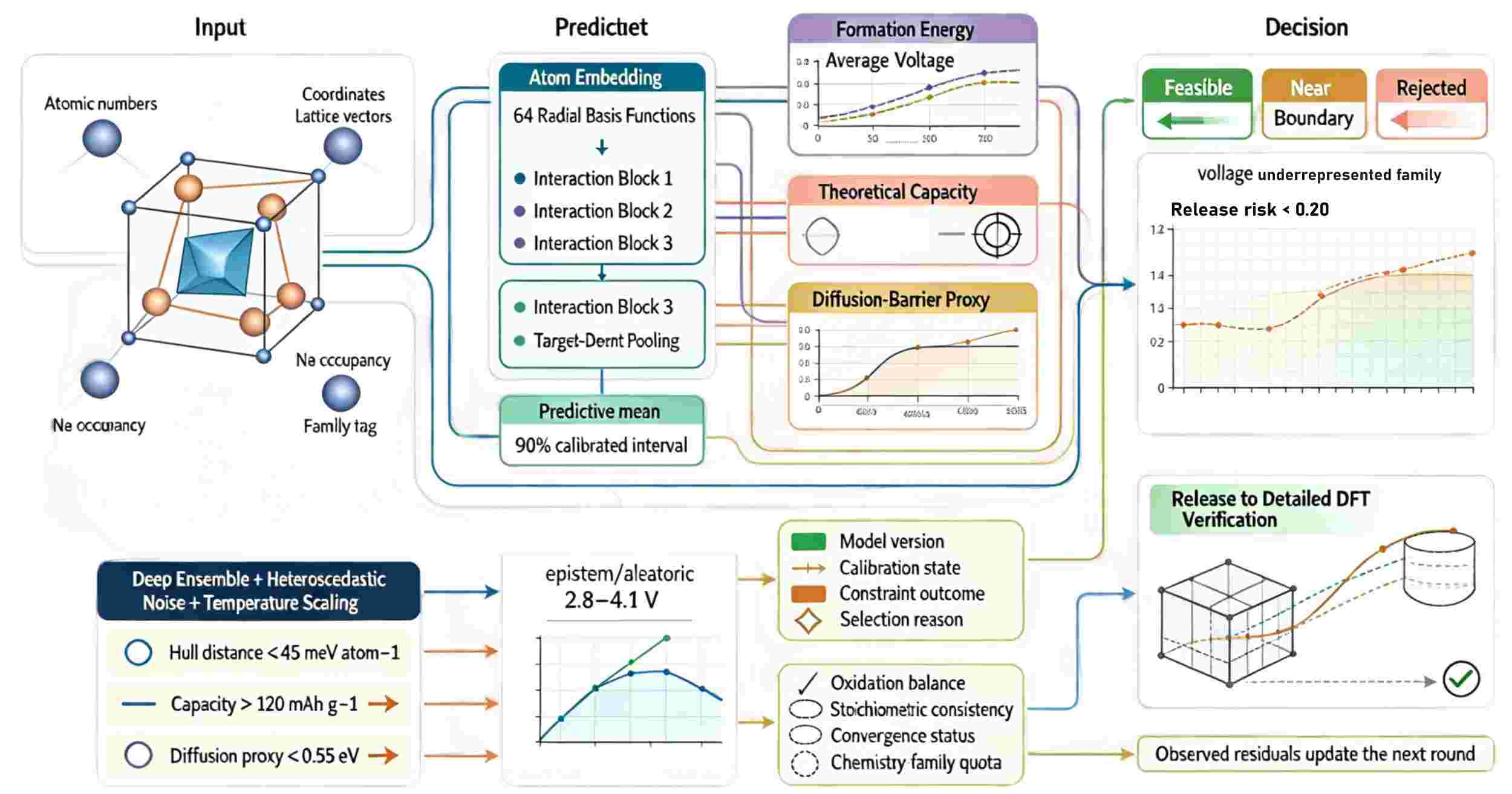
The search space for sodium-ion battery cathodes has been made relatively large by chemistry, but it is still too expensive to test with density-functional theory. This paper introduces a SchNet-active learning framework that combines continuous-filter atomistic representation learning with calibrated ensemble uncertainty and diversity-aware batch acquisition. A curated pool of 18,240 relaxed and partially relaxed inorganic structures was screened for formation energy, average sodium extraction voltage, theoretical capacity and diffusion-barrier proxy. Start with 1,200 labelled structures and add 300 calculations each time in five acquisition rounds. The proposed strategy reduced the energy mean absolute error from 92 to 31 meV atom⁻¹ and the voltage error from 0.284 to 0.118 V, and random acquisition needed 61% more labels to achieve the same energy accuracy. With a fixed budget of 2,700 labelled structures, 86.7% of the retrospectively verified top-60 candidates could be recovered. Multi-objective filtering found 47 candidates with stability below 45 meV atom⁻¹ above the convex hull, voltage between 2.8 and 4.1 V, capacity over 120 mAh g⁻¹, and a diffusion proxy below 0.55 eV. The full workflow reduces the projected screening time by 8.4 times compared with an all-first-principles calculation. Therefore, uncertainly-calibrated atomistic learning can focus the cost of calculation on chemically informative candidates without reducing screening coverage.
Downloads
Published
How to Cite
Issue
Section
License
Copyright (c) 2023 Zorana Mladenović, Danka Cvetković

This work is licensed under a Creative Commons Attribution-NonCommercial-ShareAlike 4.0 International License.