Wind Turbine Digital Twin Virtual Sensing Construction Based on a Koopman Autoencoder Model
DOI:
https://doi.org/10.64972/dea.2023.v2i2.3531d:1-14Keywords:
Wind Turbine Digital Twin, Virtual Sensing, Koopman Autoencoder, Sensor ReconstructionAbstract
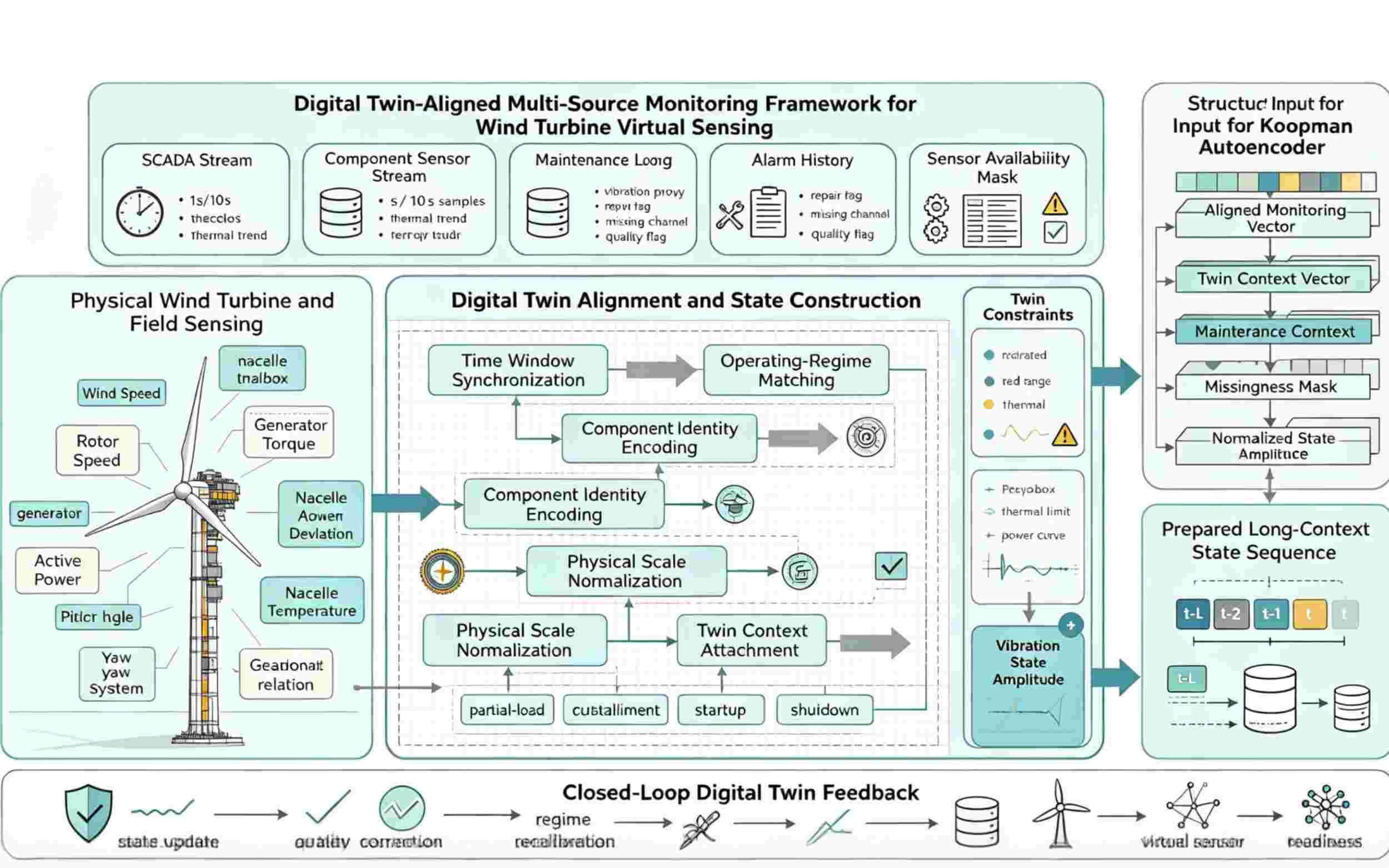
Physical sensors are unable to meet the demand for dense measurement channels in wind turbine condition monitoring because of their high cost, challenging installation, harsh nacelle environment, and long-term drift. A Koopman Autoencoder approach is suggested for building virtual sensors in a digital twin of a wind turbine. The technique creates a latent space for linear Koopman evolution of nonlinear turbine behavior by mapping multi-source supervisory control, vibration, temperature, power, and pitch-yaw data. The digital twin provides residual feedback and operating-context constraints, while the decoder reconstructs the unmeasured or missing variables. Examine the framework in the following scenarios: normal operation, wind speed variations, sensor drift, missing sensors, and cross-turbine transmission. As a result, the virtual sensor's accuracy has improved and its reconstruction error for missing channels has decreased, making it appropriate for edge-assisted turbine monitoring.
Downloads
Published
How to Cite
Issue
Section
License
Copyright (c) 2023 Jassima Al-Buflasa, Essaida Al-Harmoodi, Karima Al-Riyami

This work is licensed under a Creative Commons Attribution-NonCommercial-ShareAlike 4.0 International License.