A Transformer–PINN Fusion Model for Soft Sensing of Product Purity in Reactive Distillation Columns
DOI:
https://doi.org/10.64972/dea.2023.v2i1.3517d:86-101Keywords:
Transformer, Soft Sensor, Reactive Distillation, Product Purity, Multivariate Time SeriesAbstract
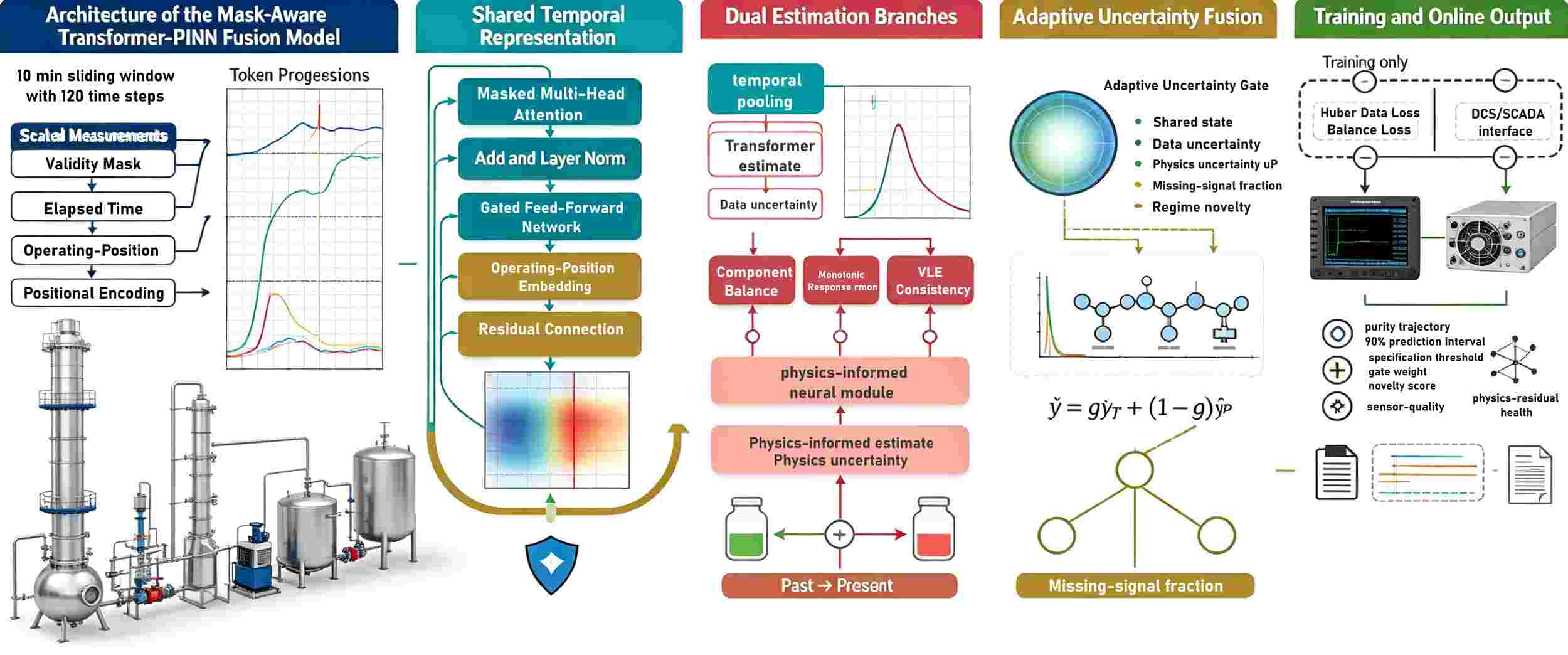
Reactive distillation is an integrated reaction-separation process that has been intensified; however, due to non-linear coupling of the products, measuring product purity is slow, infrequent, and easily affected by operational fluctuations. A soft sensor integrating a temporal Transformer and a physics-informed neural network is developed for continuous estimation of top-product purity in this study. Multiple-rate process signal is alignment through quality-aware resampling, masked self-attention encoding, and residual constraints derived from component balance, phase equilibrium and monotonic operating relation correction. A pilot-scale methyl-acetate column data set with steady-state operation, feed disturbances, reflux ramps, catalyst ageing and sensor degradation was used for evaluation. Among Partial Least Squares, Long Short-Term Memory, Temporal Convolution, and a data-only Transformer, the proposed model achieved a test root-mean-square error of 0.0028 mole fraction and a mean absolute error of 0.0019, and an R-squared value of 0.987. Under an unseen feed-composition shift, the error increased by only 18.6% for it and 52.4% for the data-only Transformer. The model found the purity excursion 11.7 minutes before the delayed laboratory analyzer and maintained 96.1% interval coverage. Based on the ablation results, balance residuals, uncertainty-weighted fusion and missing-signal masking all contribute to improved robustness. Thus, the fusion can offer a high-accuracy, physically consistent and deployable estimator for supervisory control and quality supervision in reactive distillation.
Downloads
Published
How to Cite
Issue
Section
License
Copyright (c) 2023 Leonida Xenaki, Themis Giannaki, Pavlina Damianou, Giannoula Kori

This work is licensed under a Creative Commons Attribution-NonCommercial-ShareAlike 4.0 International License.